My LeBlond family can be traced from Huguenot roots in France to London, where the family settled in the late seventeenth century, and later to Cincinnati, Ohio. This section brings together my direct LeBlond line, biographies, church and immigration records, family photographs, and related research, including Robert LeBlond and his brother Abraham, whose nineteenth-century printing business produced the color prints now known as the LeBlond ovals. I’ve also included information on other LeBlonds I have encountered during my research, whether or not a connection to my own family has been established.

My Line
My line of LeBlonds emigrated from France to England in 1685/6 and then to the U.S. in the mid 1800’s where they settled in Cincinnati. The immigrant ancestor in America was Robert LeBlond, the printer.
My line runs like this:
Robert LeBlond born ca. 1650; m. Elizabeth Mayeux; died ca. 1712. This Robert probably left France for England in 1685/6. Linen draper.
….Robert LeBlond born 1702 in London married Madeleine Lormier
……..Robert LeBlond born 1732 in London, married Elizabeth Chansac in 1754
…………Robert LeBlond born 1761 in London, married Jeanne Gammage
…………….Robert LeBlond born 1789 in London, married Elizabeth Saling
………………..Robert LeBlond born August 4, 1816 in London. Married Sarah Brooker on November 19, 1837. This Robert was the printer who was in business with his brother Abraham. Died October 18, 1863.
……………………Robert Emmett LeBlond, born November 24, 1840, in London. Married Elizabeth Jane Knight in 1863. Moved to America 1856. Died October 8, 1928.
……………………….Robert Arthur LeBlond, born February 21, 1866 in Cincinnati, Ohio. Married Anna Elinora Blomberg. Member of Ohio legislature, judge, lawyer, member of City Council. Died May 22, 1937.
…………………………..Katherine Elizabeth LeBlond, born August 22, 1910 in Cincinnati, Ohio. Married Bruce Farquhar. My grandmother. Died 2002.
There are so many Robert LeBlonds here! I’ve had to assign them nicknames based on their occupation to keep them all straight. See below for their biographies.
LeBlond Family Tree
This family tree was kindly shared with me by Lawrence LeBlond. It’s a beautifully drawn pedigree chart that starts with the Robert LeBlond (1732-1806) who married Elizabeth Chansac/Chauzot/Chaugot in 1754. He is my 6th great-grandfather. Lawrence related how he came to be in possession of this document: “These were above my grandfather’s dresser. The pedigree is by Col. Douglas Sapte. Both were given to Richard E. LeBlond in 1947 in London by Aubrey LeBlond. The story I have is she was the last of the family in that line and was looking for someone to pass them on to.”
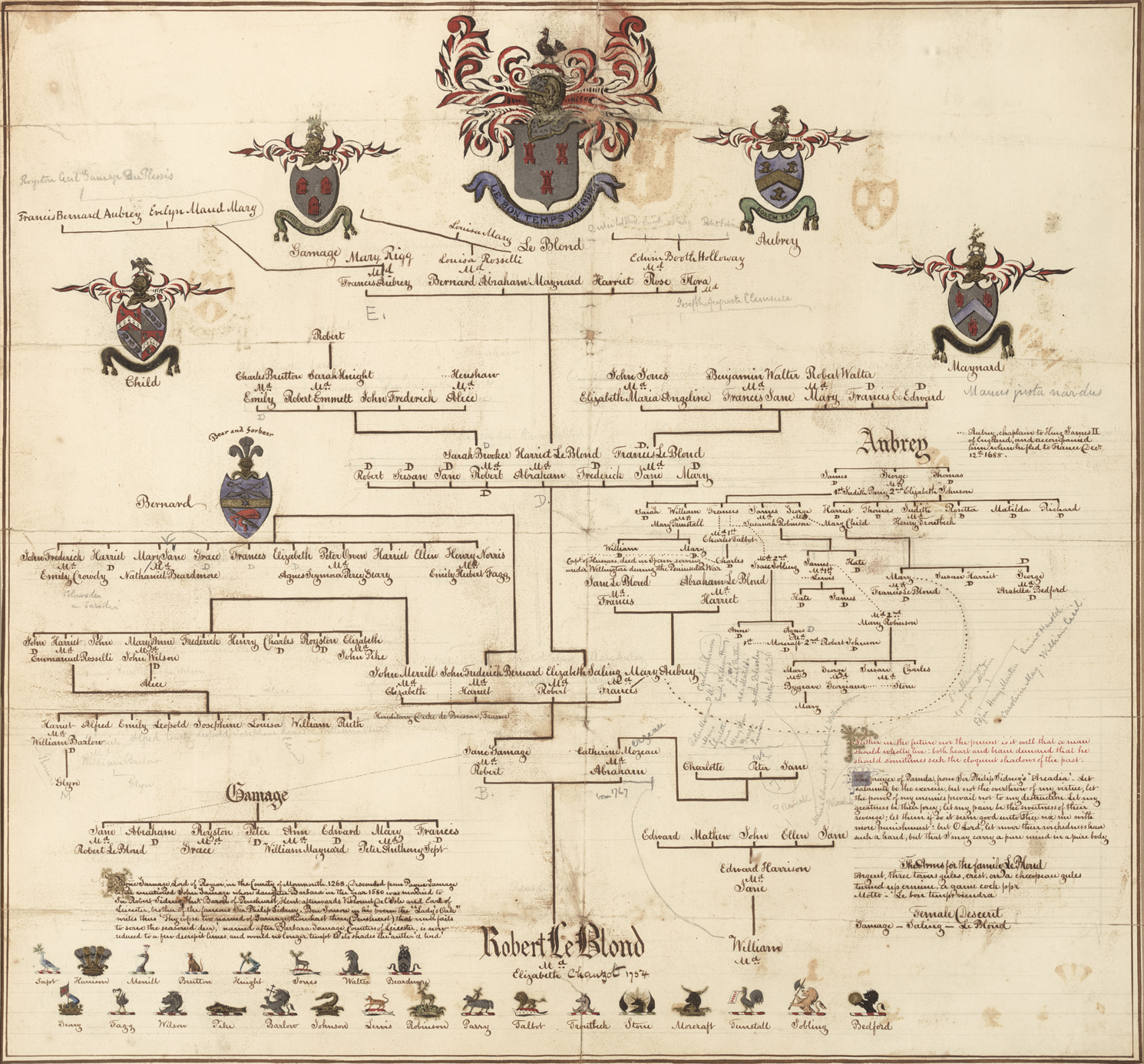
If you’d like to download a very large pdf of this image, click here.
Biographies
- Abraham LeBlond (1819-1894)
- Jacob Christoph Le Blon (1667-1741)
- Katherine Elizabeth LeBlond (1910-2002)
- Louis LeBlond (1629-) of Tourny, France
- Richard Emmet LeBlond (1900-1995)
- Richard Knight LeBlond (1864-1953)
- Robert Arthur LeBlond (1866-1937)
- Robert Emmet LeBlond (1840-1928)
- Robert LeBlond (1650-1708), Linen Draper
- Robert LeBlond (1702-1765)
- Robert LeBlond (1732-1806)
- Robert LeBlond (1761-1816)
- Robert LeBlond (1789-1824), Limner
- Robert LeBlond (1816-1863) Engraver and Printer
LeBlond Articles and Info
About the Name LeBlond
The Internet Surname Database describes the origin of the name LeBlond and lists some early carriers of the surname.
This name derives from the Old French “blund” or “blond,”, ultimately from the Latin “blondus” meaning “blond, fair or yellow-haired” and was originally given as a nickname to one with blond hair or a fair complexion. The surname is first recorded in the latter half of the 11th Century, (see below). One, Robert se Blund appears in “The Old English Byname Register”, under the date 1100, and a Ralph le Blund in “Documents relating to the Danelaw”, Leicestershire, circa 1100. The French definite article “le” precedes all recordings of the name in the Hundred Rolls of various counties, dated 1273, for example, Margareta le Blound (Cambridgeshire), and Alan le Blund, (Oxfordshire). This name was re-introduced into England with the arrival of the French Huguenots from the early 17th Century as the following recordings from London Church Registers show: Pierre Le Blond christened in Threadneedle Street French Huguenot Church on August 9th 1612 and Robert Le Blond christened in the French Huguenot Church, The Artillery, Spitalfields. The first recorded spelling of the family name is shown to be that of Rodbertus Blondus, which was dated 1086, The Domesday Book (Devonshire), during the reign of King William 1, “The Conqueror”, 1066-1087. Surnames became necessary when governments introduced personal taxation. In England this was known as Poll Tax. Throughout the centuries, surnames in every country have continued to “develop” often leading to astonishing variants of the original spelling.
Glossary
Researching the LeBlond family can have a bit of a steep learning curve as one runs into all sorts of interesting terms like Huguenot, Spitalfields, and Artillery. I’m compiling a list of these to remind myself of their definitions.
- Christchurch Cemetery, Also known as Christ Church Spitalfields Churchyard, Spitalfields, London Borough of Tower Hamlets, Greater London, England
- Nicholas Hawksmoor’s Christ Church Spitalfields was built 1714-1729 following the 1711 Fifty New Churches Act with money raised by tax on coal; it was the first of his three churches in the East End, the others being St Anne Limehouse and St George-in-the-East. His original design for Christ Church was estimated at £9,129 16s but actually cost over £39,000. The foundations were laid in 1714 and the church was finally consecrated on 5 July 1714. Income for the upkeep of the church came from various sources including leasing box pews to wealthy local families, burials in the crypt paid for by those fearful of body-snatchers, which was designed to cater for 1,000 bodies, and in the mid 19th century church elders decided to charge double fees for burials of non-parishioners. The congregation included Huguenot refugees who had fled to this country, many settling in Spitalfields; over half of the 18th century gravestones showed French names as a result.
The present garden is a fragment of the original burial ground for Christ Church, which altogether saw 68,000 burials, 67,000 of which were outside the church. Until the latter part of the 19th century the churchyard extended east to Brick Lane; it had been enlarged in 1791 and in 1859 it was extended to Commercial Street to the west. It was closed for burials and was converted into a public garden by the MPGA in 1892, the layout the work of Fanny Wilkinson, landscape gardener to the MPGA. It was later largely built over, partly by a children’s school/playgroup, and most of the monuments were removed in 1950.
The Old Artillery Ground
- The Old Artillery Ground was a roughly five-acre area in Spitalfields. It stopped functioning as a military practice ground in the 1600s and was sold for building in 1682. By the time Mary was buried in 1747/48, it was already a built-up neighborhood, but “Artillery Ground” was still used as the name of the locality. The old neighborhood corresponds today to the little street network around Artillery Lane, Artillery Passage, Gun Street and Fort Street, immediately south/west of Spitalfields. Those street names survive specifically because of the former artillery ground. Tower Hamlets now protects much of it as the Artillery Passage Conservation Area.
- Spitalfields
- Huguenot
Mystery Photos
The Mysterious Mary LeBlond
Our family archives contain a daguerreotype of this young lady seated at a table. A card inserted into the case of the daguerreotype reads, “Monday 26th / January 1864 / Age 17 / Birthday May 12th / Mary Le Blond”. (#1174, Furst Family Archives.) Note: January 26, 1864 was a Tuesday. January 26, 1863 was a Monday. So either the day of the week is incorrect or perhaps the dates are incorrect.
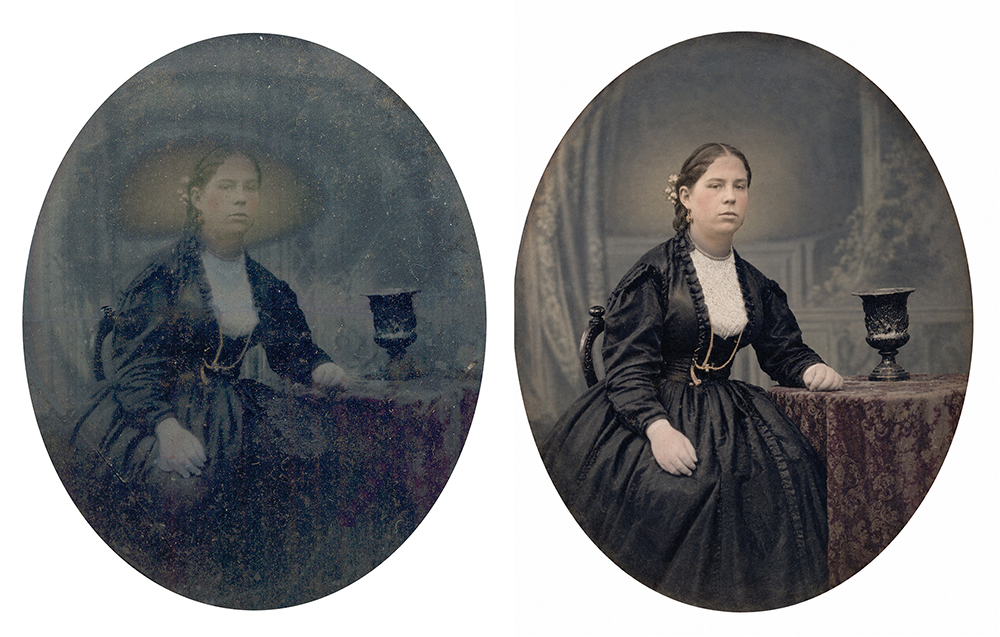
Unfortunately, none of the Mary LeBlonds I have in my database match the birth date of 1847 for this young woman. I’m guessing she must be a niece of Robert LeBlond the printer as they time frame fits. So she might be a daughter of Frederick. I have practically nothing on him. Just born 07 Feb 1823, baptized 16 Mar 1823 at Saint Luke in Chelsea, London, England.
Young Lady of the LeBlond Family
Here’s a painting called “Young Lady of the LeBlond Family” by Rosalba Carriera. I don’t know if she is from my line of the family.

Links
l’Association des Familles Leblond Inc.
Most Wanted
I’m looking for two books:
A Huguenot Family Le Blond by Marie Bennett (https://www.abebooks.com/9780951236208/Huguenot-family-Blond-Marie-Elizabeth-0951236202/plp) and Another Huguenot Family Le Blond by Robert LeBlond, written in 1994. If you have one to sell, please let me know!
Karen-
This is incredible work! It’s been awhile since I’ve contacted you. I am still building my family tree and your research has just added several generations earlier than Sarah Booker.
Where did you get her photograph?
Have you been to London or do you know of any LeBlond-related sites to see?
I believe you and I have a common relative another generation deeper than my great grandfather.
Next month I am going to a reunion of the Cincinnati “LeBlonds” to whom I’m related. It’s been many years since we were together. My father is John Knight LeBlond Jr, his father was “John senior” and my great grandfather was John A. LeBlond. I will see my dad’s sisters’ families as well. As far as the name LeBlond my 6 year old son is Samuel Harrison LeBlond. My daughter took my wife’s name. We used to live in Seattle but now live in Amherst, MA.
Thanks again!
Most of the photographs here on the site were passed down to me from family members. Yes, I’ve been to London but it was pre-genealogy bug so I did not visit any LeBlond-related sites.
Hi – Yes, I’ve been to London but not for LeBlond research. Sarah’s photo just came down to me through the family. My aunt has it now. Have fun at the reunion! Hope you find out lots of good new info.
Ardella Cottrill found online the small oval painting of Mary LeBlond. I have in my collection of family history copies this painting. One uncle thought that a John Geddis (1810) married a MAry LeBlond from the Cincinnati area. Do you have any information about this Mary LeBlond painted by her brother?
Thank you. Shirley Gaddis Rombold
Karen
We were in touch a few years ago about our common ancestors, Robert Le Blond (b 1676), Robert Le Blond (b 1702) and Robert Le Blond (b 1732). I have done some research on these and my other family. If you would like to see this, please contact me.
Paul Le Blond
Penn, Buckinghamshire, UK
Yes, I’d be delighted to chat again. I have more time now and am back to spending some time with genealogy!
Karen,Ardella Cottrill sent me your link to help me solve that the printed paper copy we have in family history papers is indeed Mary LeBlond. We were told she might be the wife of John Geddis(1810, our line) but have not been able to find any information on either of them them except the names of their children who have them from all over the map. Could you tell me anything about her. Thank you, Shirley Gaddis Rombold
I’m afraid that I have nothing further on her, sorry.
Who is Mary LeBlond, the one Robert LeBlond made a lithograph of and titled sister of Robert LeBlond?
Karen: I now understand the rationale of the oval prints display from the Lewis book. Fascinating discovery. Coincidentally our next door neighbors are Le Blonds!
Oh, interesting! Are they related to my line?
Hi Karen, it’s been awhile but I’m quite sure you and I are in the same line of LeBlonds. I am descended from Robert Emmett LeBlond (my great great grandfather). My sister, Cheri, and my father both have “Knight” as their middle names in honor of Robert’s wife. Anyways, I’ve always wanted to know if there was a central location or region of France that our LeBlonds came from. There is an oral tale from my side that the family was called something like “DuBresac” in France but changed it to LeBlond for Huguenot reasons when they moved to England. Can you shed light on this?
Afraid not. That tale did not come down through my family line. I have not yet researched the family in France but I’ll keep it in mind when I do. Those tidbits of lore sometimes come in very useful when researching. I had a similar situation with my husband’s great grandfather. The story was that he had changed his name from Cavanagh to Fay to “sound less Irish.” Well, turns out he was born a Cavanagh but his father died soon after his birth. His mother married a Fay and gave the baby that surname.
A similar fate may await my passed-down story. There is a Bresac, France, by the way!
Found something: Robert LeBlond b. 1789 who married Elizabeth Saling had a sister named Harriett who married John Frederick Bernard. On an old family pedigree chart, he is listed as “Hereditary Duke de Brissac, France.”
Wow, ok! This is an exciting piece if information. Could be nuthin’ or something!