Huguenot Timeline
My line of LeBlonds were French Huguenots and left France in the late 1600’s to escape persecution for their religious beliefs.
- 1440-1455
- Guttenberg’s invention of moveable type enabled printing and distribution of Bible and other information to the masses, which enabled works of Martin Luther and other reformers to be circulated throughout Europe.
- ca. 1500
- Erasmus (1467-1563) begins to write and preach to reform the church.
- 1509
- John Calvin (1509-1564) born.
- 1512
- Jacques le Fevre (Jacobus Faber) writes Aaneti Pauli Epistolas.
- 1515
- Accession of Francis I of France.
- 1516
- Concordat of Bologna.
- 1521
- Martin Luther proclaims documents of Reformation.
- 1523
- First French translation of the Bible.
- After 1525
- John Calvin led Protestant Reformation in France and Switzerland.
- 1526
- Tyndale’s English version of the New Testament printed in Antwerp.
- 1529
- Louis de Berquin burnt at the stake.
- 1534
- Protestant placard campaign in Paris. Calvin settles in Basle, Switzerland.
- 1535
- Edict banning all heretics in France. First refugees leave France. Publication of Tyndale and Coverdale Bible in English in Hamburg.
- 1538
- Foundation of the French Protestant church at Strasbourg.
- 1539
- Bernard Palissy settles at Saintes.
- 1540
- First substantial Huguenot settlements in Kent and Sussex, England.
- 1541
- French forts established near Quebec.
- 1545
- Jean de Maynier, baron d’Oppede, orders massacre of Waldensians at Merindol and Cabrieres. Protestants massacred in 22 French towns and 14 members of Protestant church at Mejux burned at stake over religion.
- 1547
- Death of Henry VIII of England; accession of Edward VI. Death of Francis I of France; accession of Henry II. Protestantism established officially in England. Increased immigration of Huguenots to Kent, especially Canterbury. Chambre Ardente established in Paris.
- 1548
- Large groups of French Huguenots began escaping to Channel Islands. First Huguenot congregation established at Canterbury by Jan Utehove and Francois de la Riviere of Orleans.
- 1550
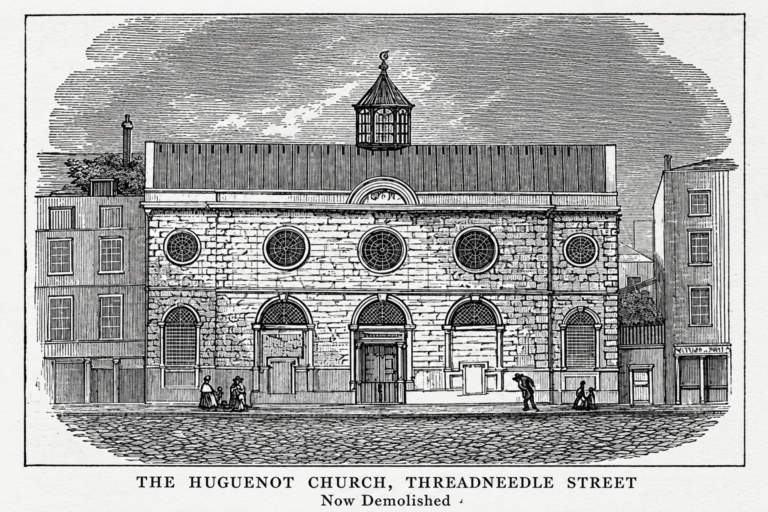
- The Huguenot Threadneedle Street Church founded in the area of Spitalfields in London. Temple of Jesus licensed, earliest foreign Protestant
Church in London. Church of St. Anthony’s Hospital in Threadneedle Street, London, given to French Huguenots. - June 27, 1551
- Edict of Chateaubriand placed severe restrictions on Protestants, including loss of one-third of property to informers and confiscation of all property of those who left France. “Heretical” books were forbidden or censored.
- 1553
- Death of Edward VI; accession of Mary I of England. Dispersion of London Protestants; persecution of English Protestants begins.
- 1555
- French Admiral Gaspard de Coligny, Huguenot leader, envisions French Protestant colony in Brazil. King Henry II consented. France Antarctique was founded in 1555; Calvinist ministers and settlers arrived in 1557. The Portuguese destroyed Fort Coligny in 1560, while French resistance/trading on the mainland continued until about 1567.
First Huguenot consistory in Paris.
- September 1555
- First Protestant Church in Paris, France, organized in a home. Date sometimes given as 1556.
- 1556
- Philip II succeeds to throne of Spain.
- 1558
- Death of Mary I of England; accession of Elizabeth I.
- 1559
- Treaty of Cateau-Cambresis. First national synod of the Reformed Churches of France in Paris at which 15 Protestant churches are represented. Death of Henry II; accession of Francis II of France.
- 1560
- Conspiracy of Amboise to kill the king of France fails. Edict of Romorantin lays interdict on Protestantism. Meeting of States General at Orleans. Death of Francis II; accession of Charles IX of France.
- July 1561
- Royal edict authorizes imprisonment and confiscation of property upon all who attend any “heretical” (non-Roman Catholic) public or private worship service. Beginning of new influx of refugees to Kent from Low Countries, Picardy, Artois and Flanders. Coiloque of Poissy attempts to bring about a modus vevendi between Catholics and Protestants in France.
- January 1562
- Royal edict of Saint-Germain recognizes new religion as legal and offers some protection. Massacre of Vassy. First battle of civil war in France at Dreux. Siege of Rouen.
- February 18, 1562
- French colonists, mostly Protestants, set sail to start colony in Florida.
- March 1562
- Massacre at Vassy marks the beginning of the Wars of Religion and the persecution of the Huguenots. Soldiers sent by Francis, Duke of Guise, leader of a Catholic faction, killed many of a congregation of 1200 Huguenots worshipping inside town walls, a forbidden act.
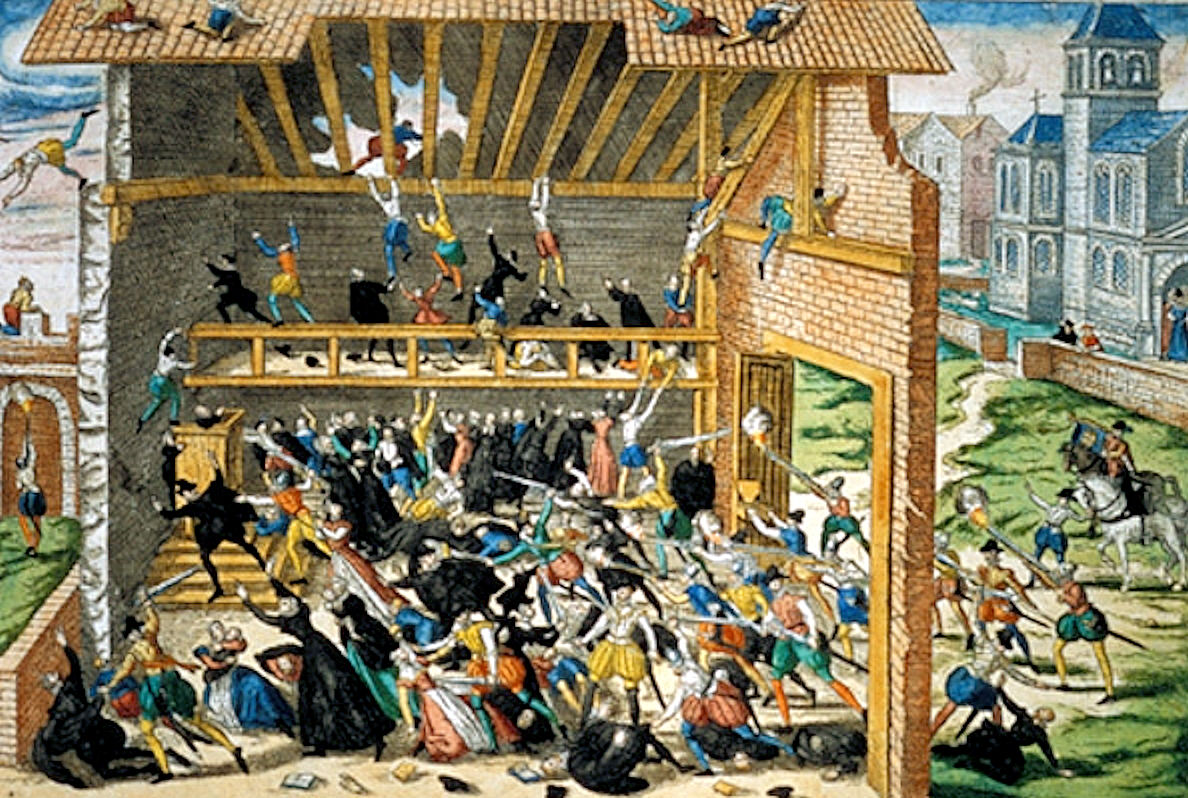
Massacre de Vassy 1562 print by Hogenberg end of 16th century - 1563
- Assassination of Francis, duke of Guise. Pacification of Amboise.
- 1564
- French settlement at Fort Caroline, Florida, founded. Treaty of Troyes.
- September 1565
- Spanish forces captured Fort Caroline and slaughtered all inhabitants.
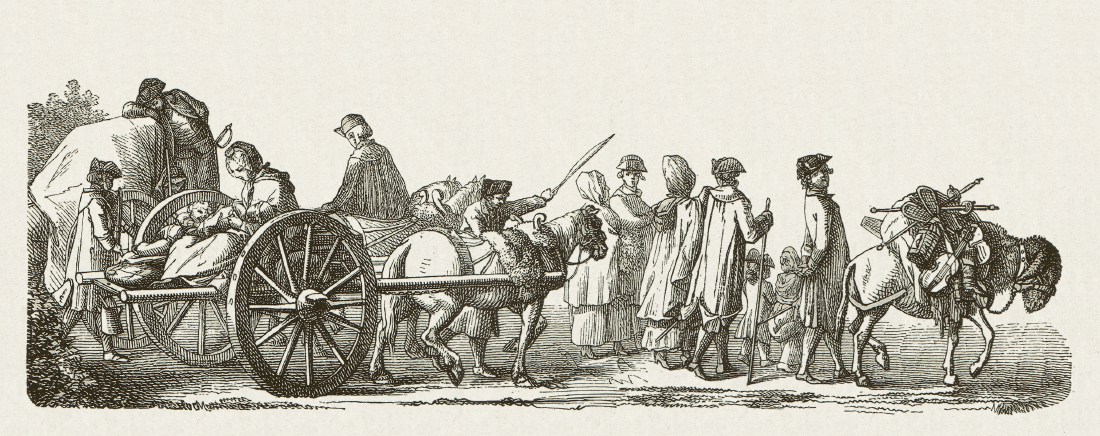
- Emigration of the Huguenots, 1566, by Jan Antoon Neuhuys
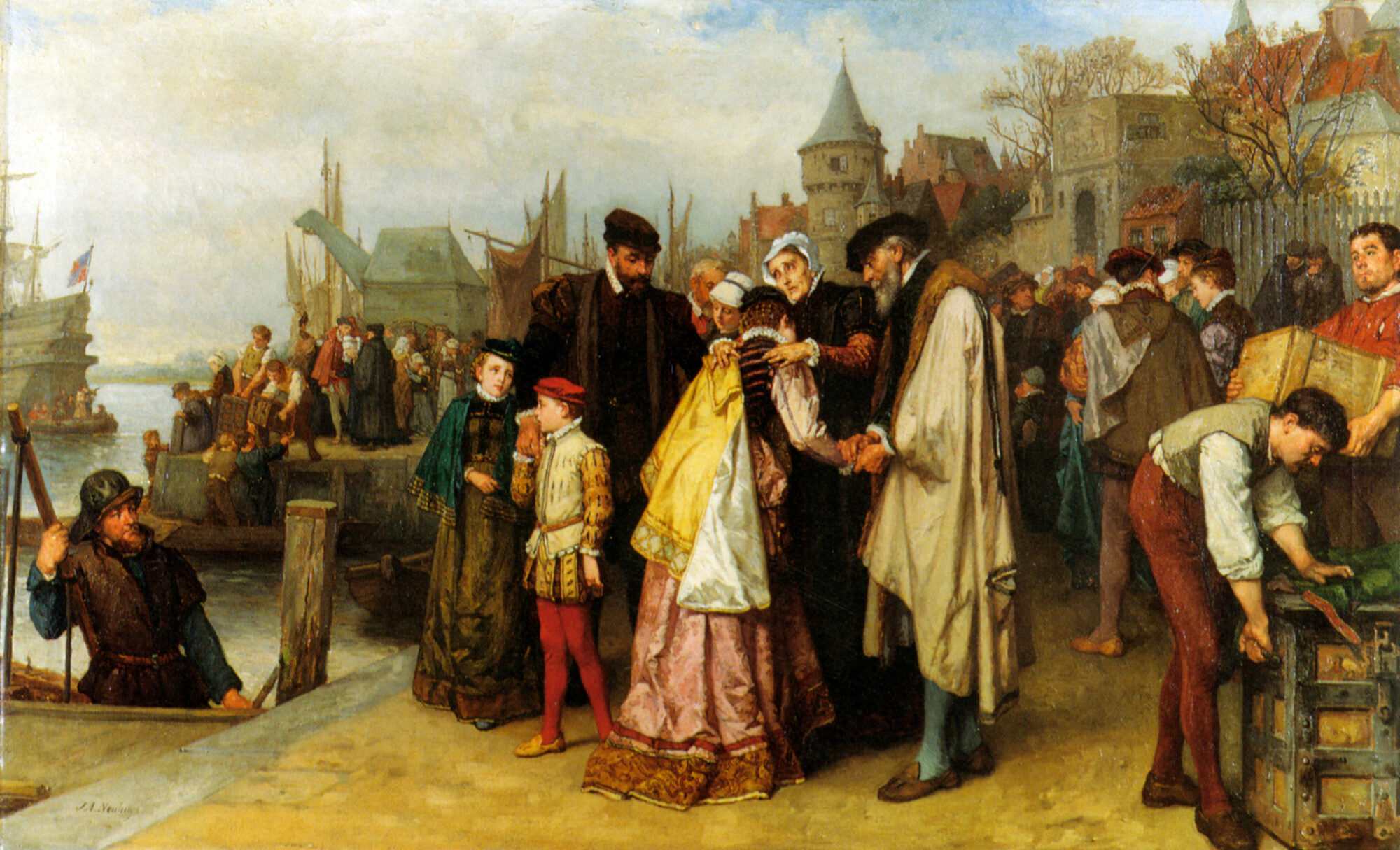
Emigration of the Huguenots, 1566, by Jan Antoon Neuhuys - 1567
- Siege of Saint-Denis. Death of Montmorency.
- 1567-1568
- Huguenot thread and lace makers established in Maidstone, England. Others escaped to Cranfield in Bedfordshire and others to the shires of Oxford, Northampton and Cambridge. Huguenots established glassworks in London during this period.
- 1568
- Treaty of Longjumeau.
Dominique de Gourgues attacked and captured the Spanish forts in 1568 and burned Fort San Mateo, the former Fort Caroline, in revenge for the 1565 massacre.
- 1569
- Battle of Jarnac. Death of Conde. Battle of Montcontour. Peace of St. Germain.
- 1570
- Treaty of Saint Germain. Henry of Navarre affianced to Marguerite de Valois.
- 1572
- Massacre of St. Bartholomew
In 1572, several thousand Protestants who had come to Paris to attend the wedding of Henry of Navarre and Margaret of Valois, died in the so-called Massacre of St. Bartholomew. On Friday, August 22, 1572, Admiral Coligny was wounded in the hand and arm by a shot fired from a window in the Louvre. Catholic mobs locked the city gates and killed 2,000 to 3,000 Huguenots. Other massacres followed in Bordeaux, Lyons and other cities, killing 10,000 more Huguenots.
Francois Dubois (1529-1584) Saint Bartholomew’s Day Massacre, ca 1572-84, oil on panel, Musee cantonal des Beaux-Arts, Lausanne 
French Huguenots grieving after the Massacre of St. Bartholomew’s Day (August 24–25, 1572), in which thousands of Huguenots were killed by French Catholic forces. - 1572-1573
- Siege of La Rochelle
After the massacres of St. Bartholomew’s Day and others across France in the fall of 1572, numerous Huguenots fled to the largely autonomous and overwhelmingly Huguenot city of La Rochelle, as a last refuge. The city of 20,000 inhabitants was well fortified, with access to the sea; in fact, its port was of strategic importance with historic links to England. The city’s leaders refused to accept a royal governor, sparking conflict with the crown. The six-month siege, led by the future Henry III, the Duke of Anjou, was brought to an end by the signing of the Edict of Boulogne.
The Siege of La Rochelle by the Duke of Anjou in 1573 (History of Henry III tapestry, completed in 1623), Musee d’Orbigny Bernon - June 1573
- The Peace of La Rochelle / The Edict of Boulogne
– conceded freedom of conscience and a restricted right of worship to Protestants. - 1574
- Death of Charles IX; accession of Henry III of France. Huguenot settlement at Winchester, England, moved to Canterbury. Truce with Huguenots in France.
- 1575
- Confederation of Milhaud.
- 1576
- Formation of the Holy League. Peace of Monsieur and defeat of Henry III. War renewed.
- 1577
- Peace of Bergerac.
- 1579
- Peace of Fleix. Ordonnance of Blois.
- 1584
- Death of duke of Anjou; Henry of Navarre becomes heir to the throne of France. Duke of Guise proclaims Cardinal de Bourbon heir apparent. Treaty of Joinville.
- 1585
- Henry III forced to surrender to the League and the Guises. Treaty of Nemours. Outbreak of the War of the Three Henrys.
- 1586
- Truce of Saint-Brice.
- 1587
- Execution of Mary, queen of Scots. Battle of Coutras. Battle of Auneau.
- 1588
- Day of the Barricades. Spanish Armada. Edict of Union. Duke of Guise and cardinal of Guise assassinated at Blois.
- 1589
- Henry III (Duke of Anjou) killed by a Catholic fanatic. Although he led the army to besiege La Rochelle in 1573, he later argued that a strong and religiously tolerant monarchy would strengthen the kingdom. Henry III of Navarre succeeded him as Henry IV, the first of the kings of the House of Bourbon.
- 1590
- Battle of Ivy. Siege of Paris.

Armed procession of the Holy League in Paris in 1590, Musée Carnavalet. - 1592
- Battle of Aumale.
- 1593
- States General meet in Paris to elect king. Henry IV converted to Catholicism.
- 1594
- Henry IV crowned at Cartres. Henry IV enters Paris.
- 1595
- Defeat of Spanish at Fontaine-Francaise.
- 1596
- Conference of Notables at Rouen.
- 1597
- Spanish capture Amiens. French recapture Amiens.
- 1598
- Edict of Nantes signed by Henry IV. Protestant worship was permitted only in specified places, while a separate patent gave Protestants about 150 places of refuge, including 51 fortified strongholds, initially for eight years. The edict was supposedly “perpetual and irrevocable.” Protestant worship, previously held in secret, became public as permanent temples were built.
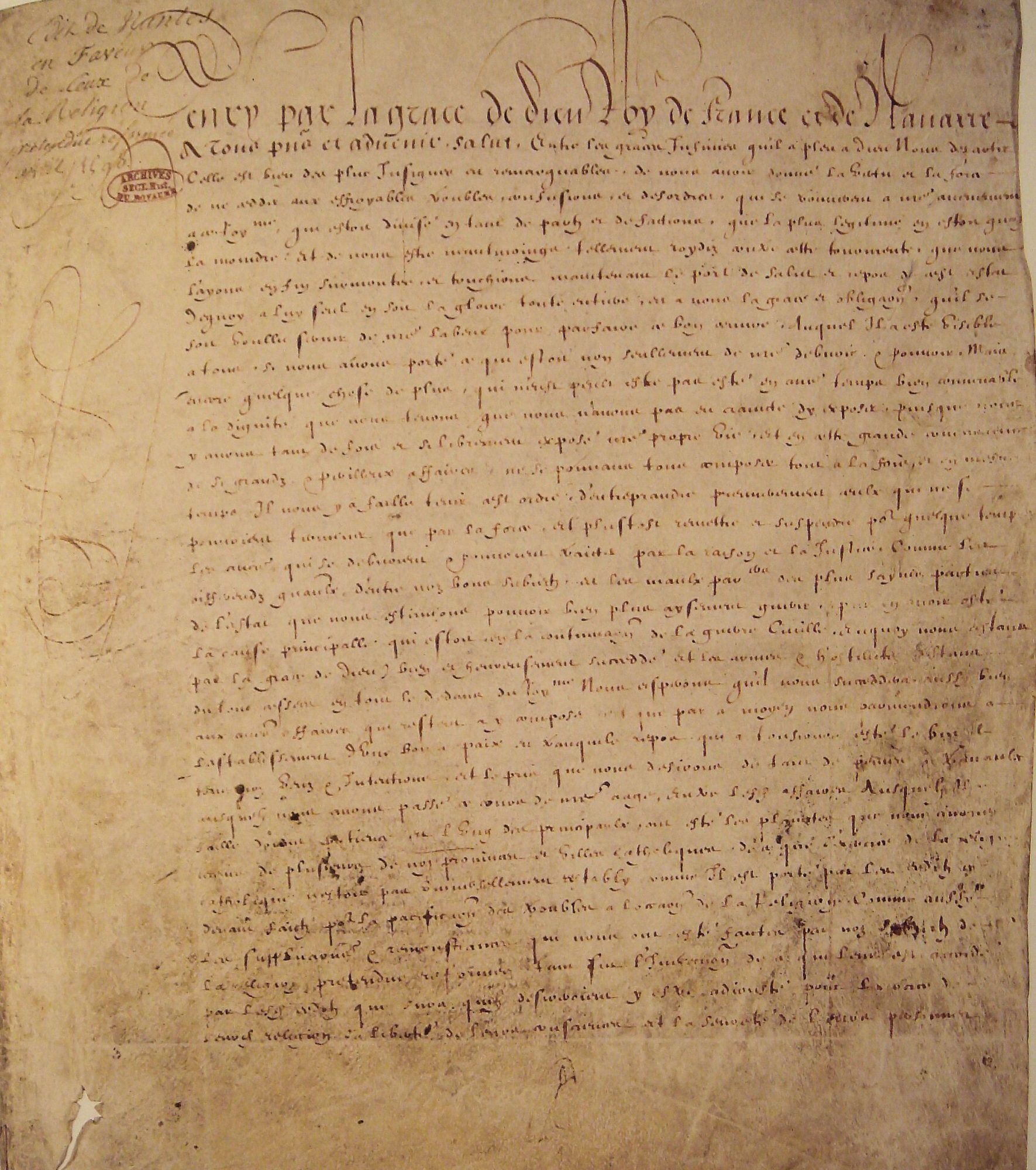
Edit de Nantes Avril 1598, Henry IV – Grands Documents de l’Histoire de France, Archives Nationales - 1603
- Pierre du Gua, sieur de Monts, a Huguenot, was granted royal permission to possess and settle North America from the 40th to 46th degree North Latitude for 10 years. (Acadia, later Nova Scotia). Death of Elizabeth I of England and accession of James I.
- 1605-1613
- Several French refugee merchants had settled in Dublin and Waterford in Ireland.
- 1607
- Jamestown, VA, English colony established. Trade privileges for de Monts withdrawn by king and Port Royal abandoned.
- 1608
- Samuel de Champlain landed at what is now Quebec City and established trading post. Religious liberty was unrestricted and trade prospered.
- 1609
- Group of Flemish Huguenots settled in Canongate, Scotland. Disrupted succession to the duchy of Cleves. By 1609, French Huguenots established manufacture of cloth in north and west of England in Worcester, Evesham, Droitwich, Kiddeminster, Stroud and Glastonbury and in east at Colchester, Hereford and Stamford. Colchester had 1,300 Walloon citizens by 1609. In the north of England, Huguenot establishments made coatings at Manchester, Bolton and Halifax and cloth caps and woolen stockings at Kendal.
- May 14, 1610
- King Henry IV of France killed by assassin; accession of Louis XIII. Duke de Rohan becomes leader of the Huguenots. Alliance with Evangelical Union of Swabisch. De Monts surrendered his colonization rights in North America which were purchased by Antoinette de Pons, a lady of honor to the queen and an intense devotee of Church of Rome and supporter of Society of Jesus (Jesuits).
- 1613
- By this time Jesuits controlled religion in Acadia and restricted Protestants.
- 1616
- Treaty of Loudon.
- 1618
- Cardinal Richelieu publishes “Principal Points of Faith of the Catholic Church.”
- 1619
- From 1619 the Council of the Huguenots sat regularly at La Rochelle. Huguenot Church of Bearn rejects Decree of Restitution. La Rochelle supports Bearnaise resistance to Louis XIII.
- 1620
- Death of duke of Luynes. Defection of Sully, La Force and Chatillion to the Catholics.
- 1621
- Jesse de Forest’s request to settle in English colonies turned down by Sir Dudley Carleton. Instead they were directed to NY.
Siege of Montauban
- September 1621
- English under King James I, laid claim to much of Canada east of St. Croix River and south of St. Lawrence, including much of Acadia (Nova Scotia).
- 1621 to 1627
- Religious toleration still existed in Quebec and area and Huguenot merchants prospered.
- 1622
- Archbishop Laud attempts to compel refugees to conform to Anglican liturgy. Siege of Montpellier abandoned and peace signed.
- 1624
- Richelieu given seat on Royal Council and appointed chief minister to Louis XIII.
Sailing ship New Nederlandt sailed with about 30 Walloon families from Texel River, Holland, for New Amsterdam. Four Huguenot families left New Amsterdam and settled near “Trenton Falls” on the Delaware River in Delaware, but returned to New Amsterdam because of Indian attacks. Other later early settlements were destroyed by Indians.
- 1625
- Huguenot settlers established along the James River in VA. From 1625-1686, Huguenots sought refuge in French colonies in Lesser Antilles of Caribbean – St. Christopher, Guadeloupe, Martinique.
- 1625
- By 1625, La Rochelle had become the stronghold of the French Huguenots, under its own governance. One of the largest cities in France, with over 30,000 inhabitants, it was the center of Huguenot sea power and the strongest center of resistance against the central government. Changes in the monarchy met with increased Protestant resistance until tensions escalated to the point that Huguenots ensconced in the city revolted under the Duke of Rohan.
- 1626
- England declared war on France in support of the Protestants but the British army failed to defeat the French near La Rochelle. Jesuits joined Franciscans in Quebec and religious turmoil began as privileges were withdrawn for Huguenots. Trade declined. Cardinal Richelieu was rising to power in France as he moved to reduce the political power of Huguenots.
Manhattan Island bought from Indians by Peter Minuet, a Huguenot. Permanent settlement established at Salem, MA, included Huguenots.
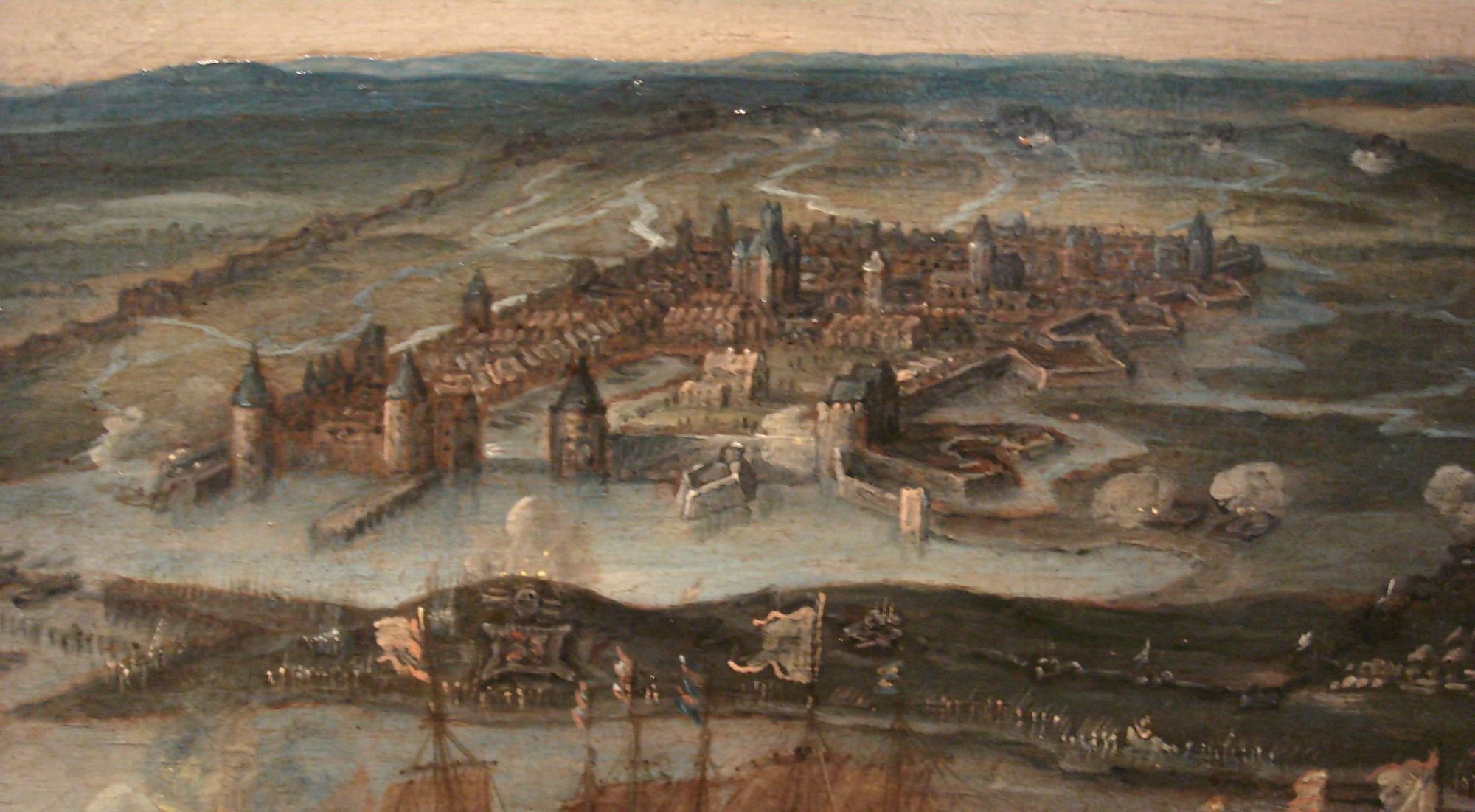
La Rochelle during the 1628 siege, Orbigny-Bernon Museum - 1627
- Siege of La Rochelle begins. The city was besieged by a Catholic army under Cardinal Richelieu. The siege marked the apex of the tensions between the Catholics and the Protestants in France, and ended with a complete victory for King Louis XIII and the Catholics. Ten thousand of its 25,000 citizens died of starvation in the fourteen-month siege, along with many more from disease and casualties of war.
- King Charles I of England declared himself a friend of French Huguenots.
- 1628
- English fleet sent to relieve Huguenots at La Rochelle, which had been under blockade by French troops under Louis XIII. Relief failed and La Rochelle fell to French troops on Oct. 8, 1628. Acadia (Nova Scotia) fell to the English.
- By 1628
- There were 300 inhabitants of New Amsterdam, mostly Huguenots. First Huguenot Church established on Manhattan Island.
- 1629
- Peace of Alais / Edict of Alès / Edict of Grace
In this treaty negotiated by Cardinal Richelieu with Huguenot leaders and signed by King Louis XIII of France on 27 June 1629, the basic principles of the Edict of Nantes were reaffirmed, with additional clauses stating that the Huguenots no longer had political rights and further demanding they destroy all their fortifications and relinquish all garrison towns and fortresses immediately. It ended the religious warring while granting the Huguenots amnesty and civil equality and guaranteeing them tolerance and freedom of worship. - Huguenots in England ask for permission from King Charles I to settle in Carolinas and set sail in 1630, but landed in Virginia instead. Massachusetts Bay Company charter granted.
- Jan. 1629
- Some 50 settlers left England to establish, Charlestown, MA. Sir Robert Heath’s Carolina charter granted. Baltimore decides to settle on the Chesapeake. Peace of Alais ends civil war in France and Huguenots cease to exist as a political force.
- July 20, 1629
- Quebec surrendered to English forces after the English war with France was officially over.
- Sept. 24, 1630
- First ship of de Sauce’s French emigrants arrived at Southampton Hundred on the James River, but the colony did not prosper and they believed to have dispersed.
- 1632
- English returned Quebec to France with Emery de Caen, son of Gullaume, sieur de la Mothe, as governor. Lord
Baltimore’s Maryland charter granted. Louis XIII bans all Huguenots from Canada. - 23 May, 1633
- Champlain again appointed governor of French Canada and returned Jesuits to religious power. From this time, Canada was formerly closed to Protestant colonists. While some Huguenot traders were allowed to remain, permanent residency was granted to none but Frenchmen of the Roman Catholic faith, marking the beginning of a steady decline of the economy with some Huguenots escaping to Nova Scotia and the British colonies. Huguenot merchants in France continued to trade with those remaining in Quebec.
- 1633
- Archbishop Laud appointed to head commission for regulating colonies.
- By 1634
- Some 20 villages established in Boston, MA, area, including Charlestown, Newton, Watertown, Roxbury and Dorchester.
- 1642
- Death of Richelieu.
- 1643
- Death of Louis XIII; accession of Louis XIV. Louis XIV guarantees Edict of Nantes. Mazarin prevents clamour for revocation.
- 1648
- Outbreak of Fronde in France. Treaty of Westphalia.
- 1652
- Louis XIV declared his intention to maintain the Edict of Nantes. However, he gradually increased persecution of Huguenots until he issued the Edict of Fontainebleau (1685), ending any legal recognition of Protestantism in France and forcing the Huguenots to convert or flee in a wave of violent dragonnades.
- The Dutch East India Company established the permanent refreshment station at Table Bay under Jan van Riebeeck in 1652.
- 1654
- Beginning of Huguenot emigration on a large scale to North America.
- Robert Sedgwick’s English conquest of French Acadia.
- 1658
- New Harlem founded.
- 1659
- Treaty of the Pyrenees.
- 1659-1671
- Virginia passed acts allowing for naturalization of non- British in the colony.
- 1660
- Restoration of Charles II to English throne.
- 1661
- Cardinal Mazarin, who had acted as the Huguenot protector in France, died. Beginning of serious persecution of Huguenots and infringement of Edict of Nantes. Series of proclamations seriously restricted terms of Edict of Nantes. Louis XIV begins systematically restricting the protections granted to Protestants under the Edict of Nantes; legal and administrative persecution intensifies. Escaping Huguenots were welcomed in many countries of Europe – England, Holland, Germany, Switzerland, Sweden. At one time, more French resided in Berlin than Germans.

Three hundred families of persecuted Huguenots leaving La Rochelle, November 1661, engraving by the Dutch school. Wars of Religion, France, 17th century. - 1662
- Jean Touton’s colony in Massachusetts founded.
- 1663
- Carolinas Grant from King Charles II of England to eight proprietors.
- 6 September 1664
- New Netherland became an English colony and name changed to New York.
- 1665
- First Dutch church registers in South Africa.
- 1670
- Three ships arrived in Carolinas carrying settlers from London, mostly Huguenots.
- 1677
- Huguenots purchased land on which New Platz, NY, established.
- 1678
- Peace of Nijmegen. Attacks on Huguenots across France. Campaign was underway to convert Protestants.
- April 30, 1680
- Ship “Richmond” arrives from England at Charles Town, SC, with 75 French Protestants.
- 1681
- William Penn Jr. receives grant of Pennsylvania England’s King Charles II.
The first dragonnades begin in 1681 in Poitou. Protestants in the province of Poitou were forcibly converted to Catholicism. Protestant temples were demolished. Troops were billeted on the Protestant population. (Billeted means for soldiers to live with families who had to support them financially.) The edict encourage children aged seven and above to abjure their faith, leave home, and demand an allowance from their parents.
The Musée Protestant says the dragonnades reached Normandy only in October–November 1685, around the time of the Revocation. Rouen was subjected to them at the end of October; Caen followed in November. “In November 1685, the Northern and Eastern areas around Chartres, Rouen, Dieppe, Caen, and Nantes were attacked.” [Source: The “Dragonnades” (1681-1685)]
For the territory of the modern Eure, it appears that by just before 1685 only a few organized Protestant churches remained, principally in Évreux, Pont-Audemer, and Quillebeuf. After the Revocation those communities disappear abruptly from the record. A local history of Bernay also mentions Protestants being confined in convents as part of the post-Revocation coercion. [Source: Histoire du protestantisme dans l’Eure] | The Protestant Evangelical Centre of Bernay
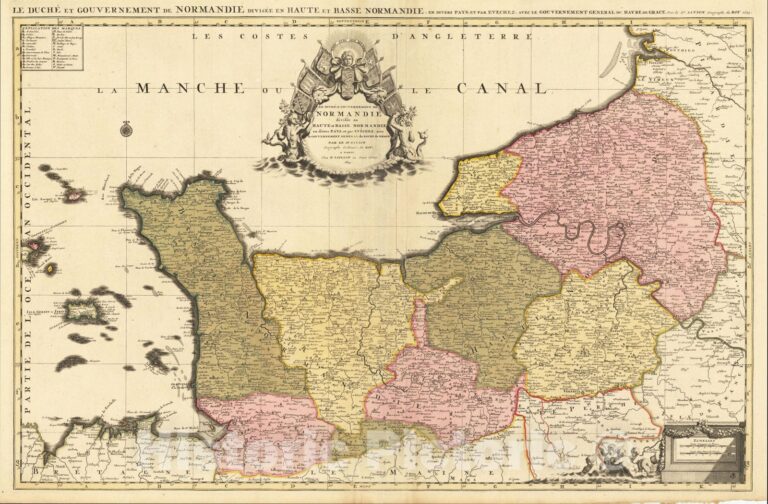
Our line of LeBlonds were thought to have lived in Normandy, probably in Eure, and possibly in the area of Bernay. Family lore indicates that Robert left in 1685 but this has not been proven.
Charles II of England issued proclamation offering England as place of refuge for Huguenots. Londoners and their countrymen participated in house-to-house collections to aid in the relief of the Huguenot refugees. A soup kitchen was opened in Spitalfields for the Huguenot poor. Charitable groups were established to assist aged Huguenots and paid apprenticeships for the children. (Spitalfields became a French community depended heavily on the weaving trade.)
William Penn Jr. receives grant of Pennsylvania England’s King Charles II.
- 1683
- The King and Françoise d’Aubigné (Madame de Maintenon), the former governess to the king’s illegitimate children, were secretly married.
- 1685
- A petition was presented to Louis XIV stating that the Protestants have been refused admission to public office and have been dismissed from positions of authority in which they had served with honor and fidelity. Protestant children were taken from their homes. The petition pleaded for a return to the observance of the Edict of Nantes, which Louis XIV revoked. The new law ordered the destruction of churches, the closing of schools, the Catholic baptism of Huguenots and the exile of Huguenot pastors who refused to renounce their faith.

Persecution of the French Huguenots (After the Revocation of the Edict of Nantes by Louis XIV in 1685), 1904, Maurice Leloir (1853-1940 French), Color lithograph Tens of thousands of Huguenots fled to other countries including Holland, England, and Prussia. The Revocation gave Protestant ministers a fortnight in which to leave France, on pain of death or imprisonment if they delayed. Other Protestant subjects caught attempting to leave the country would be condemned to the galleys, if men, or imprisonment, if women.
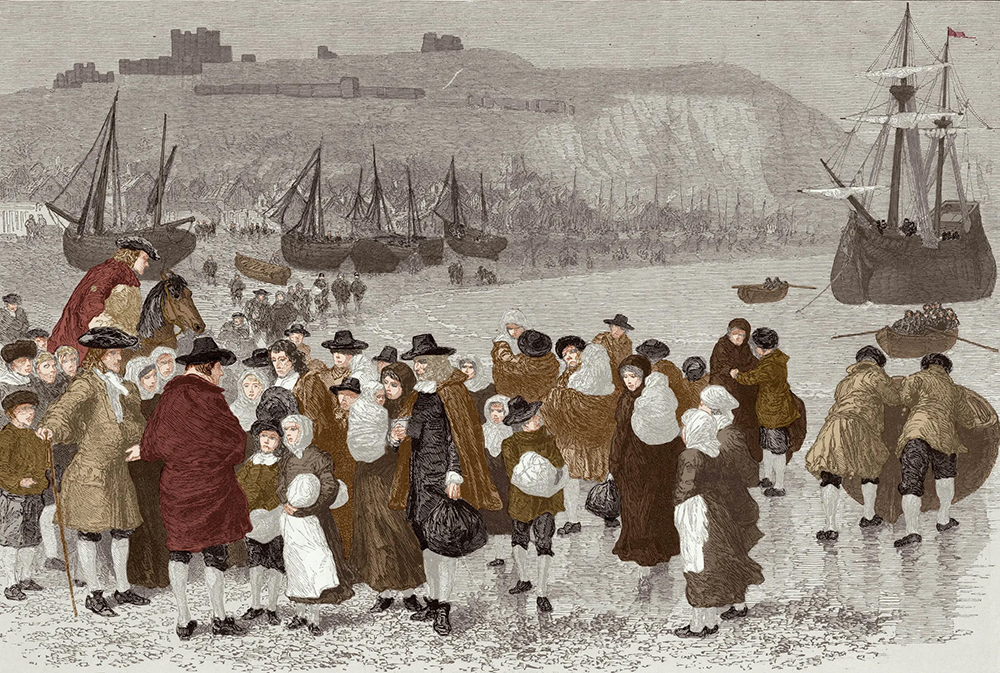
French Huguenots arriving in Dover (England) after the Revocation of the Edict of Nantes, 1685, Coloured engraving Some 80,000 French manufacturers and workmen fled to the British Isles, bring such industries as paper making, silk makers, tanners, furniture making, silver smithing. England became an exporter, rather than an importer of such items as velvets, satins, silks, taffetas, laces, gloves, buttons, serge cloth, beaver and felt hats, linen, ironware, cutlery, feathers, fans, girdles, pins, needles, combs, soap, vinegar and many more items manufactured by the new Huguenot citizens. But life in another country was not without its problems, not only of language but also when the hard-working, frugal Huguenots came into competition with the citizens.
- October 1686
- Group of French Huguenots established Frenchtown, RI, 10 miles inland from Narragansett Bay. By 1691, their neighbors had driven all but two families from the town.
- 1687
- Huguenot Relief Committee in London aided 600 Huguenots in their move to VA. Huguenots granted permission for Huguenot church in Boston on Nov. 24, 1687. Was completed in 1716. It later became an Anglican Church and later a Roman Catholic Church and the site now is occupied by a Boston bank. Huguenots had built their church in Charlestown, SC.
- 1690
- French Huguenots from VA established permanent settlement on the Pamlico River in NC.
- 1700
- By 1700 there were 20,000 to 25,000 Huguenots in the area of modern greater London.
Some 700 emigrants led by Marquis de la Muce landed in Virginia and started Manakintown settlement. First ship to land was the “Mary Ann,” which cleared from London on April 19, 1700, and arrived at Hampton, VA, on July 23. The “Peter and Anthony” landed Oct. 6, 1700; and the fourth was the “Nassau” or “Nasseau,” which landed March 5, 1701. Little is known of the third ship.
- 1705
- French Huguenots founded town of Bath, NC, on Pamlico River.
- By 1707
- 400 refugee Huguenot families had settled in Scotland. Helped establish the Scottish weaving trade.
- 1710
- Huguenots settled on the Trent and Neuse Rivers in NC and other Huguenots from Switzerland and Palatine Germany established New Bern, NC, soon thereafter.
- January 1733
- General James Oglethorp, chief trustee of Georgia, arrived with 120 settlers, many of whom were Huguenots, at Yamacraw Bluffs on the Savannah River. Within four years the population had grown to 1,000.1740By act of English Parliament, alien immigrants into the colonies receive British citizenship.
- 1750-1775
- By the later eighteenth century, many Huguenot communities in Britain and the American colonies had largely assimilated linguistically and culturally.
- 1755
- Acadians expelled from Nova Scotia.
It is estimated that 200,000 to 250,000 Huguenots left France while 700,000 remained and abjured their faith. Most who left went to the Dutch Republic, then Britain, Germany, Ireland, and the American colonies.
Sources
- Murdoch, T.V. The Quiet Conquest: the Huguenots 1685-1985. London: Museum of London, 1985. DA122.H89* (Winterthur Library)
- The Pierre Chastain Family Association, Huguenot and Protestant Reformed Chronology

I have French Protestant ancestors; My maternal grandmother Elizabeth Couser was aware of her Huguenot forebearers who went to Northern Ireland to run a linen mill. My paternal grandmothers maiden name was Agnew, a common name in Ulster. How can I find out more?
Try Ancestry.com – they should have something to help you. Good luck!
Thank you for this exquisite timeline. I am doing genealogy on my husband’s family which ended up as original settlers in New Rochelle, NY. This will allow me to explain clearly what they fled and their courage of a new start.