
The Le Blond Family in Protestant Exiles from France in the Reign of Louis XIV
Denization records, Huguenot migration, and some intriguing connections among the Le Blonds, Doublets and Le Telliers
While researching my Le Blond ancestors in Spitalfields, London, I came across a useful nineteenth-century work: the Rev. David C. A. Agnew’s Protestant Exiles from France in the Reign of Louis XIV; or, The Huguenot Refugees and Their Descendants in Great Britain and Ireland.
Agnew first published the work in 1866, but later regarded that edition as incomplete and sometimes inaccurate. The second, corrected and enlarged edition appeared in 1871–1874 in three volumes. The first two volumes were issued in 1871; a third “Index-Volume,” containing additional material, corrections, alphabetical tables and re-copied naturalization records, followed in 1874. Agnew based his expanded edition on research at the Public Record Office, Doctors’ Commons, libraries, manuscripts and earlier Huguenot scholarship.
For a family historian, the work is particularly valuable because Agnew did more than write a narrative history of the Huguenots. He transcribed long lists of French Protestant refugees whose legal status in England was recorded in the Patent Rolls. Agnew stated that his lists represented the actual royal grants as entered on those rolls, rather than merely copying earlier published lists that he considered unreliable. That makes the book an excellent finding aid. It is still a nineteenth-century transcription rather than the original seventeenth-century document, so an important identification should ideally be checked against the original Patent Roll or a modern Huguenot Society index. But Agnew gives us names, families and dates that would otherwise be extremely difficult to locate.
What was Denization?
Naturalization and Denization are two different legal designations. A denizen was a foreign-born person who had been granted a special legal status by the Crown. The National Archives describes denization as a form of “limited naturalisation.” A denizen received many of the protections enjoyed by a native-born English subject, but not all of them. Denizens could still be taxed at alien rates and could not vote, hold certain civil or military offices, or inherit land. Full naturalization conveyed greater rights and normally required parliamentary action during this period.
This distinction matters for genealogy. A denization entry is not a passenger list and it is not an immigration record. The date of the grant does not tell us when a person arrived in England. Someone might have been living in London for years before obtaining denization.
Agnew also explains that numerous refugees were included together in a single royal grant. In fact, he says that “most of the refugees were naturalised in groups.” He sometimes combined individual grants into lists for convenience as well. Therefore, people appearing beside one another in one of Agnew’s lists should not automatically be described as traveling together.
What the lists can show is something almost as interesting: people who were being legally processed during the same period. When the same surnames also turn up together in marriages, wills, baptisms and church records, those groupings become valuable clues to possible family and community networks.
The Historical Setting
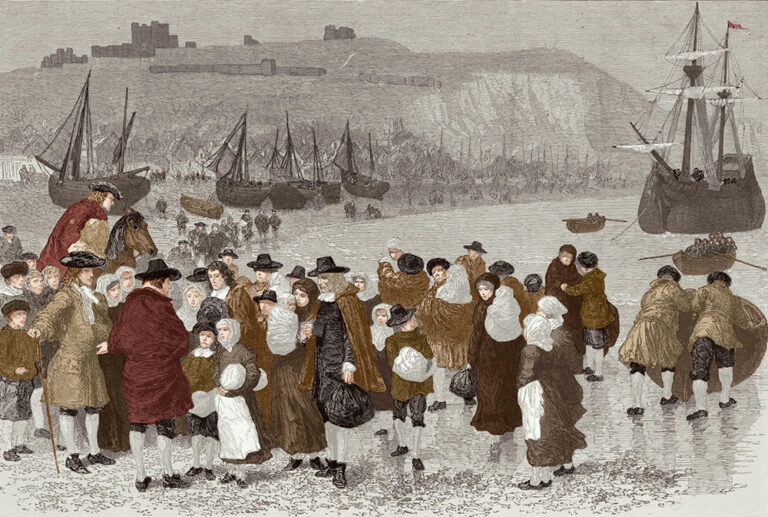
French Protestants had been coming to England long before 1685, but persecution increased sharply under Louis XIV. The dragonnades beginning in 1681 placed soldiers in Huguenot homes as a means of intimidation. Then, in October 1685, Louis XIV revoked the Edict of Nantes, effectively ending legal toleration of Protestantism in France. Although emigrating was itself forbidden, perhaps 200,000 French Protestants escaped France, with roughly 50,000 reaching England. London became one of the major centers of the Refuge, and Spitalfields developed an especially important Huguenot community. The Agnew lists show that Le Blonds were among these refugees even before the Revocation of 1685.
The Le Blonds in Agnew’s Denization Lists
I searched Agnew for Le Blond, Le Blon, and plausible variants such as Blond. These are the relevant denization entries I have found.
- Date of grant
- Name as printed by Agnew
- Details
- 8 Mar. 1682
- Francis Le Blon
- Listed with Mary his wife and Jeanne and Peter their children. A Daniel Le Tellier appears in the same enormous grant.
- 15 Apr. 1687
- Peter Le Blond
- Appears individually in Agnew’s List XIII.
- 5 Jan. 1688 n.s.
- James Le Blond
- Appears in List XIV. The same grant contains the remarkably interesting James Doublet, Martha his wife, and their children David, James and Mary.
- 10 Oct. 1688
- Jacob Le Blond
- Appears individually in List XVI.
- 10 July 1696
- Isaac Le Blond
- Appears individually in List XXI.
- 11 Mar. 1700 n.s.
- Robert Le Blond
- Appears in List XXIV. The same grant also contains Isaac Blond, Isaac Le Tellier, Gabriel Doublet and David Doublet Jr.
- 11 Mar. 1700 n.s.
- Robert Le Blond
- A second Robert Le Blond occurs later in the same list.
- 3 July 1701
- Daniel Blond
- A possible Le Blond spelling variant, although I would not assume he belongs to this family without other evidence.
Agnew warns us that the surname spellings are simply those written by government clerks. That is important when dealing with names such as Le Blond, Le Blon and Blond. I have not included names such as Blondet, Blondett or Blondel as Le Blonds. They occur in the lists, but those can be separate French surnames and should not be merged merely because they look similar.
The 1688 Doublet entry is especially interesting. The 5 January 1688 grant containing James Le Blond also contains James Doublet, Martha his wife, and children David, James and Mary. That caught my attention because the Doublet name appears repeatedly in my own Robert Le Blond records. Robert’s 1708 will refers to James Doublet as his brother-in-law. The will also describes a financial note dated 8 July 1692 that had originally been made in favor of Robert’s deceased first wife. That has led me to suspect that Robert’s first wife may have been a member of the Doublet family, although the will does not actually state her maiden name. There is more. When Robert and his second wife Elizabeth’s daughter Judith was baptized at the French Artillery Church in Spitalfields in 1707, her godfather was David Doublet. Consequently, the James Doublet family in Agnew’s 1688 grant deserves serious attention. The household includes a son David, precisely the name that later appears in the Le Blond baptismal records. This does not yet prove that the 1688 James and David are the same Doublets appearing in Robert’s family records—but the chronology and names make them excellent candidates.
And then there is the extraordinary 1700 grant. Agnew’s grant of 11 March 1700 is the most intriguing entry of all. Within this one large legal grouping we find: Isaac Blond, Isaac Le Tellier, Gabriel Doublet, Robert Le Blond, David Doublet Jr., a second Robert Le Blond, later David Le Tellier and another David Doublet Jr. These names are scattered through a very large list rather than forming a neat family group, so their placement should not be overinterpreted. Agnew himself says that large numbers of refugees were often dealt with in the same grants. Nevertheless, from what we now know independently about my Robert Le Blond, the recurrence of these surnames is striking.
Robert was already in London by 1695, when, described as a widower, he married Elizabeth Mayeux/Mahjou at St Botolph without Aldgate. His will identifies James Doublet as his brother-in-law. His daughter from his first marriage, Mary Le Blond, married Daniel Le Tellier, a Spitalfields weaver. David Doublet served as godfather to another daughter. And an Isaac Le Blond witnessed Robert’s will. Against that background, finding Le Blond, Doublet and Le Tellier names together in the 1700 denization grant is much more interesting than it would be in isolation. It still isn’t proof of kinship. But it gives us a clearly defined group of people worth investigating.
Which Robert Le Blond was Denized in 1700?
One of the two Robert Le Blonds in the March 1700 grant could very plausibly be my ancestor. We know independently that my Robert was living in the London area by 1695, so the chronology fits perfectly. But Agnew’s list provides no occupation, age, birthplace or address with which to distinguish the men. The appearance of two adults named Robert Le Blond in the same grant is itself important. Robert’s son Robert by Elizabeth was not yet old enough to account for a second adult denizen, so the second man must represent another Robert altogether—or possibly a duplication in the underlying records or in the way Agnew assembled his list.
Until the Patent Roll itself is checked, I would not turn the two Roberts into a father and son, brothers, cousins or any other relationship. But it certainly strengthens the possibility that there was more than one adult Le Blond family member in the Huguenot community at this time.
Isaac Le Blond
An Isaac Le Blond received denization on 10 July 1696. Twelve years later, an Isaac Le Blond witnessed Robert’s 1708 will. Whether these are the same man is not yet proven, but the identification is quite plausible and deserves further investigation. This becomes still more interesting because another family tree I have encountered identifies an Isaac as an older son of Robert. At present I do not have primary evidence proving that relationship, so I am keeping that possibility firmly in the “research lead” category.
Other Le Blonds Recorded by Agnew
Agnew’s book contains several additional Le Blond references outside the denization lists. These cannot automatically be connected to Robert’s family, but they help demonstrate how widespread the surname was among French Protestant refugees in England.
- Date
- Person
- Record
- 15 July 1689
- Ester Le Blond
- Married Jacques Rougereau at the French Church at Thorp-le-Soken, Essex. She is identified as daughter of Isaac Le Blond and Marie de Caux and as a native of “Lautreteau.”
- 17 Jan. 1702
- Madelaine Le Blond
- Served as a baptismal sponsor at the Crispin Street French Church in London.
- 19 Oct. 1712
- Susanne Judith Le Blond
- Served as a sponsor at the Wheeler Street French Church in London.
- 12 Dec. 1714
- Jean Le Blon and Anne Dufour
- Their daughter Jeanne, born 26 November, was baptized at the Artillerie French Church, the same congregation used by Robert Le Blond’s children.
- 1719 and 1727
- James Christopher Le Blon
- Appears in Agnew in connection with inventions involving color printing and tapestry weaving.
- 1744
- Charles Le Blon
- Appears among French Protestant names associated with a large loyal address by London merchants.
The 1714 Jean Le Blon at the Artillery Church is particularly worth keeping in mind. Robert’s children were baptized in that same French congregation. Again, shared church membership is not proof of family relationship, but Jean belongs on the list of possible relatives to investigate.
Francis Le Blon Pushes the Name Back Before 1685
The earliest Le Blond entry I found in these lists is particularly useful historically. On 8 March 1682, Francis Le Blon was denized together with his wife Mary and children Jeanne and Peter. That was more than three years before the Revocation of the Edict of Nantes. The Le Blonds therefore cannot be understood only as refugees suddenly arriving after October 1685. At least one Le Blon household was already seeking permanent legal standing in England during the earlier wave of persecution associated with the dragonnades. Whether Francis belonged to Robert’s immediate family remains unknown.
Were these people traveling together? This is the tempting question, but Agnew cannot answer it. A royal denization grant was not an arrival manifest. Someone denized in 1700 might have arrived in 1699—or fifteen years earlier. Likewise, two people appearing in the same grant did not necessarily cross the Channel together.
So I would not say that Robert Le Blond traveled to England with the Doublets and Le Telliers. What the evidence supports is more cautious—and, genealogically, more useful: Le Blonds, Doublets and Le Telliers repeatedly appear within the same Huguenot legal and family networks in England during the period in which Robert Le Blond was living in Spitalfields. In Robert’s particular case, the connection is no longer based solely on names in Agnew. The family’s own records independently link Robert to James and David Doublet and to Daniel Le Tellier. The denization lists therefore give us possible earlier appearances of people who may belong to that already documented network.
What Agnew Adds to the Story of Robert Le Blond
Agnew does not tell us where my Robert was born or identify his parents. It does not prove that the Robert denized in 1700 is my Robert. Nor does it establish relationships among the other Le Blonds named in the book. What it does do is substantially broaden the picture. Instead of a single Robert Le Blond appearing suddenly in London in 1695, we can now see a series of people carrying the name in English Huguenot records: Francis in 1682, Peter in 1687, James and Jacob in 1688, Isaac in 1696, two Roberts in 1700, and possibly Daniel in 1701. And intertwined with them are surnames that occur in Robert’s own family documents: Doublet and Le Tellier. That makes Agnew’s book valuable not because it gives us a ready-made Le Blond pedigree—it doesn’t—but because it provides a research map.
The next stage is to work outward from the people named here: identify the original Patent Roll entries, search French Protestant church registers for the Doublets and Le Telliers, investigate Isaac Le Blond, and try to determine whether any of these earlier Le Blond households can be linked securely to Robert.
About the Source
The work I have referred to here as the “1871 Agnew” is the second edition, corrected and enlarged, published by Reeves & Turner in London in 1871–1874 in three volumes. Volume III, the index and supplementary volume, was published in 1874. The complete work is in the public domain and can be read online: Read or download Agnew through Open Library