
Abraham LeBlond was born February 11, 1819, at Wymondham, Norfolk, England, the son of Robert LeBlond and Elizabeth Saling. He belonged to the English branch of a Huguenot LeBlond family whose roots can be traced through the French Protestant community in and around Spitalfields and London. Abraham was the younger brother of Robert LeBlond (1816–1863), my great-great-great-grandfather, with whom he would establish one of the better-known Victorian color-printing firms. Abraham is therefore not my direct ancestor, but his career is closely tied to the history of my LeBlond family.

Baptism
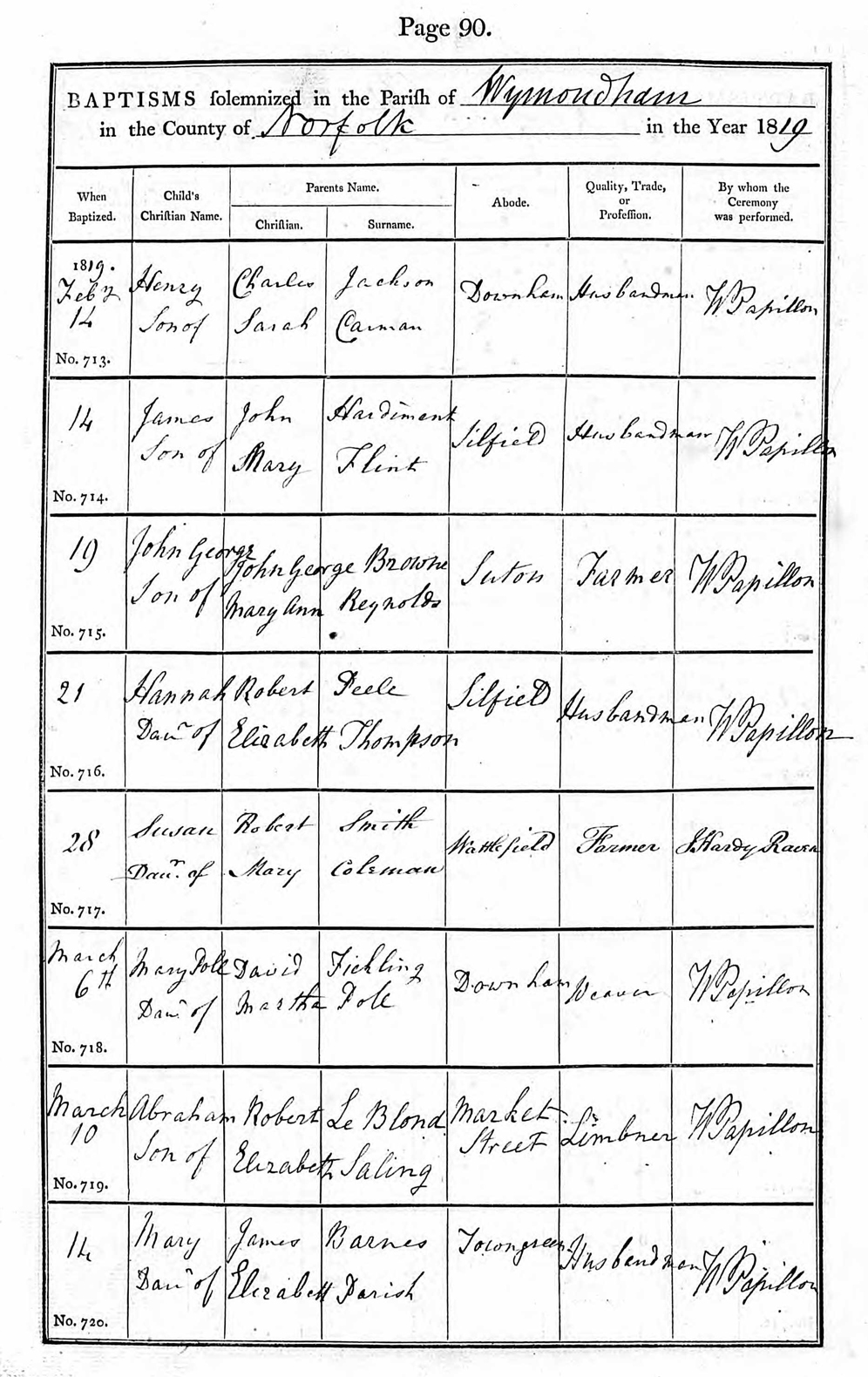
Abraham was baptized on March 10, 1819, at Norfolk. His parents lived on Market Street in Wymondham, a market town and civil parish in the South Norfolk district of Norfolk, England. His father was a “limbner,” or limner, and old word for painter or artist, especially someone who painted portraits, miniatures, or decorated manuscripts. Contemporary dictionary definitions describe a limner as a person who paints or draws.
Apprenticeship in 1833
Abraham’s training as a printer can be traced through his surviving apprenticeship indenture. In 1833, at the age of fourteen, he was bound for seven years to William Richard Newman, an established printer and lithographic engraver of Widegate Street, Bishopsgate. Abraham’s family paid a premium of £40, and Newman agreed to teach him the trade while providing his food, clothing, and lodging. After completing his apprenticeship, Abraham was admitted to the Freedom of the City of London in 1841.
The key opening lines identify him as: “Abraham Le Blond son of the late Robert Le Blond of Rye in the County of Sussex Broker” and state that he bound himself apprentice to William Richard Newman, described formally as a Citizen and Vintner of London, “to learn his Art.” Newman was not simply a wine merchant. The bottom of the document identifies him as: W. R. Newman, Printer, Widegate Street, Bishopsgate, and independent print-history sources identify William Richard Newman (1797–1855) as a lithographic engraver and printer working at 27 Widegate Street, Bishopsgate.

In return for Abraham’s £40 payment, Newman agreed to teach Abraham the “art and mystery” of his trade and to provide him with meat, drink, apparel, lodging, and all other necessaries for the duration of the apprenticeship.
The rest is the wonderfully severe boilerplate of a nineteenth-century apprenticeship contract. Abraham promised to serve faithfully, keep his master’s secrets, obey lawful commands, not waste his master’s goods, not marry, not commit fornication, not gamble at cards or dice, not frequent taverns or playhouses, and not absent himself from his master’s service without permission. Those restrictions were standard language in apprenticeship indentures of the period.
There are also two features worth noticing visually. The coat of arms near the upper left appears to be associated with the Vintners’ Company, which explains why Newman is called a “Citizen and Vintner” even though his actual occupation was printing. Membership in a London livery company and one’s day-to-day trade did not necessarily match. The red wax seals at lower right are the seals of the contracting parties.
Abraham completed his seven-year term around 1840, and then in 1841 he was admitted to the Freedom of the City of London.
Establishment of LeBlond & Co.
About 1840 Abraham and his older brother Robert established Le Blond & Co. in the Walbrook area of the City of London. Early directories describe the firm as steel- and copper-plate engravers and printers. The business later expanded into premises at 24 Budge Row as well as workshops at 4 Walbrook. During these early years the brothers undertook general commercial printing, including calling cards, labels, bookplates, advertising material and colored labels for the textile trade.
Freedom of the City of London
Abraham’s early training can be traced through his Freedom of the City of London record. On September 3, 1841, after completing an apprenticeship to William Robert Newman, a Citizen and Vintner of London, Abraham was admitted as a Freeman of the City of London. The document identifies him as the son of Robert LeBlond and provides valuable evidence of the apprenticeship through which he learned his trade before establishing himself as an engraver and printer.

“Freedom” here has nothing to do with emancipation or modern civil liberties. In nineteenth-century London, becoming a Freeman of the City of London was an old civic status connected with trade, apprenticeship, and membership in the City’s livery-company system. Historically, freemen gained rights to conduct business in the City and participate in aspects of civic life. One of the traditional routes to the Freedom was completing an apprenticeship to an existing Freeman.
The important opening portion reads approximately: “Abraham Le Blond, son of Robert, & late appr[entice] of William Rob[er]t Newman, Cit[izen] & Vintner of London, was admitted unto the Freedom aforesaid…”
Note: Newman was a Citizen and Vintner of London — meaning he belonged to the Vintners’ Company, one of the City’s livery companies. “Vintner” here is his civic/livery affiliation and does not necessarily mean Abraham himself trained as a wine merchant.
The City of London still recognizes Freedom by Servitude as the route based on completing an apprenticeship. Historically, the apprentice served his term under a Freeman, and after satisfactory completion could be admitted to the Freedom himself.
Marriage in 1842
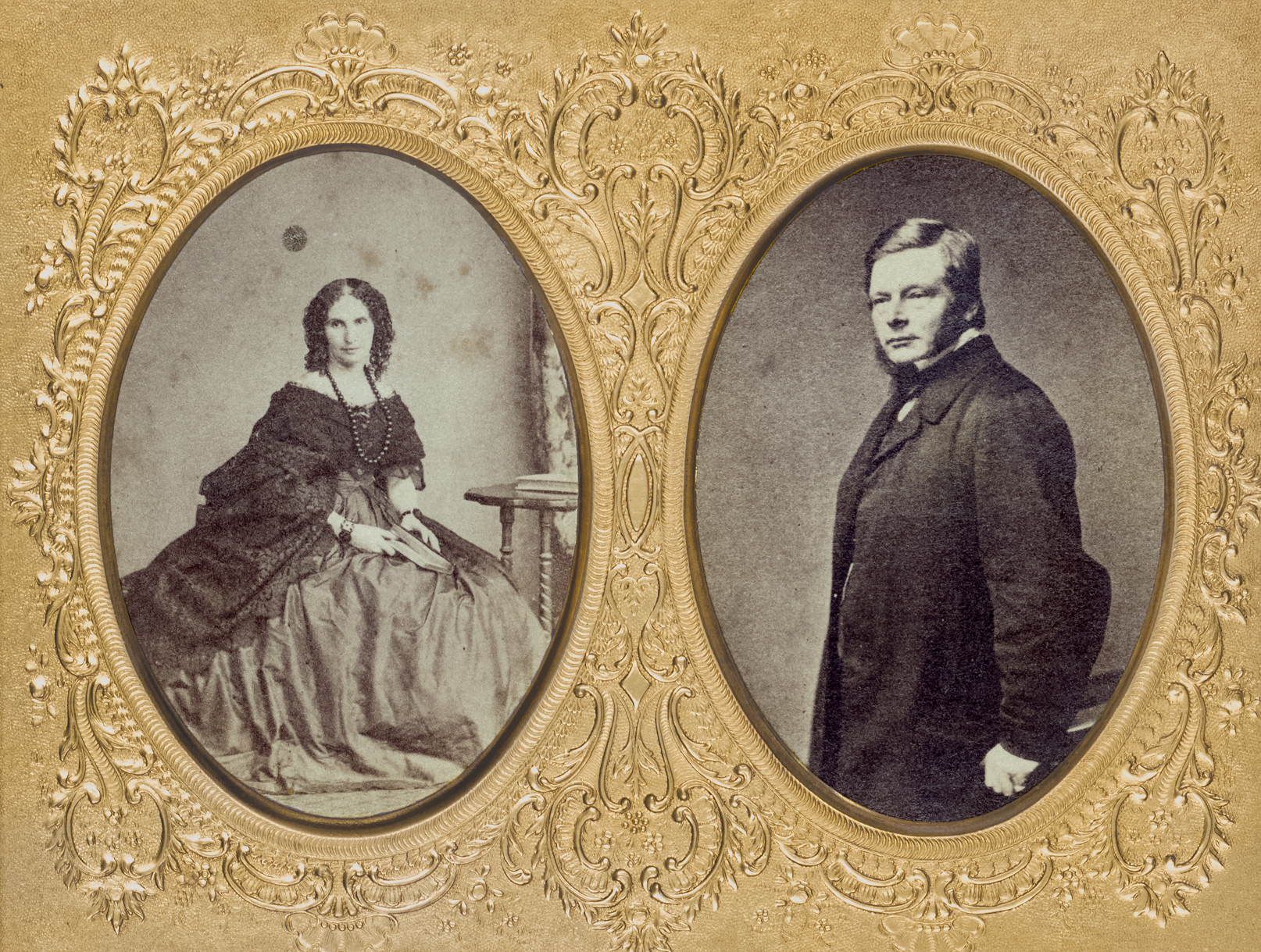
Abraham married Harriet LeBlond in 1842. Contemporary and later family accounts describe her as a relative or cousin. The couple eventually settled at Kingston, Surrey, and had sons who later became involved in the family printing business. Francis LeBlond, the elder son, is known to have helped transfer designs into print, as did Abraham’s younger son Bernard Maynard LeBlond.
Children
- Francis Aubrey LeBlond (1844-1910). Born 1844 in Islington, Middlesex, England. Married Mary Rigg, June 18, 1868, in Norbiton, Surrey, England.
- Bernard Abraham Maynard LeBlond (1845-1922). Born March 31, 1845, in Islington, Middlesex, England. Married Louisa Rosselli 29 Apr 1869 St. Matthew, City Road, England.
- Harriet LeBlond (1847-1891). Born 1847 in Islington, Middlesex, England
- Rose LeBlond (1850-1911). Born 1850 in Walbrook, Middlesex, England. Married Edwin Booth Holloway.
- Flora LeBlond (1852-1906). Born 1852 in Walbrook, Middlesex, England. Married Auguste Clemence.
The decisive change in the fortunes of Le Blond & Co. came in 1849, when George Baxter began granting licenses to use his patented method of printing pictures in oil colors. Le Blond & Co. became the first firm to take a Baxter license. Abraham appears to have taken a particularly active role in mastering the complicated process, and a later family account states that he personally studied Baxter’s methods before setting up the process in the LeBlond workshop.
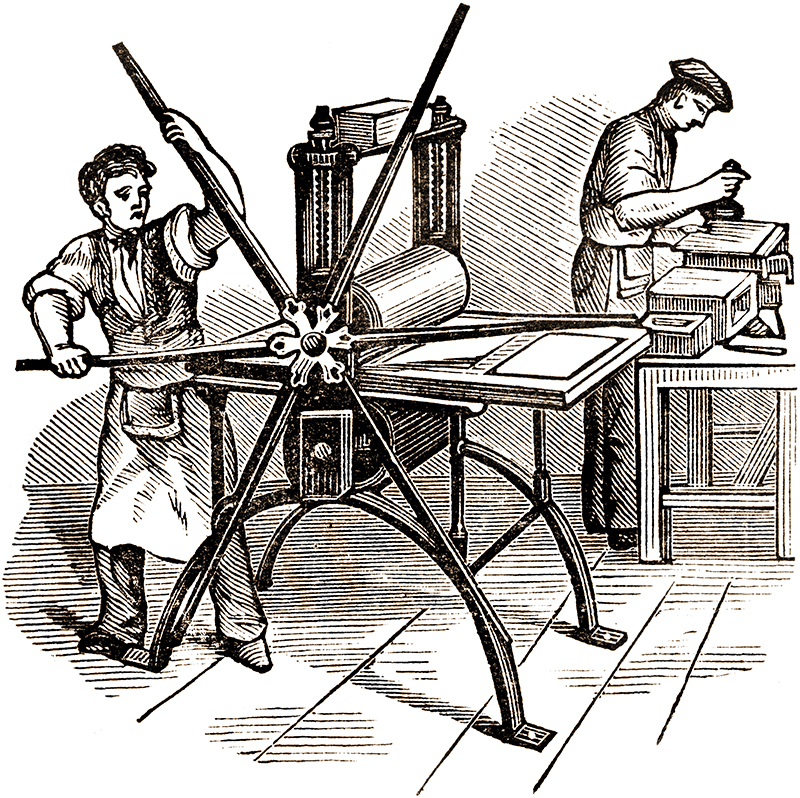
The Baxter process began with an engraved metal key plate, after which numerous wood or metal blocks were used to build up the colors one impression at a time. It was painstaking work requiring careful registration and repeated passes through the press. Abraham and his firm became particularly accomplished practitioners of the method. The British Museum identifies Le Blond & Co. as a Baxter licensee from 1849 until the patent expired in 1854, after which the firm continued producing color prints by the same process.
Le Blond & Co.’s first major Baxter-process print was The Royal Family at Windsor, issued in 1850. The Metropolitan Museum of Art records the print as being made from nine blocks. Over the following years the firm produced more than one hundred original subjects, including royal portraits, landscapes, sentimental scenes, book illustrations, needle-box prints and tiny pictures intended for pocket books and other decorative uses.
Robert Departs for America
Robert LeBlond left the London business in 1856 and emigrated with his family to the United States. From that point Abraham effectively carried Le Blond & Co. on alone. Robert also helped establish an American market for the firm’s products, and later impressions of some LeBlond prints bear the name of L. A. Elliot & Co. of Boston, which distributed the prints in the United States.
The Ovals
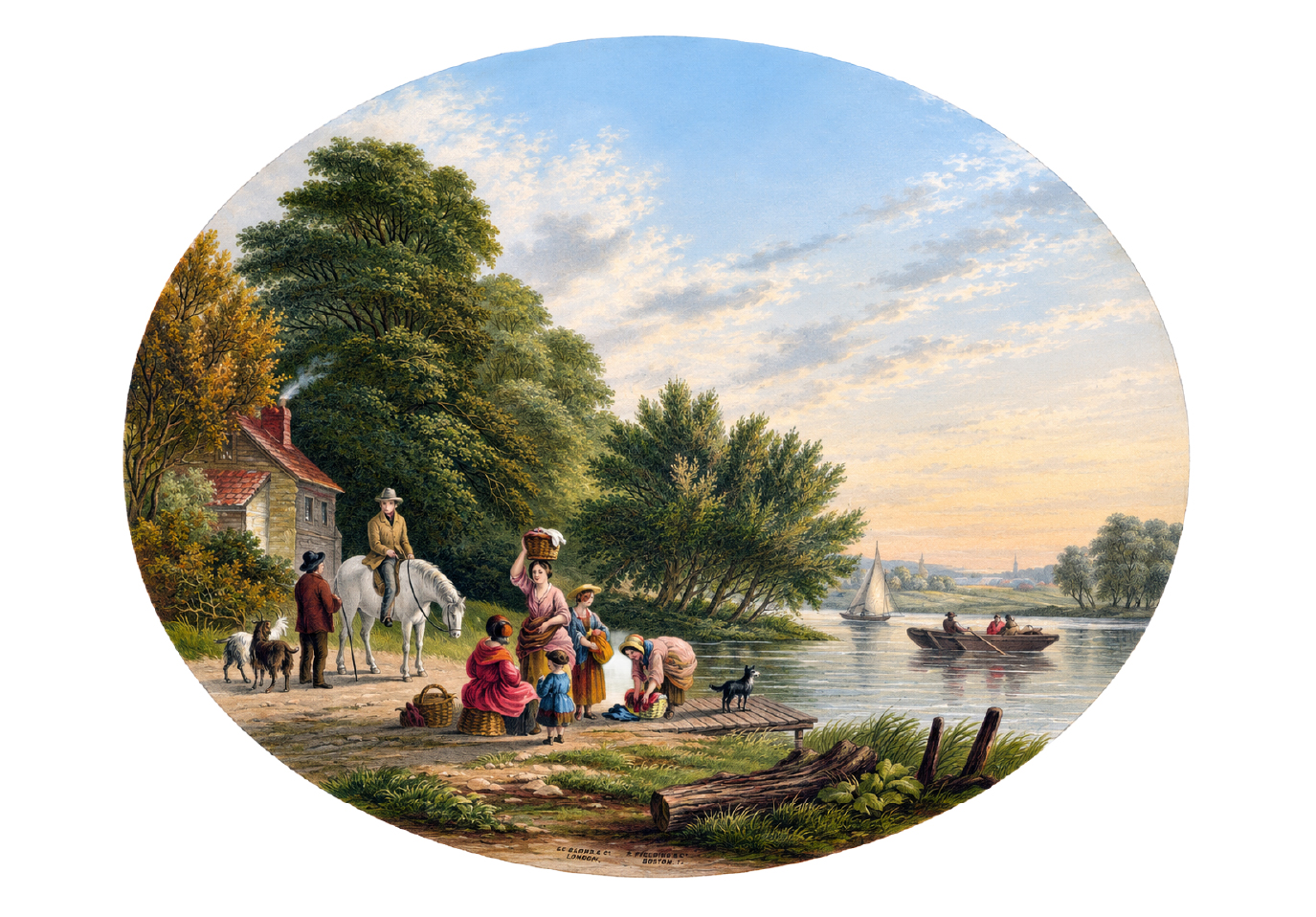
Abraham is best remembered today for the series of 32 LeBlond ovals, produced during the middle decades of the nineteenth century. These small, highly finished scenes depict children, village life, courtship, rural occupations and domestic subjects. Unlike many contemporary prints that were pasted onto separate mounts, the LeBlond ovals were printed directly onto paper that was then embossed to form a decorative oval border, with the title and identifying number below. Later examples often carry both the London LeBlond imprint and the Boston imprint of L. A. Elliot & Co.
Many of the oval compositions appear to have been based on paintings by John Anthony Puller. Research cited by the Fitzwilliam Museum suggests that Le Blond employed artists including George Stone and his own sons Francis and Bernard Maynard LeBlond to translate paintings into designs suitable for the complex printing process.
After George Baxter’s death in 1867, Abraham acquired a large group of Baxter’s original plates and color blocks from Vincent Brooks, Day & Son. In 1868 Le Blond & Co. began reissuing subjects from these original materials. These later impressions are now known as “Le Blond-Baxters.” Many were simplified for commercial reasons by using fewer color blocks than Baxter had employed, although some fully finished examples could approach the quality of the originals.
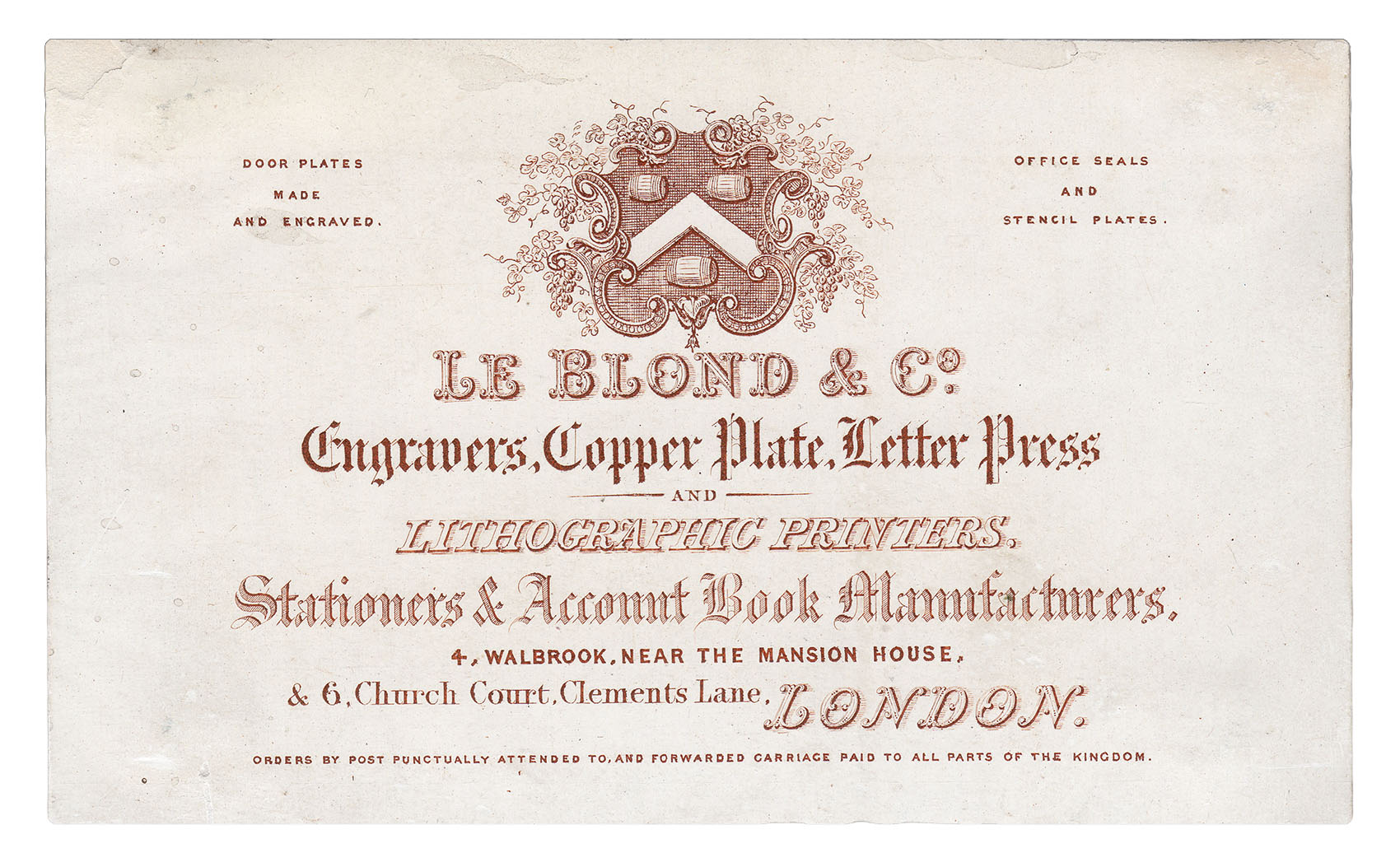
By the later nineteenth century, however, the elaborate Baxter process was being overtaken by cheaper and faster methods such as chromolithography. Le Blond & Co. itself increasingly turned to lithography, but the change was not enough to secure the long-term future of the business. In 1881 the firm moved to Carron House, 14 Upper Thames Street, with works at Kingston, Surrey, where Abraham also lived.
In 1893 Abraham sold the firm’s stock of plates and blocks—including the Baxter material he had acquired—to Frederick Mockler, a collector and bank manager who later used some of the plates for his well-known portfolio of reprints. Financial problems nevertheless continued, and a receiver was appointed to Le Blond & Co. in 1894. The business was eventually acquired by Barclay and Fry.
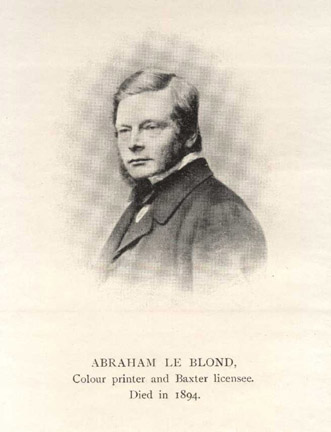
Abraham LeBlond died at Kingston, Surrey, in 1894, aged seventy-five. C. T. Courtney Lewis, writing in The Le Blond Book in 1920, portrayed him as quiet, patient and deeply fond of gardening and nature. Lewis believed those interests could be seen in the rural and domestic subjects that appeared so frequently in the firm’s prints. Whatever allowance must be made for the affectionate tone of that later account, Abraham’s surviving work demonstrates an exceptional command of one of the most technically demanding forms of Victorian color printing.
Today, Le Blond & Co. is remembered particularly for the quality of its Baxter-process work and for the thirty-two ovals that have become the firm’s most recognizable productions. Examples of Abraham LeBlond’s work are held by institutions including the British Museum, Metropolitan Museum of Art, and Fitzwilliam Museum, as well as by private collectors.
C. T. Courtney Lewis on Abraham LeBlond
C. T Courtney Lewis in the LeBlond Book of 1920 describes Abraham thusly:
Abraham Le Blond was born on February 11, 1819; where he learned his trade we do not know, but probably at the same source as his brother Robert. He married in 1842 a lady of the same patronymic as his own. In 1881 the business of Le Blond & Co. was moved to Carron House, 14 Upper Thames Street, London, with works at Kingston, Surrey, in which latter town Abraham Le Blond also lived, and where in 1894 he died, aged seventy-five. Unfortunately, the firm, which at some time was turned into a company (probably about the year 1881, when it moved), borrowed money on debentures, under which, in 1894, a receiver was appointed, who sold off all the assets, the business itself being ultimately purchased, we believe, by Messrs. Fry and Barclay, and then for the first time—since 1842 at least—no Le Blond & Co. appeared in the London directory. Abraham Le Blond had always ardently desired that his two sons should possess the business after him; and when it met with financial disaster it was a great grief to him, and undoubtedly hastened the end not only of his own useful life, but of his wife who predeceased him by only a few months. But his was a kindly, patient, and uncomplaining nature, and he was never known to utter a word of reproach about those who he conceived had done him a great injury, and to some of whom he had shown many kindnesses in days gone by. About the year 1848, when Louis Philippe and his Queen had to fly from France, and, as so many other fallen monarchs have done, came to this country, Abraham Le Blond is said to have saved the life of Her ex-Majesty. All the facts are not within our knowledge, but he certainly received from her a fine bowl and a letter in token of her gratitude. He was a man of a simple mind, and passionately fond of his garden and of all nature, as it is not difficult to perceive from the subjects of most of his prints; but he was a reticent being and difficult to understand, and it is doubtful whether even his wife ever fully did so.
Note
A note on James Christopher Le Blon: Older accounts of the LeBlond printing family claimed descent from James Christopher (Jacob Christoph) Le Blon, the eighteenth-century pioneer of three-color printing. My genealogical research has found no evidence that he belongs to this LeBlond family line, and I do not consider him an ancestor of Robert and Abraham LeBlond.