Cochranville Schools
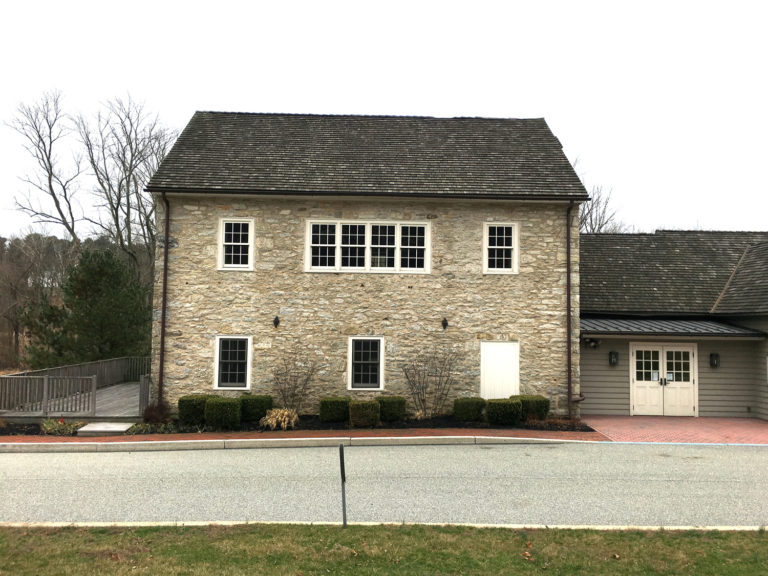
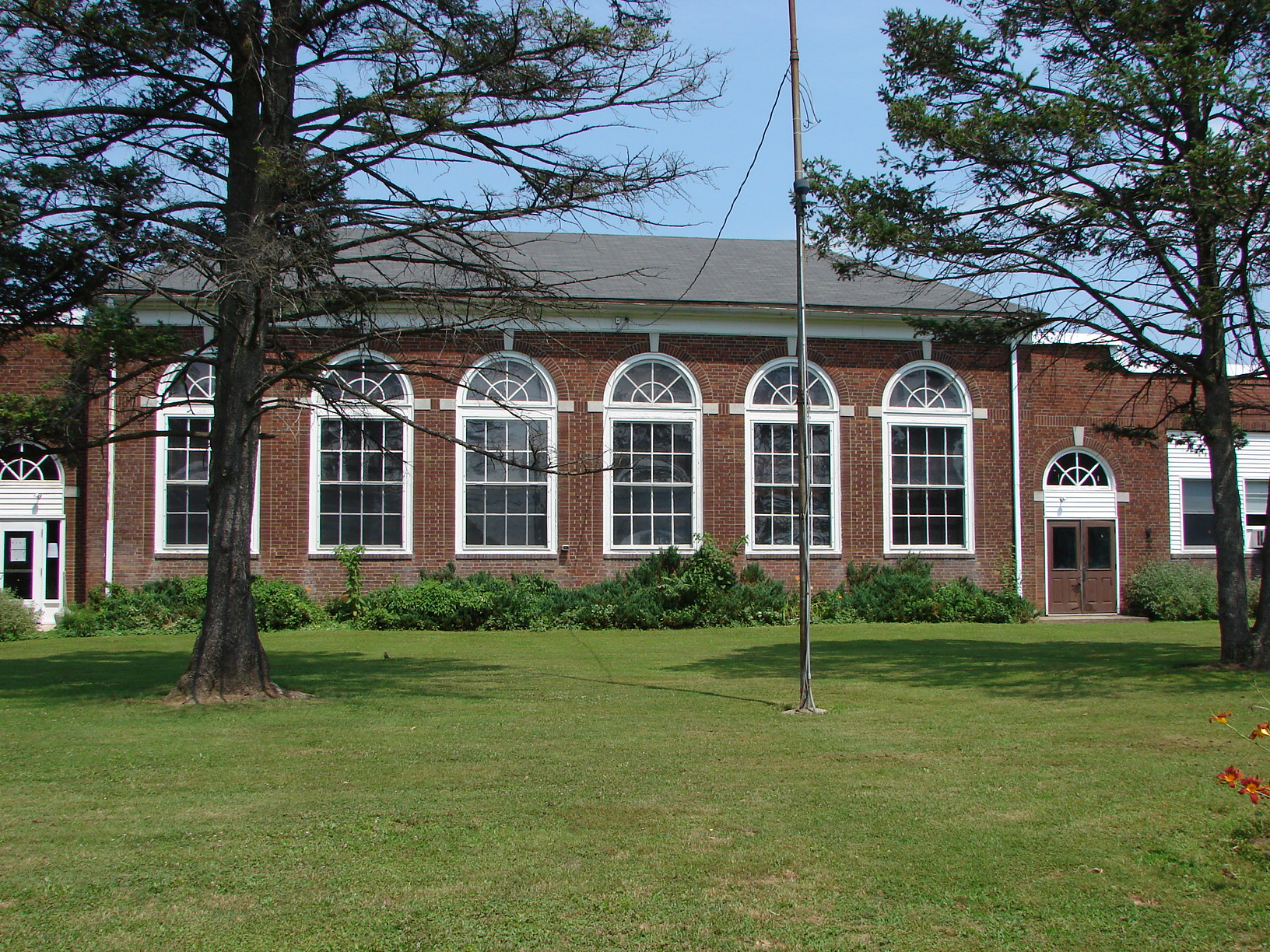
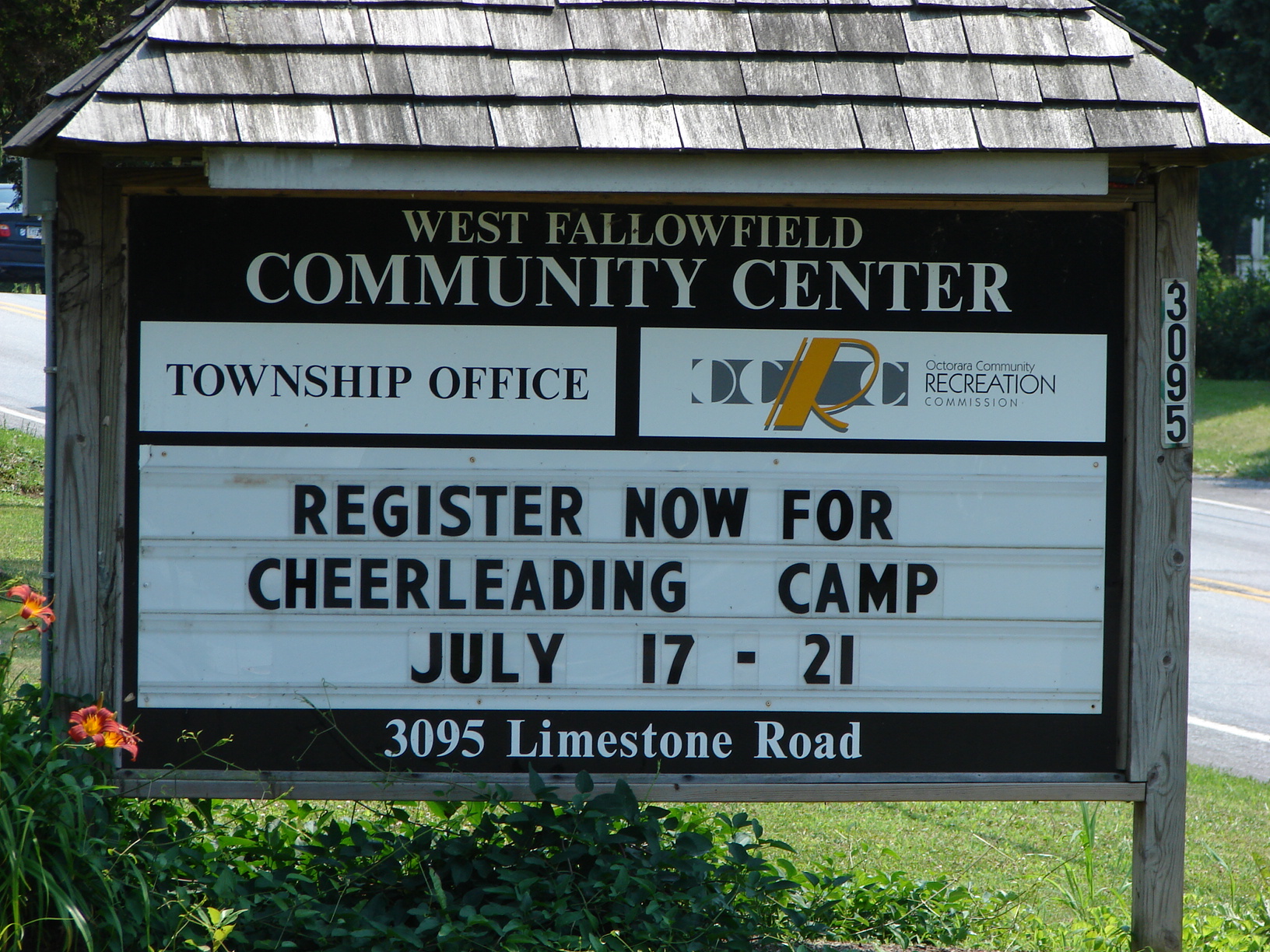
The West Fallowfield Community Center, located at 3095 Limestone Road in Cochranville, Chester County, Pennsylvania, was once the West Fallowfield Elementary School, where I attended third grade in the 1970s. Today, the building serves as a community center and houses the West Fallowfield Township offices. It is one of several schools that have served the Cochranville area over nearly three centuries, beginning with the Faggs Manor Classical School in the eighteenth century.
Early Schooling in Cochranville
The history of education in the Cochranville area dates back to the eighteenth century. About 1741, the Reverend Samuel Blair (1712–1751), pastor of Faggs Manor Presbyterian Church, established a classical school at Faggs Manor, also known as New Londonderry. Blair had settled in the community in 1739 and was installed as pastor in 1740.
The school was modeled on the Log College established by the Reverend William Tennent at Neshaminy, Pennsylvania. It provided advanced classical education, particularly for young men preparing for the Presbyterian ministry. Among its students were several who became prominent ministers, including Samuel Davies, Alexander Cumming, John Rodgers, James Finley, and Hugh Henry. Davies later served as president of the College of New Jersey, now Princeton University.
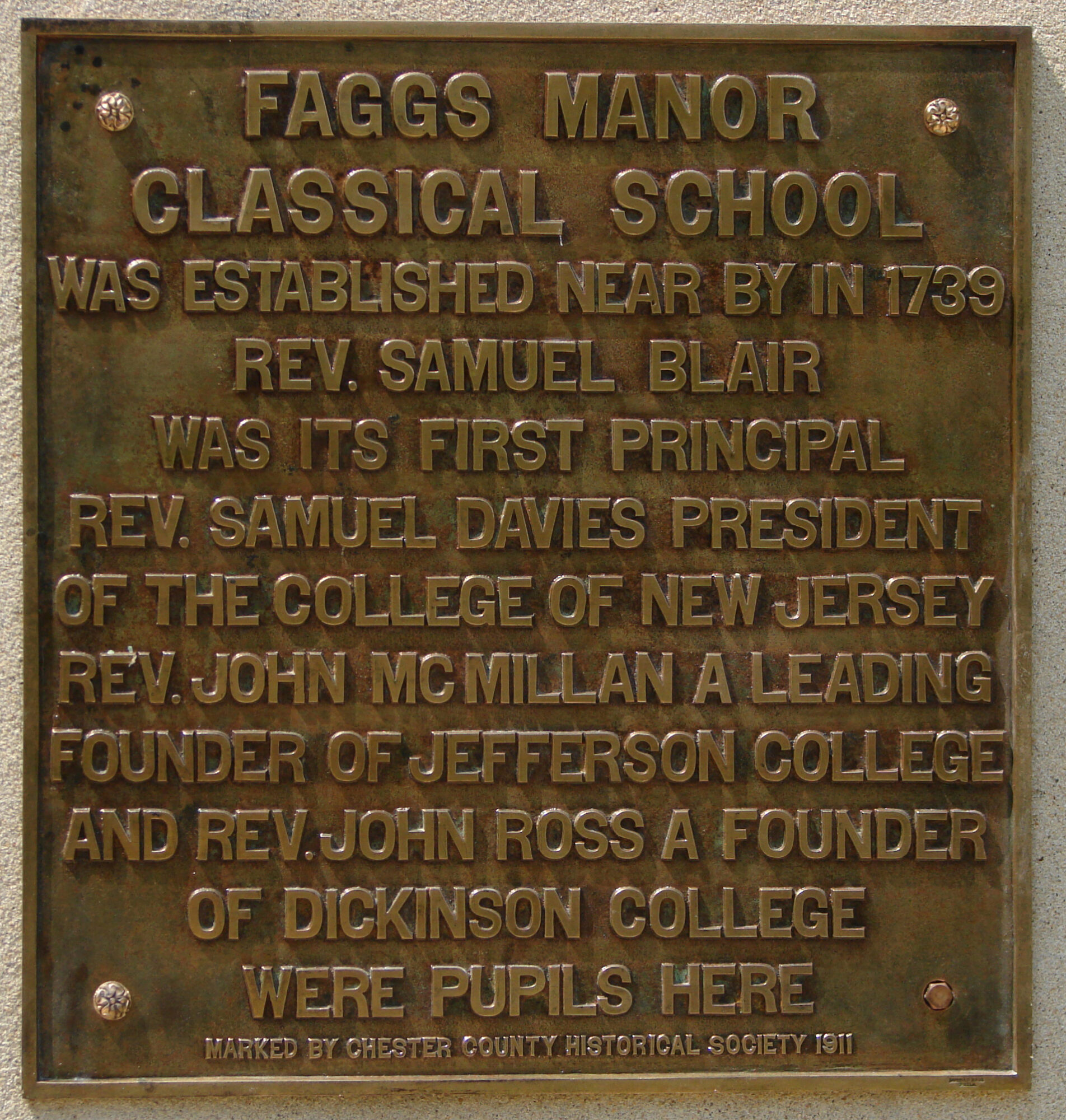
Following Samuel Blair’s death in 1751, his younger brother, the Reverend John Blair, eventually succeeded him as pastor at Faggs Manor in 1757. John also took charge of the school, which continued to prepare students for the ministry. He remained there for approximately nine years before accepting an appointment as professor of theology at the College of New Jersey.
Nearly a century later, in 1848, the Reverend Alfred Hamilton advertised the reopening of Cochranville High School under the new name Blair Hall School. His advertisement explicitly described the institution as a revival of the grammar school founded by Samuel Blair and continued by his brother John. This provides an interesting link between the area’s eighteenth-century educational history and its nineteenth-century schools.
1700s
A Grammar School was established in Cochranville, in or near the Faggs Manor Church, about 1741, by Reverend Samuel Blair, and continued after his death by his brother John Blair until his removal to Princeton in 1768. [Source: 1848-10-17 Blair Hall School, The Village Record, West Chester, PA p2]
From the Manor Presbyterian Church website we learn that
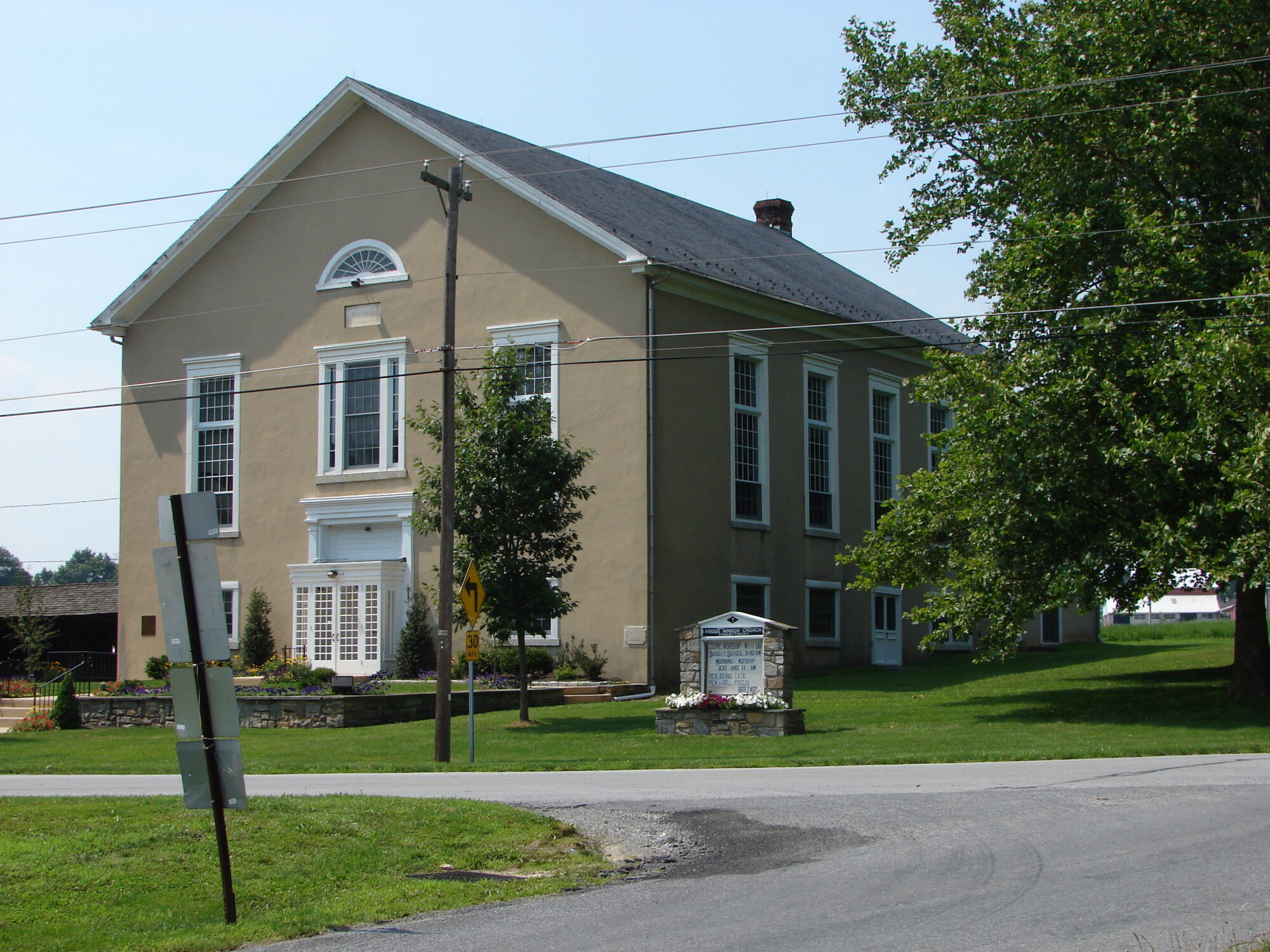
Manor, previously named Faggs Manor after Sir John Fagg(e) and originally called Londonderry Presbyterian Church, was organized in 1730, making it the third Presbyterian Church established before the American Revolution. Originally a log cabin, the building in which the church gathers now, after four buildings and additions, is made of stone covered by stucco.
The land on which this church is built is a small portion of 30,000 acres that William Penn left for his two children. The eastern portion of the acreage was given to his daughter Letitia in 1701, and was named Fagg’s Manor because Sir John Fagge was William Penn’s neighbor in England before he came to Pennsylvania.
Faggs Manor’s first minister, Reverend Samuel Blair, came in 1740 after ten years of prayer for a pastor. It was during his time here that the second meeting house was erected to accommodate the rapidly growing congregation gathering to hear Blair preach.
Ever since Manor’s beginning, God has done great works for His kingdom in and through this church. Rev. Blair graduated from William Tennent’s Log College before coming to Faggs Manor, and later opened the first established school in Chester County, his own log college to train men for the Presbyterian ministry, bringing Presbyterianism to Western Pennsylvania.
A particularly interesting source is Biographical Sketches of the Founder, and Principal Alumni of the Log College, published in the nineteenth century. Its chapter on Reverend John Blair confirms that John succeeded his brother Samuel both as pastor and as teacher of the school.
1800s
In the 1840s, boys were offered schooling at Cochranville High School, which seems to have been less of a place and more of an organization run by a group of local men.
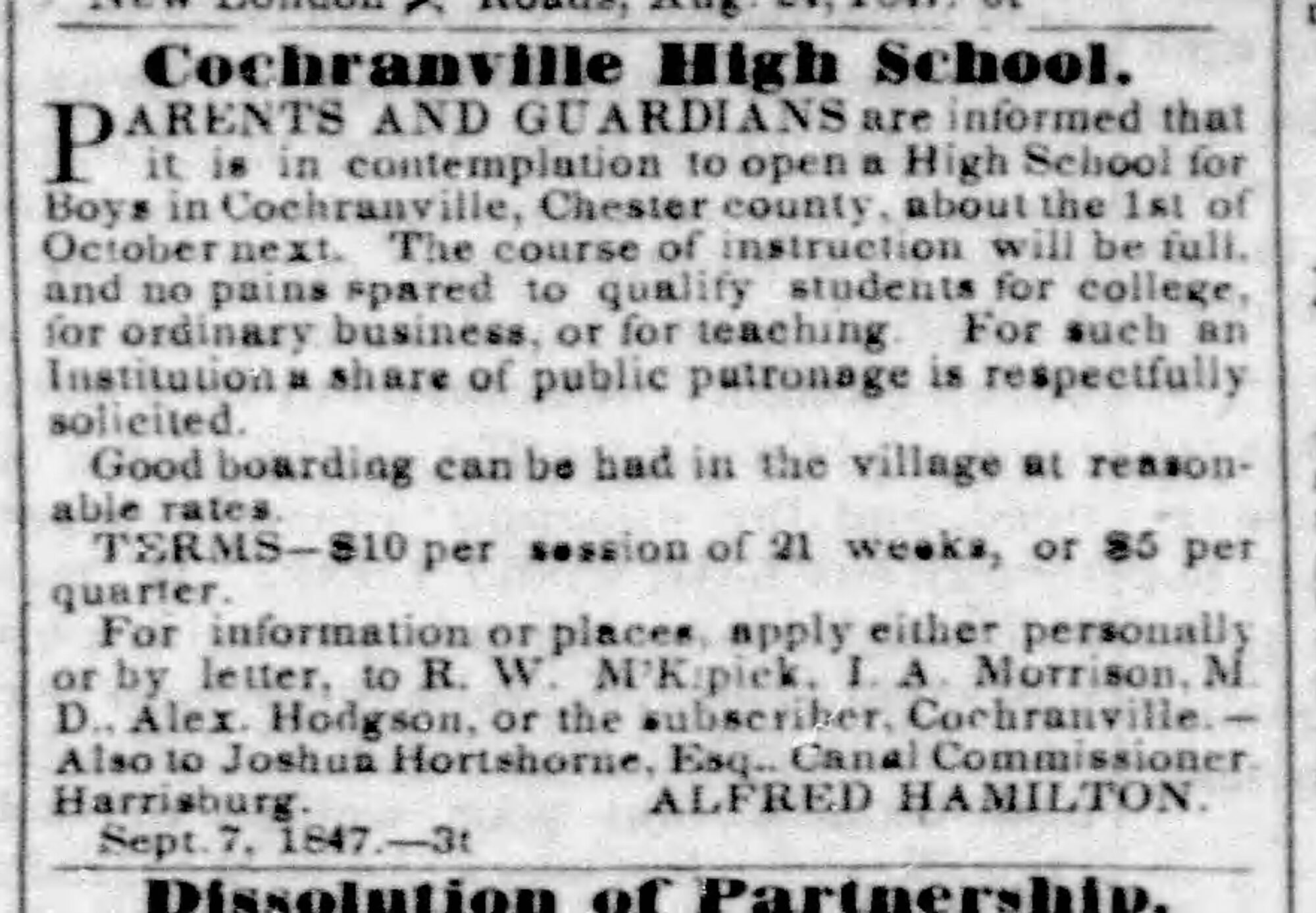
This notice appears three times in the local paper, on Tuesday, September 7, 14, and 21. It reads:
Cochranville High School
PARENTS AND GUARDIANS are informed that it is in contemplation to open a High School for Boys in Cochranville, Chester county, about the 1st of October next. The course of instruction will be full, and no pains spared to qualify students for college, for ordinary business, or for teaching. For such an Institution a share of public patronage is respectfully solicited.Good boarding can be had in the village at reasonable rates.
TERMS—$10 per session of 21 weeks, or $5 per quarter.
For information or places, apply either personally or by letter, to R. W. M’Kipick, I. A. Morrison, M. D., Alex. Hodgson, or the subscriber, Cochranville.—Also to Joshua Hortshorne, Esq., Canal Commissioner, Harrisburg.
ALFRED HAMILTON.
Sept. 7, 1847.—3t
The following year, 1848, this notice appeared twice in The Village Record, on Tuesday, October 3rd and 17th. The 17th is a clearer version so that’s presented here. The high school was help at the residence of Alfred Hamilton near Faggs Manor Church.
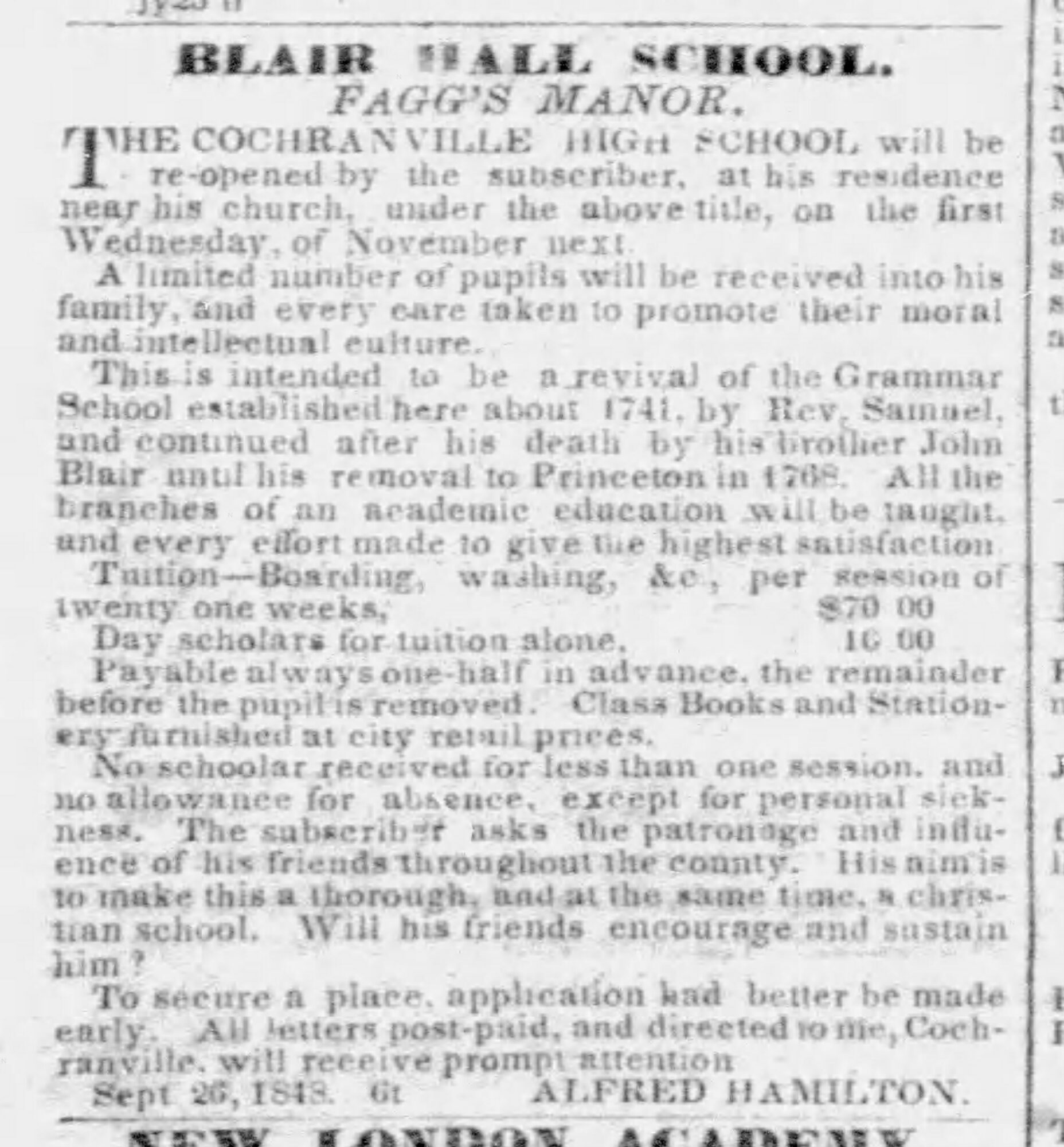
BLAIR HALL SCHOOL.
FAGG’S MANOR.
THE COCHRANVILLE HIGH SCHOOL will be re-opened by the subscriber, at his residence near his church, under the above title, on the first Wednesday of November next.
A limited number of pupils will be received into his family, and every care taken to promote their moral and intellectual culture.
This is intended to be a revival of the Grammar School established here about 1741, by Rev. Samuel, and continued after his death by his brother John Blair until his removal to Princeton in 1768. All the branches of an academic education will be taught, and every effort made to give the highest satisfaction.
Tuition—Boarding, washing, &c., per session of twenty-one weeks, $70 00
Day scholars for tuition alone, 10 00
Payable always one-half in advance, the remainder before the pupil is removed. Class Books and Stationery furnished at city retail prices.
No scholar received for less than one session, and no allowance for absence, except for personal sickness. The subscriber asks the patronage and influence of his friends throughout the county. His aim is to make this a thorough, and at the same time, a christian school. Will his friends encourage and sustain him?
To secure a place, application had better be made early. All letters post-paid, and directed to me, Cochranville, will receive prompt attention.
Sept. 26, 1848. 6t
ALFRED HAMILTON.
The Cochranville High School
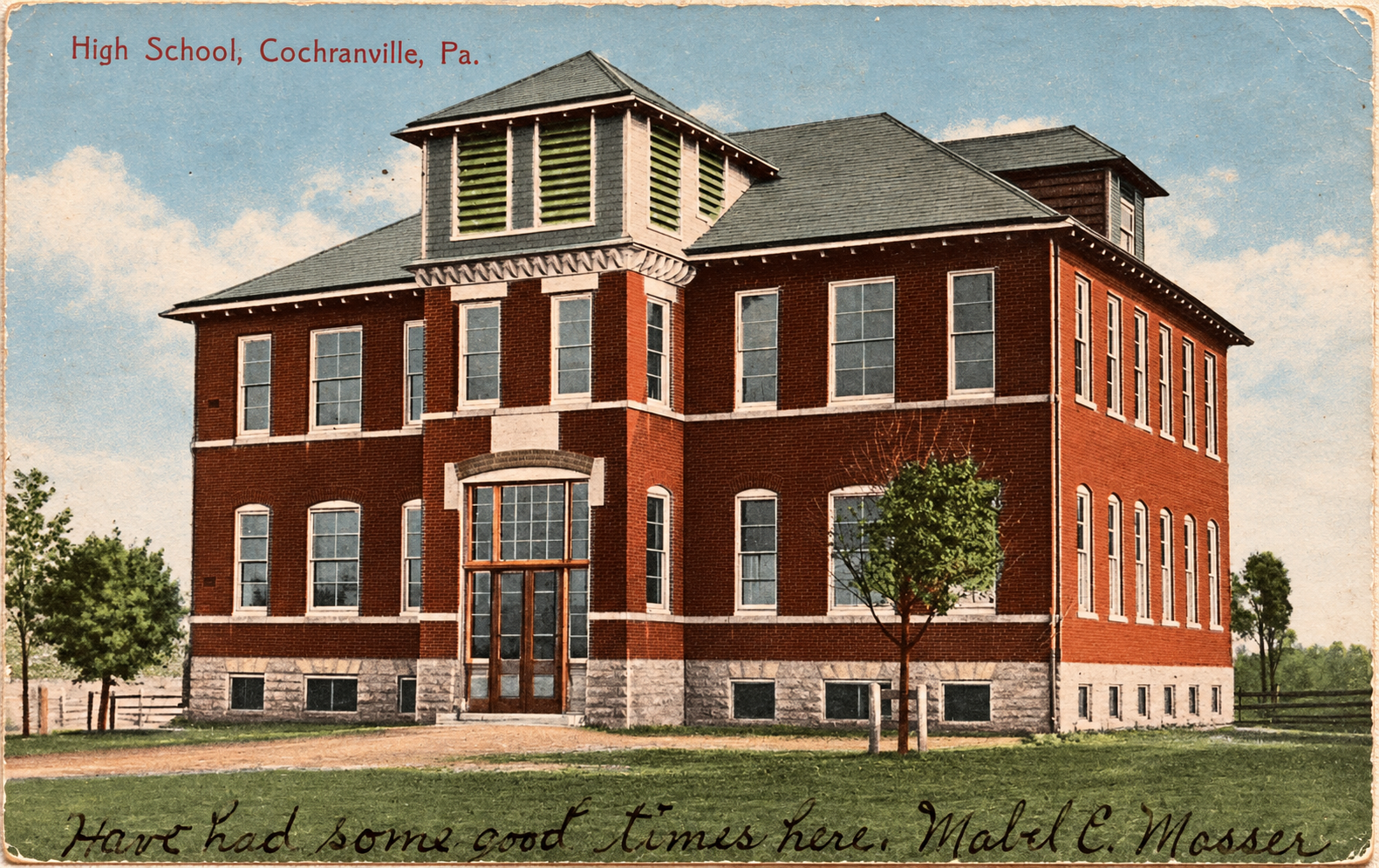
An actual Cochranville High School was built some time before 1901 as newspaper references to it start at that time. Both girls and boys were permitted to attend. The name appeared in at least one publication as West Fallowfield Township High School. [Source: Accredited Secondary Schools in the United States, Bureau of Education, 1928.]
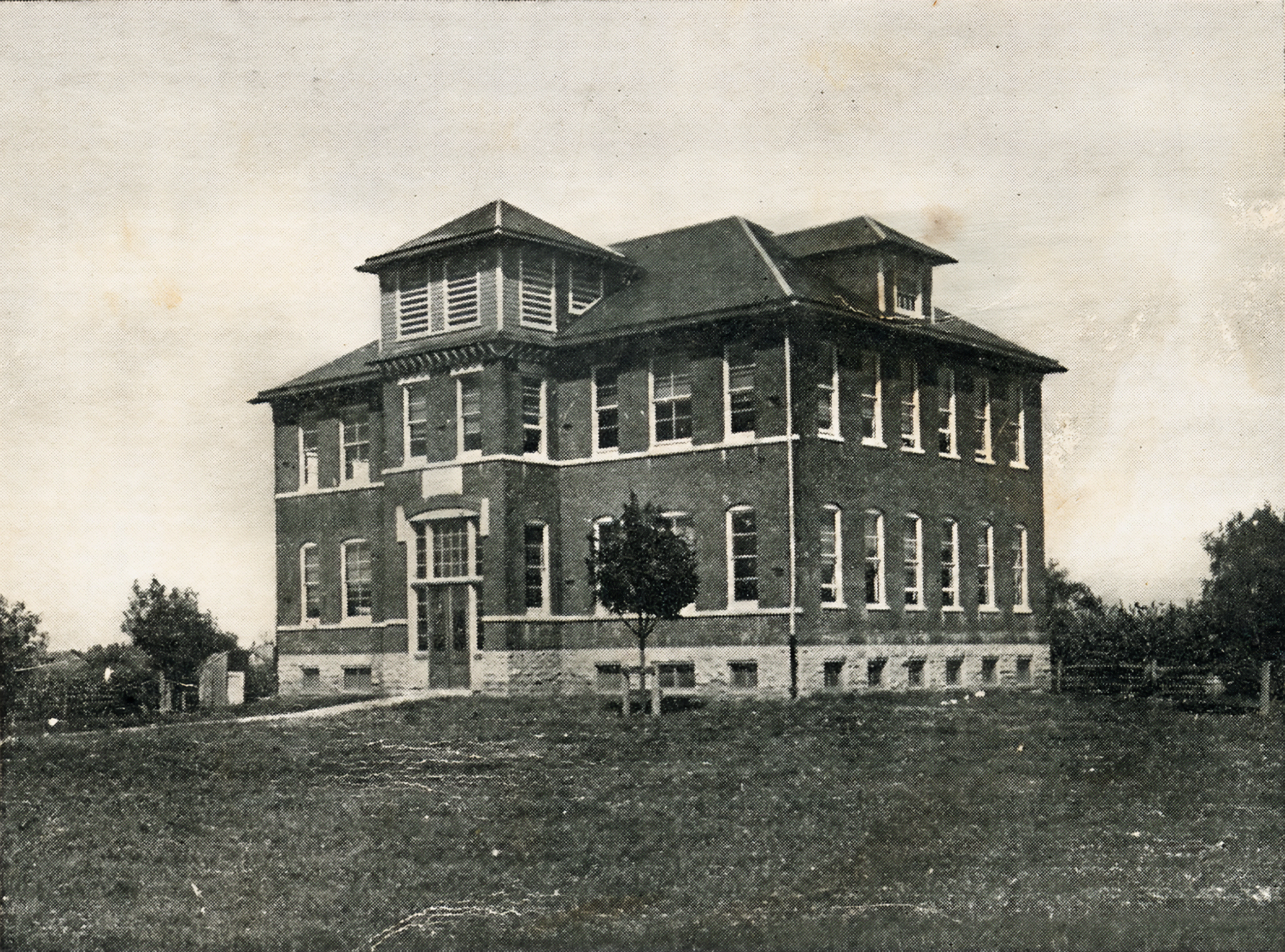
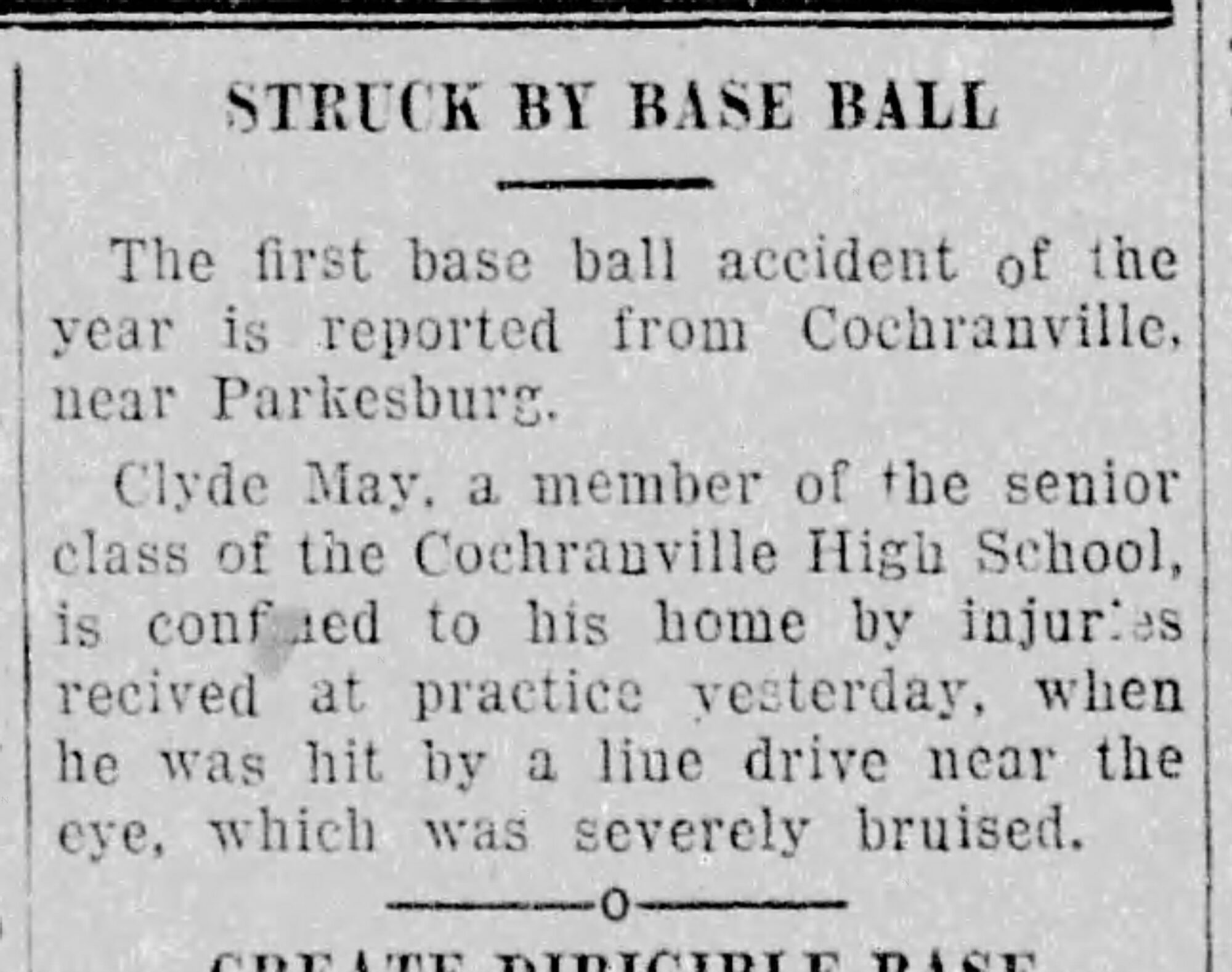
There was a girls basketball team and a boys baseball team. In 1931, Clyde May, a senior at Cochranville High School, was struck by a baseball in a line drive to the eye.
1923
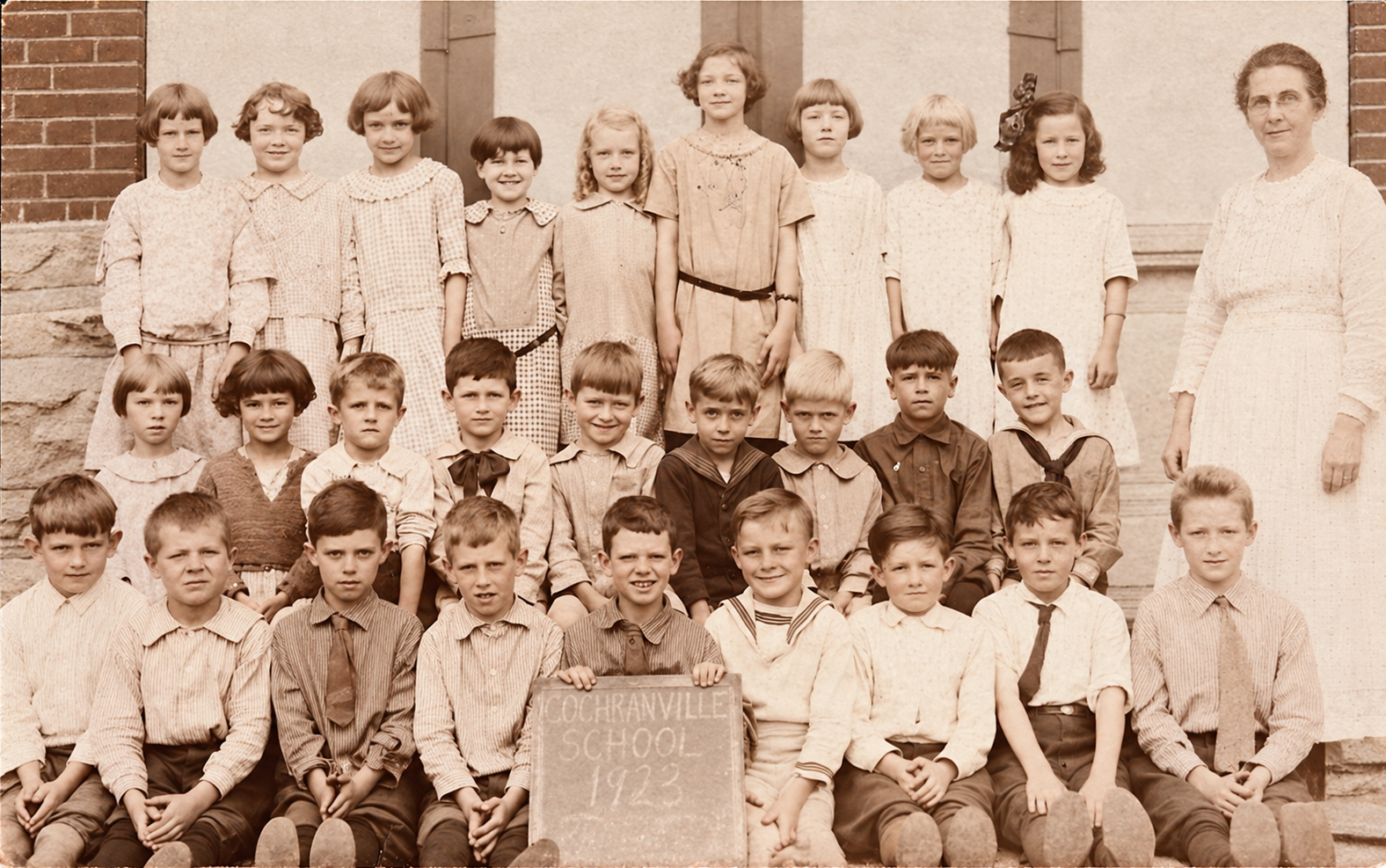
Please leave a comment if you recognize any of these children.
1952
In 1952, 78 free chest x-rays were taken at the high school in by the Chester County Tuberculosis and Heath Society in a cooperative case-finding survey. [Source: The Archive, Downingtown, PA, Thursday, May 22, 1952 ·Page 1, newspapers.com]
The last reference to Cochranville High School I’ve found is dated Thursday, July 9, 1953, in the Brandywine Archive, Page 9, a reference to the summer meeting of the Pomona Grange schedule for July 11th. The new Octorara Consolidated School District was formed in 1953 and completed in 1956, after which time students from Cochranville and other surrounding small towns attended the new high school. I assume this school was torn down in the years following. A new, one-story building was built next to it. The old building stood where the parking lot and pavilion are now.
West Fallowfield Elementary School
I don’t have a date for the construction of this school but it was presumably in the 1950s.
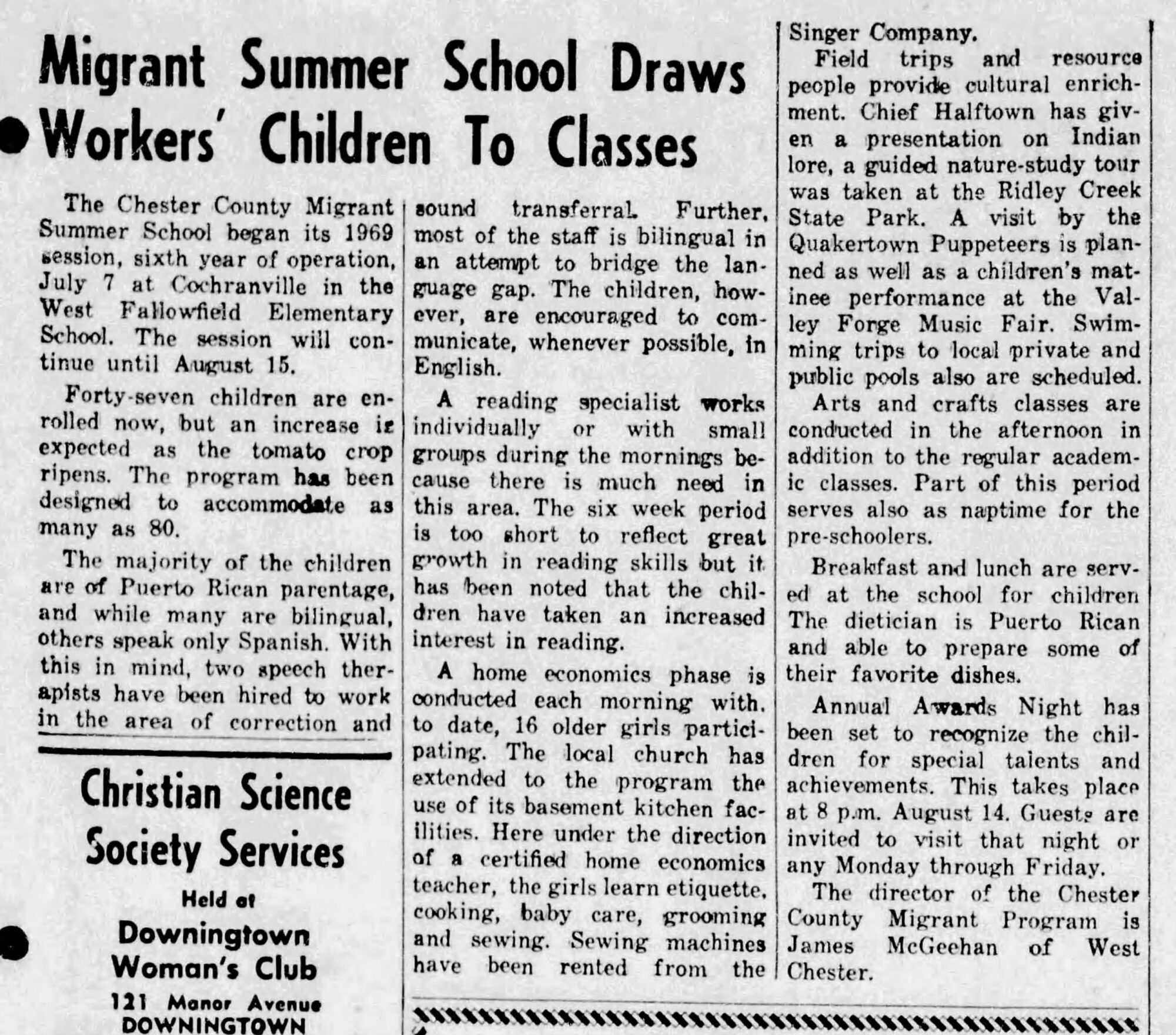
In the 1960s, the school hosted a summer school for ESL students.
The last class went through here about 1974 or so. Now students go to the consolidated Octorara Area School in Atglen, PA, established in 1956.
From the Octorara District website we learn that “the name “Octorara Area Schools” was officially selected at the May 4, 1953 meeting of the Board. “Octorara” is a name that is Native American in origin and it is given to the two major streams that drain the area. Legend reports that the name refers to either “flowing waters” or to “the sun”. The unique design of the proscenium arch above the high school stage is attributed to the architect’s interpretation of the rising sun. Octorara is a semi-rural community whose boundaries encompass parts of southwestern Chester County and southeastern Lancaster County. Within the school district can be found some of the richest agricultural land in the United States.”
The building is now the West Fallowfield Community Center and the Township Office.
Sources
- Archibald Alexander, Biographical Sketches of the Founder, and Principal Alumni of the Log College (Princeton, N.J.: J. T. Robinson, 1845), Chapters XIV, “The Rev. Samuel Blair,” and XV, “The Rev. John Blair.” Read online.
- The Village Record (West Chester, Pennsylvania), October 17, 1848, p. 2, “Blair Hall School.”
- Octorara District website
- Manor Presbyterian Church website
- Presbyterian Historical Society, Cochranville, Faggs Manor Presbyterian Church