A Brief History of Greenville By Roy C. Beaver
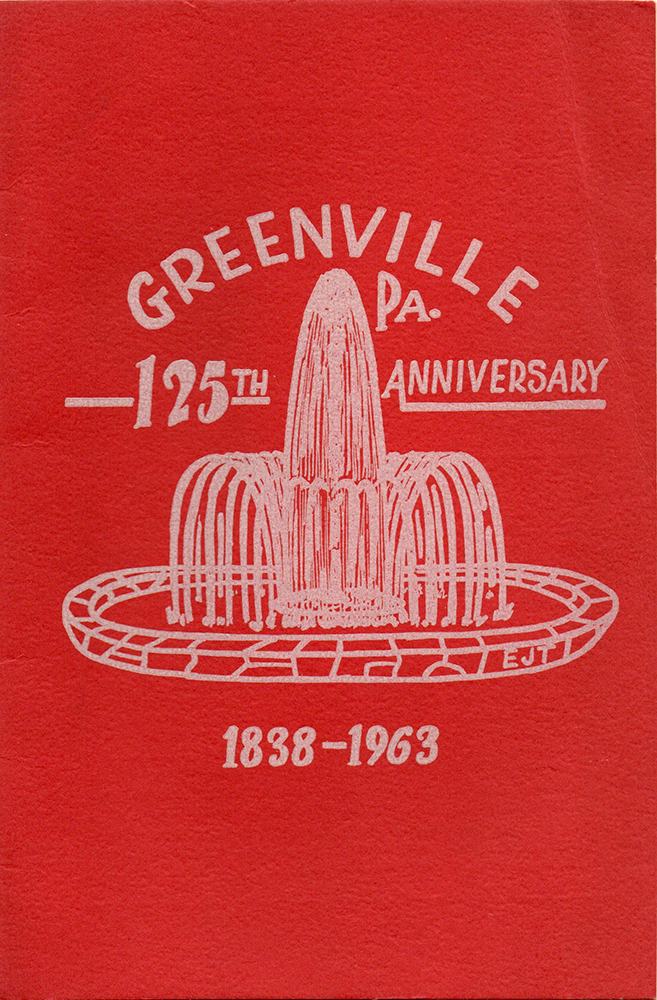
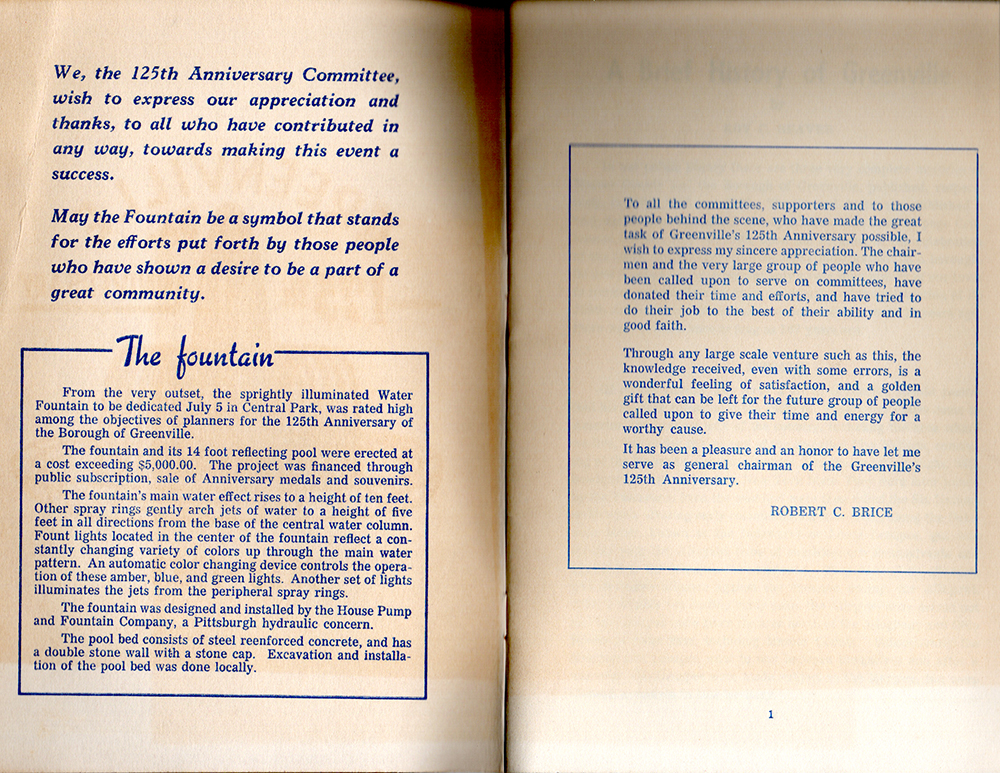
In my files is a booklet from 1963 titled “Greenville, Pennsylvania, 125th Anniversary”. Most of the booklet is comprised of a history of Greenville written by Roy C. Beaver. I’ve transcribed his essay here and provided scans of the booklet.
The Booklet
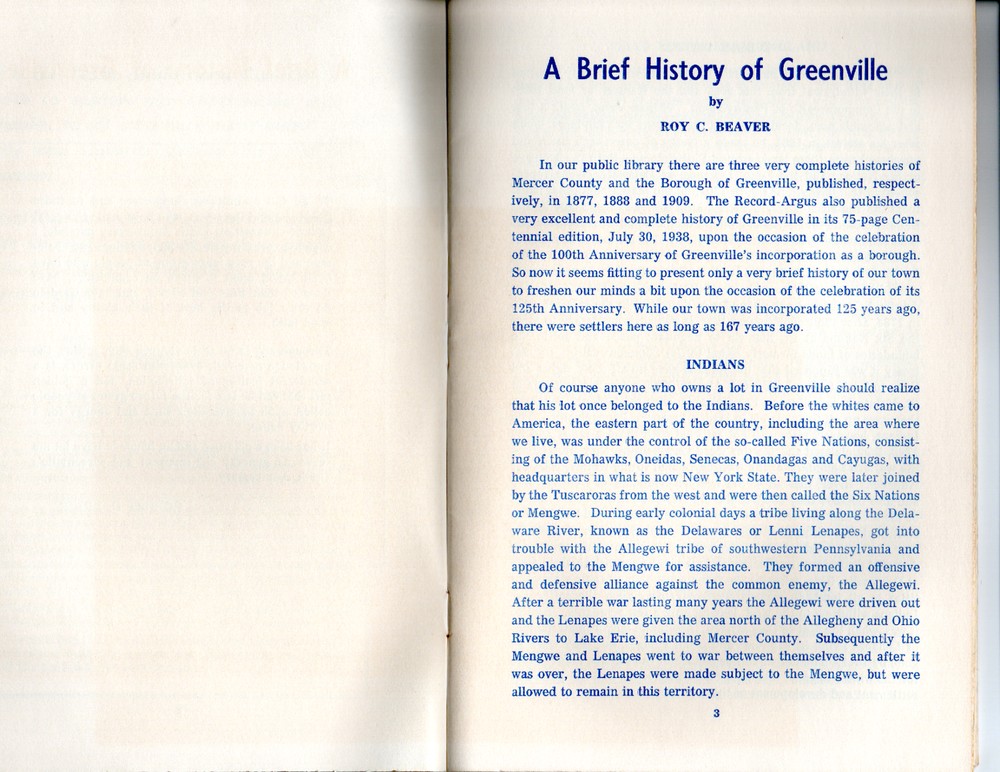
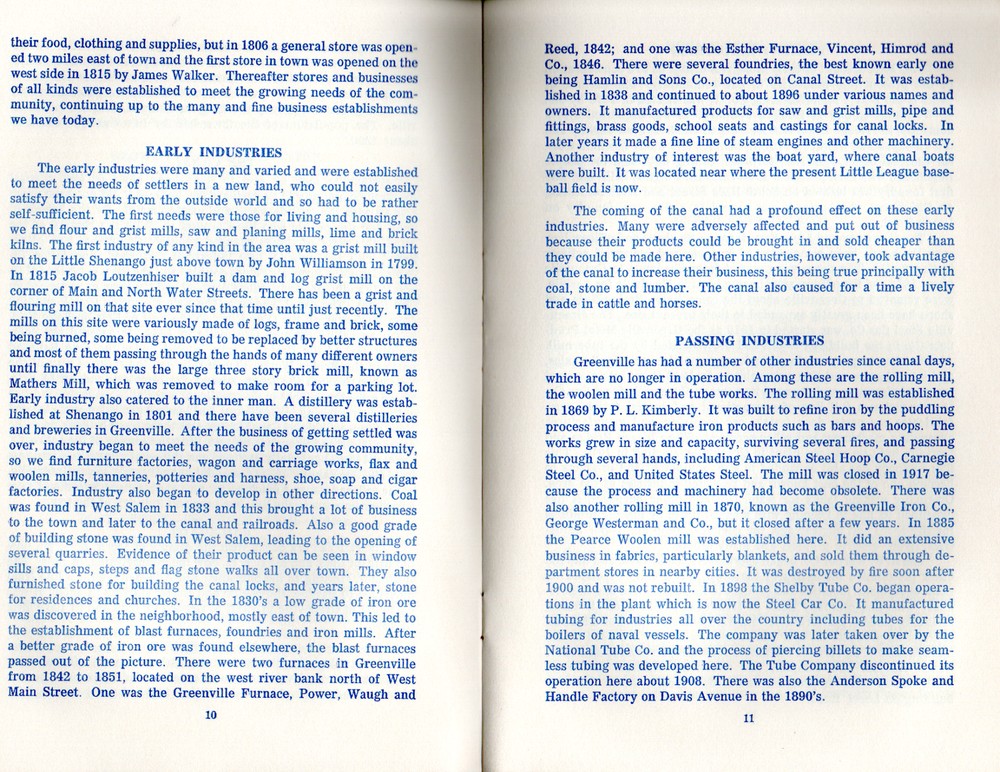
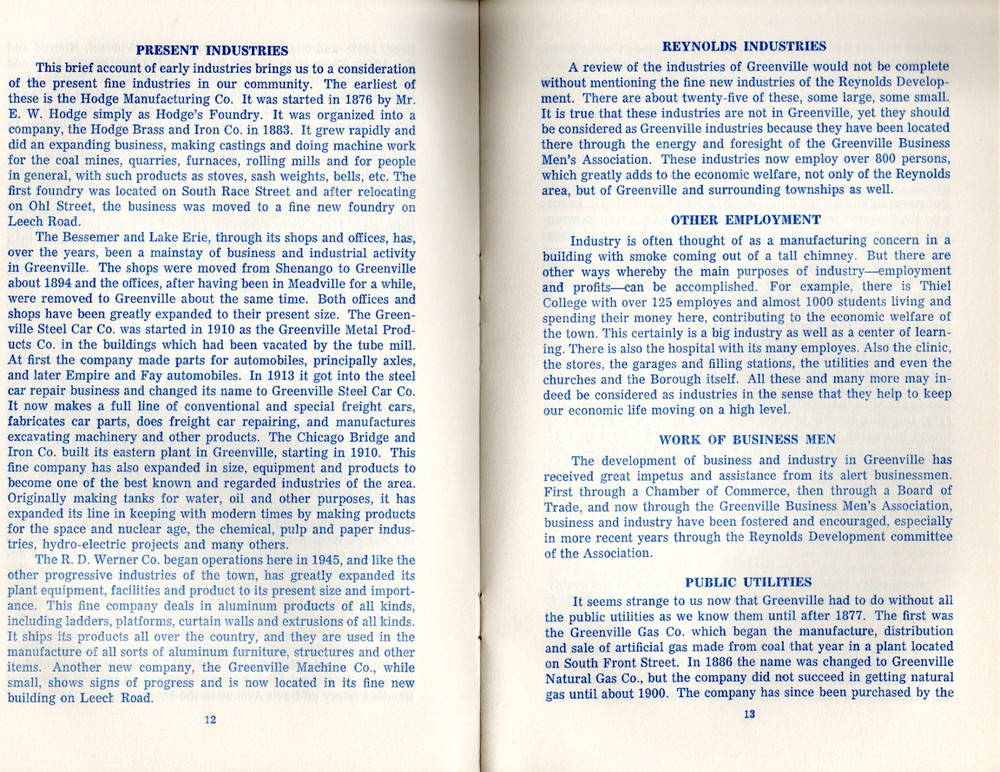
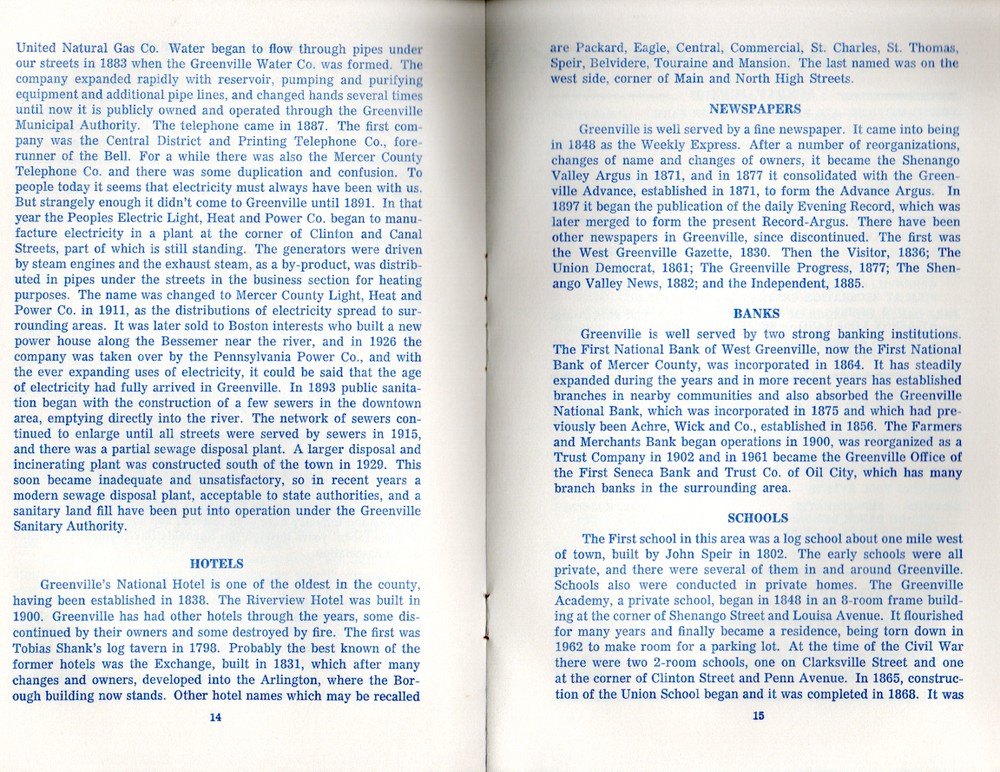
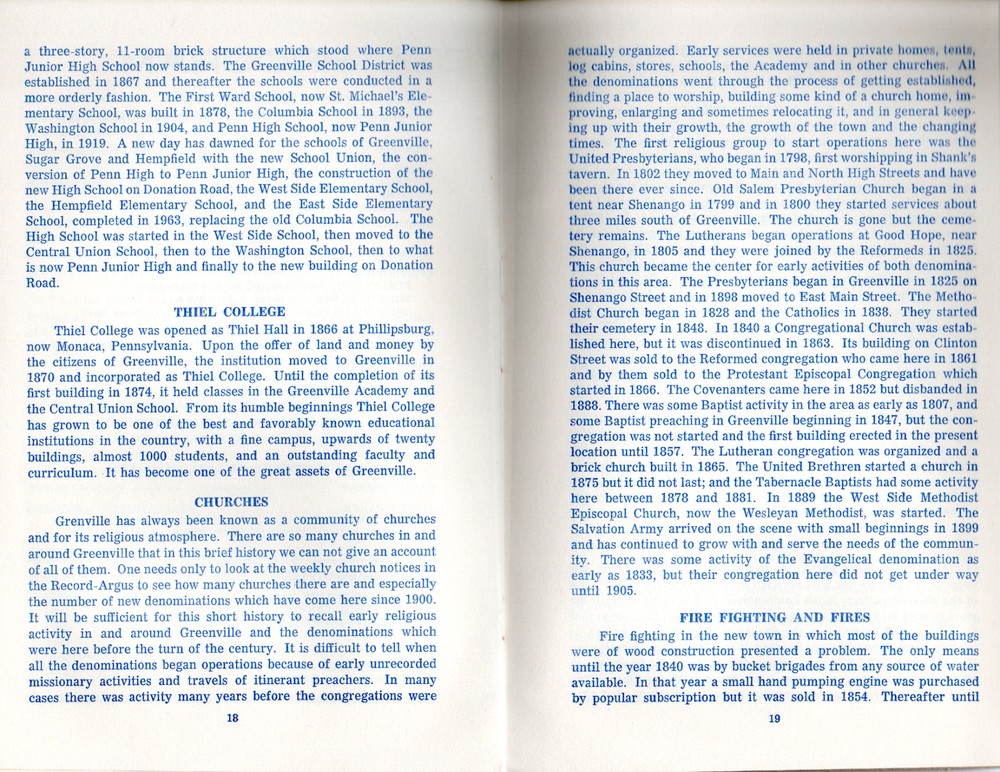
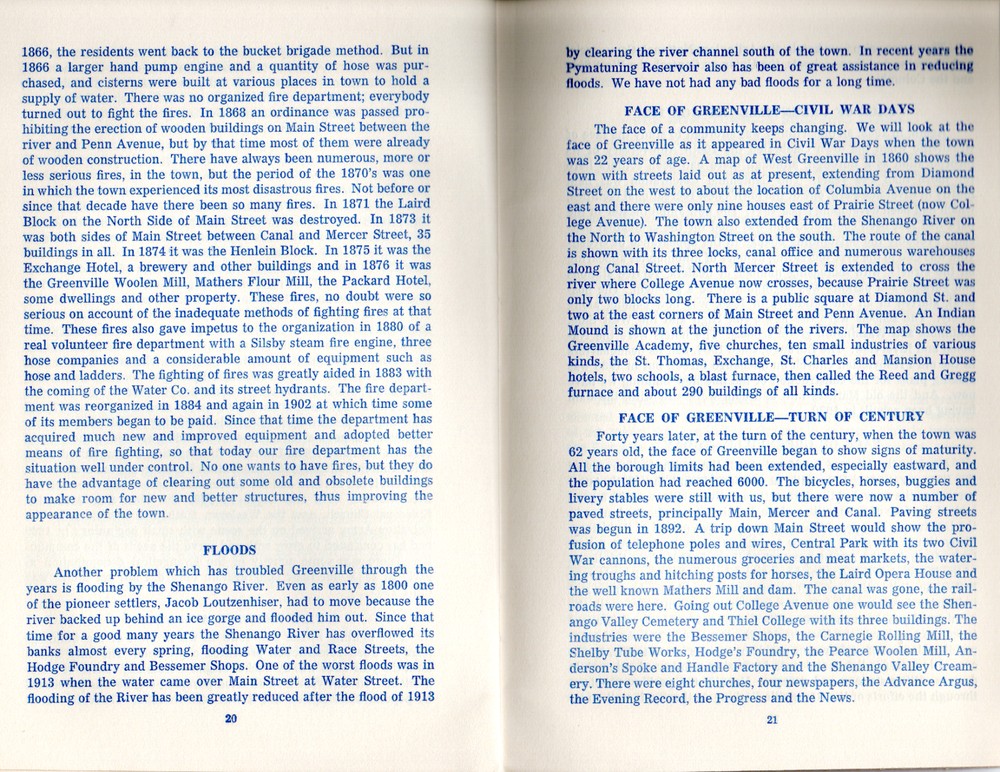
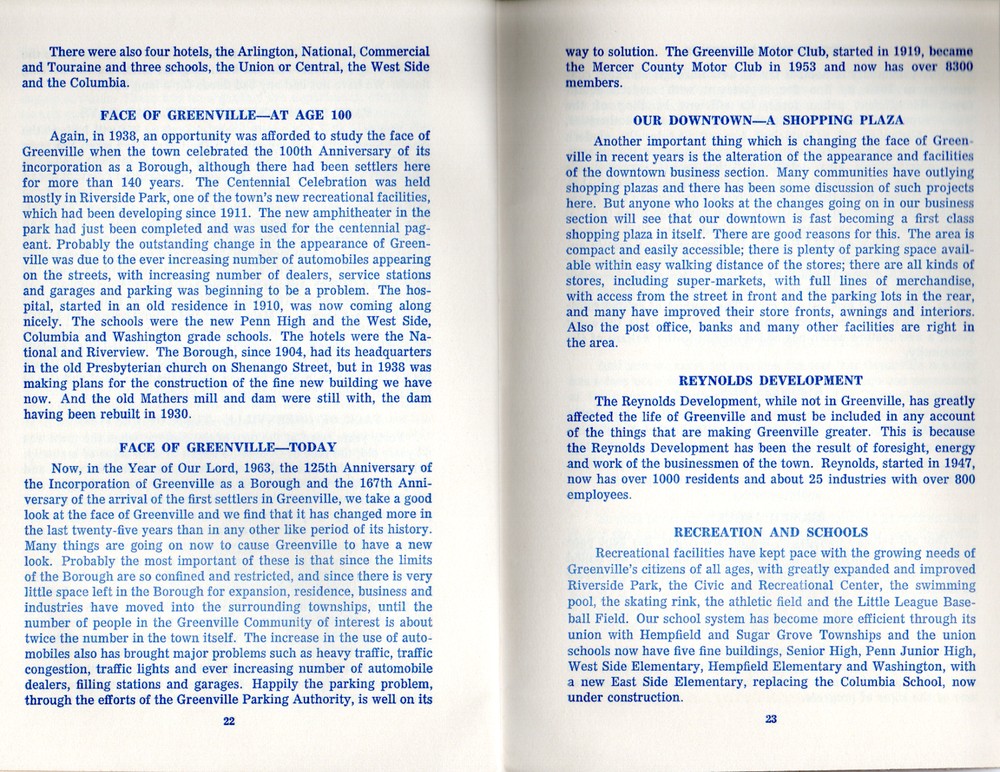
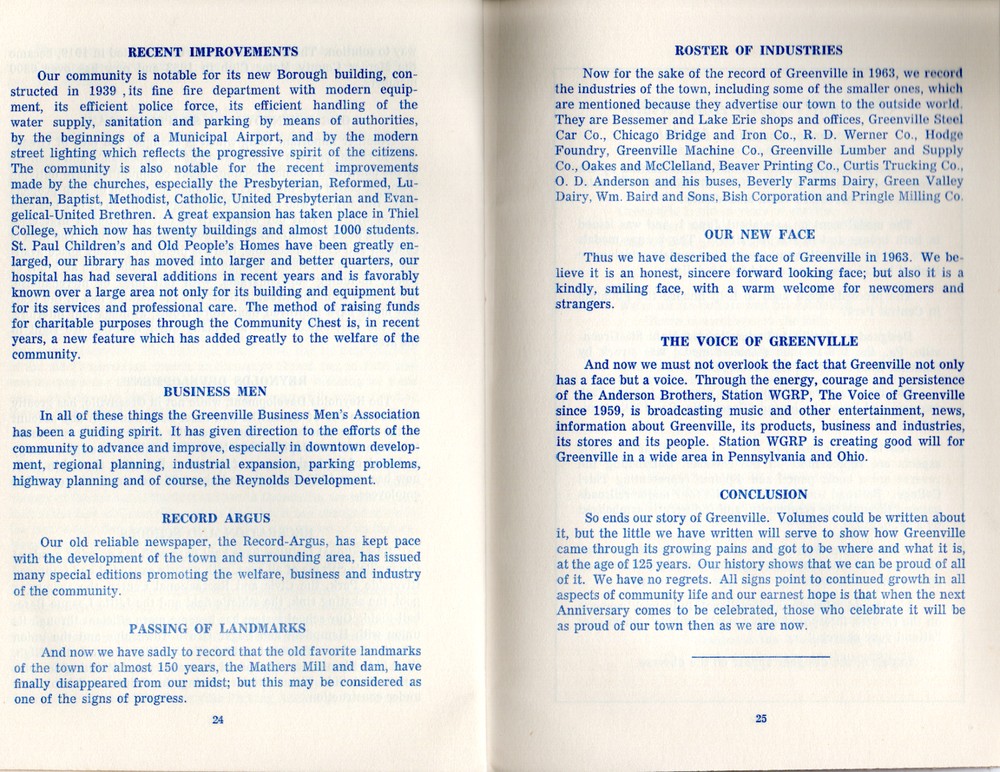
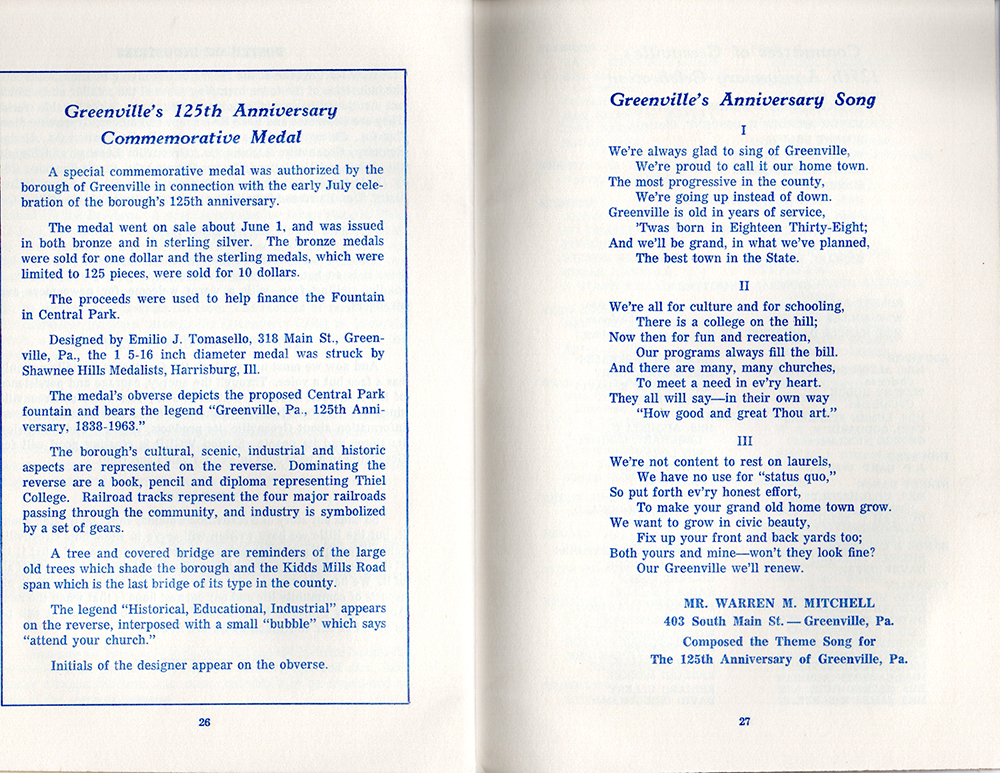
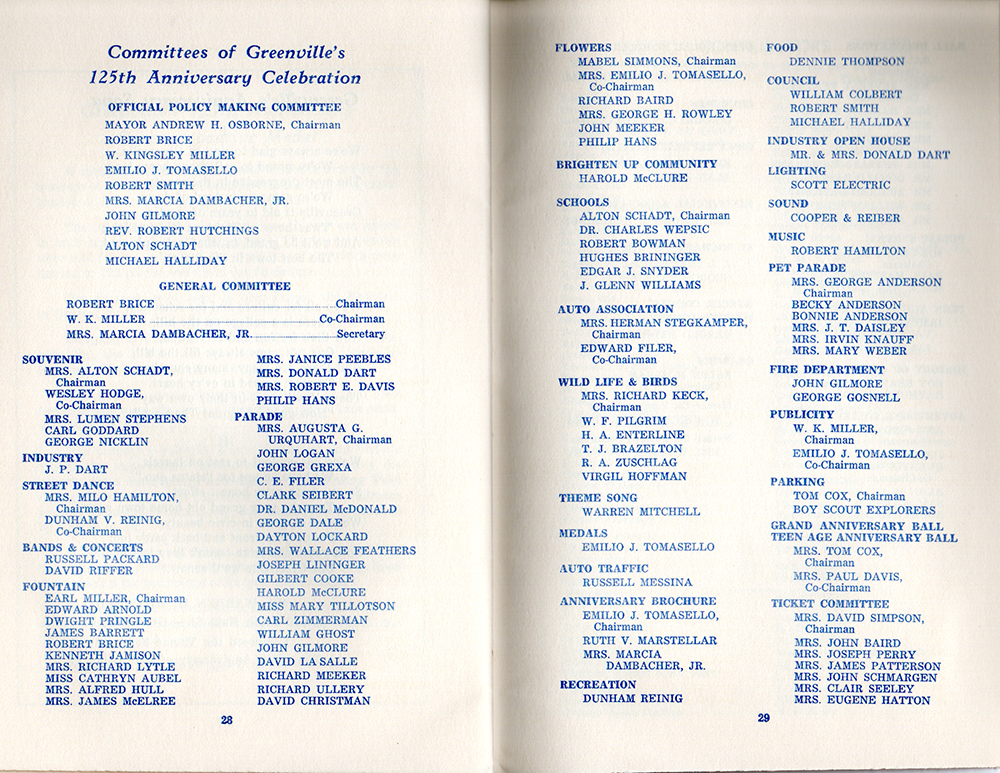
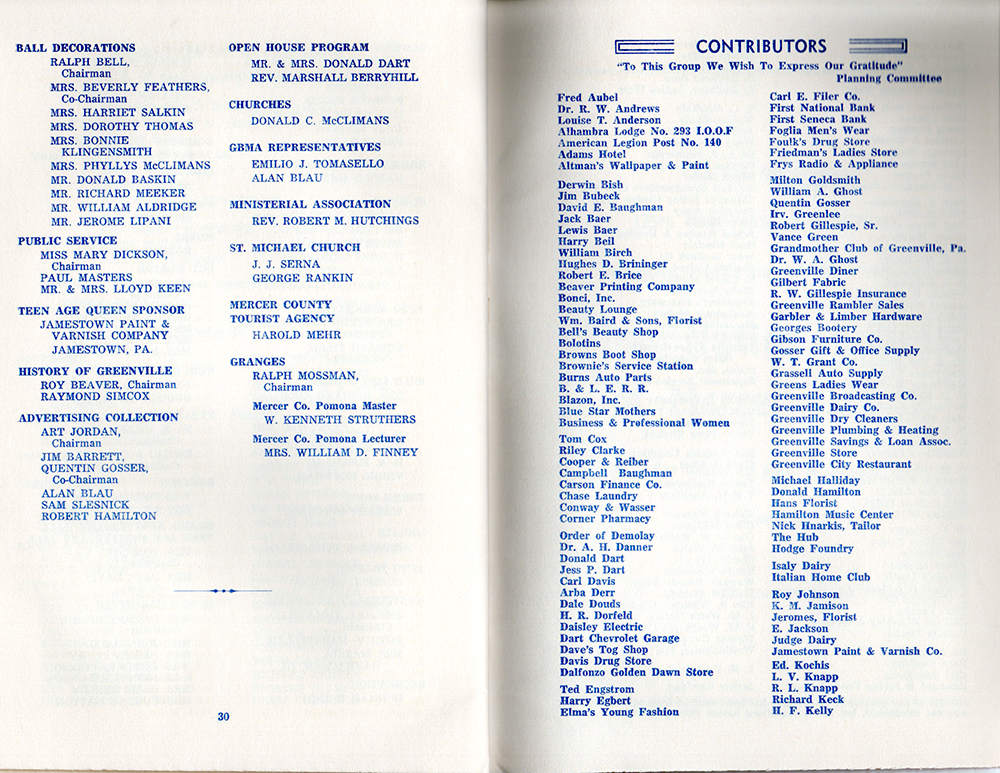
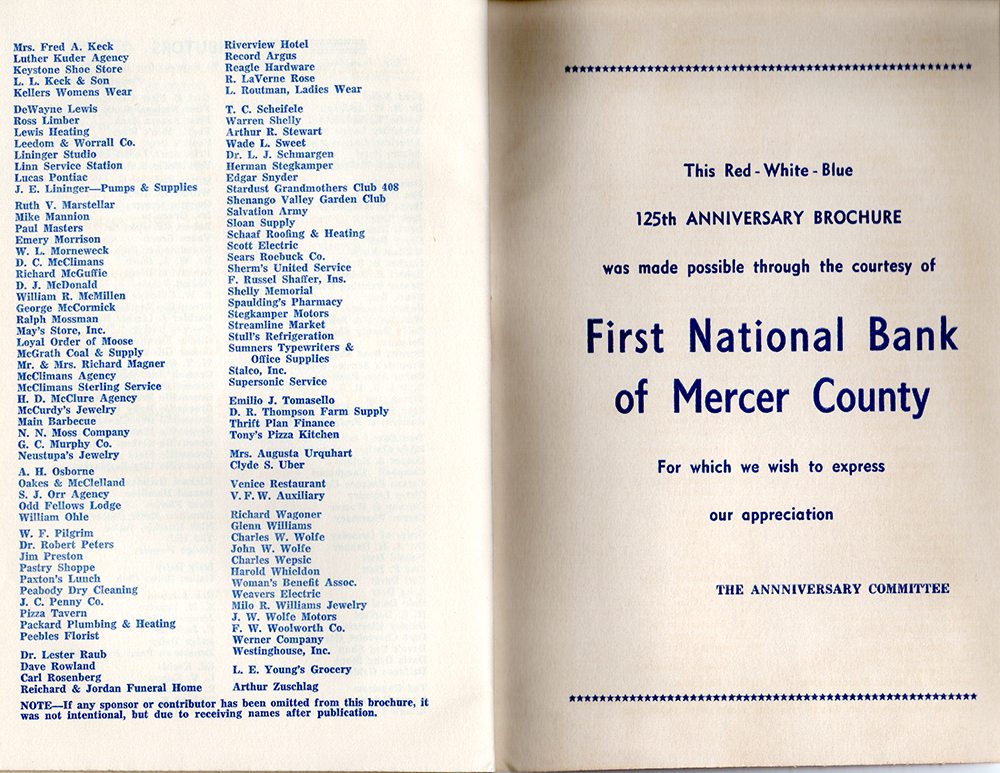
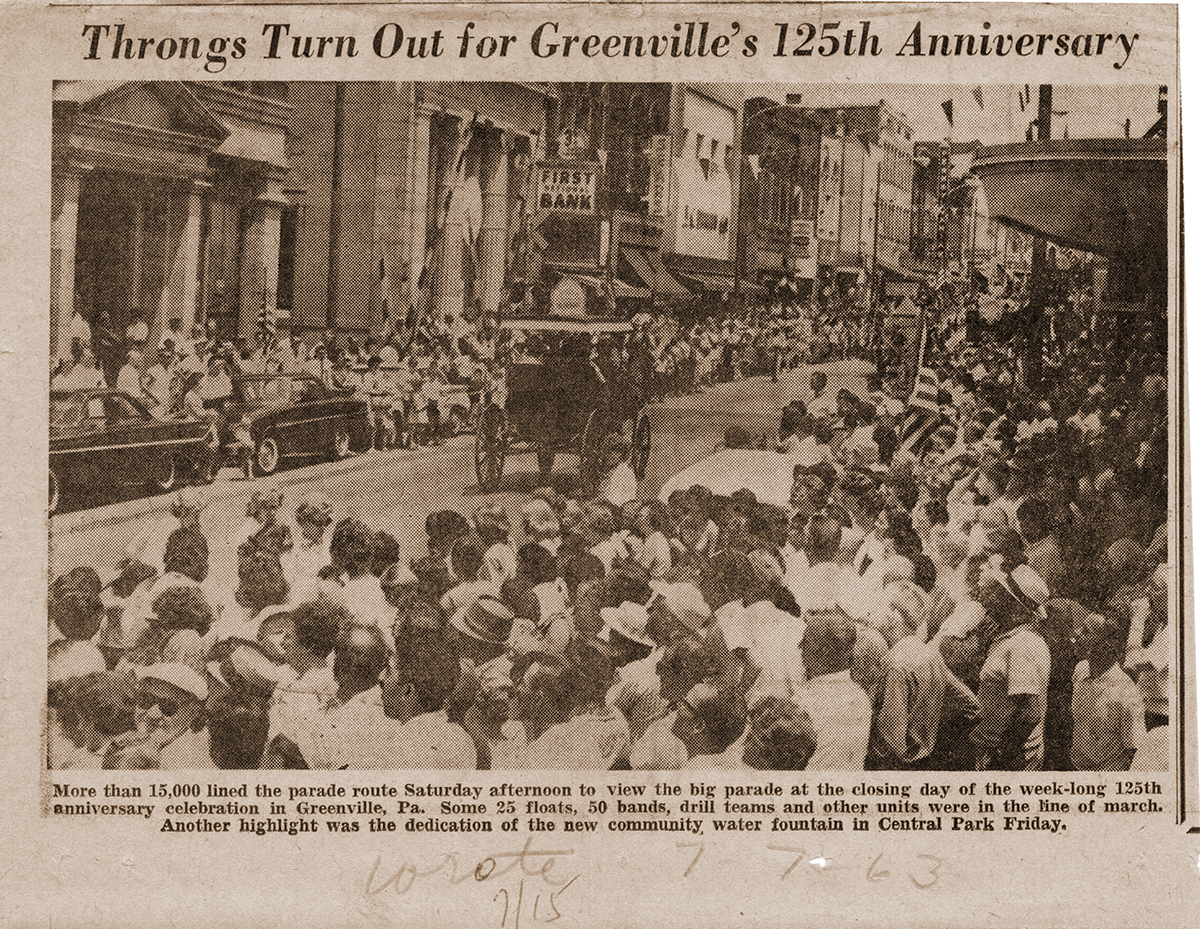
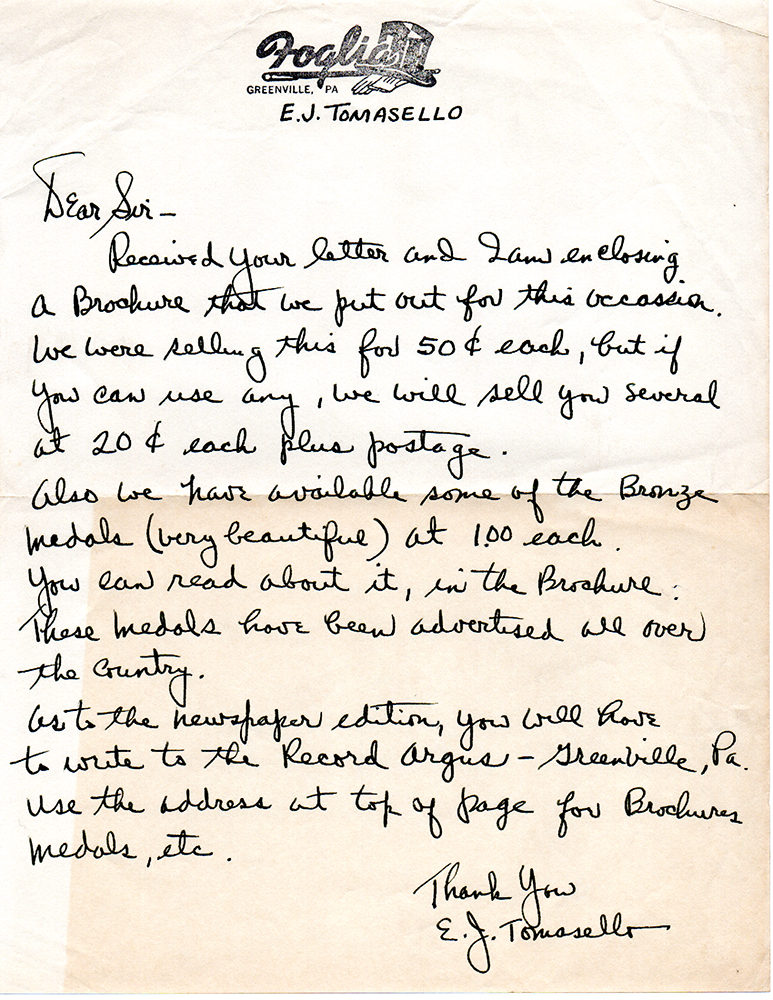
Tucked inside the booklet was a letter from Emilio J. Tomasello and a unidentified newspaper article about the celebration and parade, dated July 7, 1963.
A Brief History of Greenville
By Roy C. Beaver
In our public library there are three very complete histories of Mercer County and the Borough of Greenville, published, respectively, in 1877, 1888 and 1909. The Record-Argus also published a very excellent and complete history of Greenville in its 75-page Centennial edition, July 30, 1938, upon the occasion of the celebration of the 100th Anniversary of Greenville’s incorporation as a borough. So now it seems fitting to present only a very brief history of our town to freshen our minds a bit upon the occasion of the celebration of its 125th Anniversary. While our town was incorporated 125 years ago, there were settlers here as long as 167 years ago.
INDIANS
Of course anyone who owns a lot in Greenville should realize that his lot once belonged to the Indians. Before the whites came to America, the eastern part of the country, including the area where we live, was under the control of the so-called Five Nations, consisting of the Mohawks, Oneidas, Senecas, Onandagas and Cayugas, with headquarters in what is now New York State. They were later joined by the Tuscaroras from the west and were then called the Six Nations or Mengwe. During early colonial days a tribe living along the Delaware River, known as the Delawares or Lenni Lenapes, got into trouble with the Allegewi tribe of southwestern Pennsylvania and appealed to the Mengwe for assistance. They formed an offensive and defensive alliance against the common enemy, the Allegewi. After a terrible war lasting many years the Allegewi were driven out and the Lenapes were given the area north of the Allegheny and Ohio Rivers to Lake Erie, including Mercer County. Subsequently the Mengwe and Lenapes went to war between themselves and after it was over, the Lenapes were made subject to the Mengwe, but were allowed to remain in this territory.
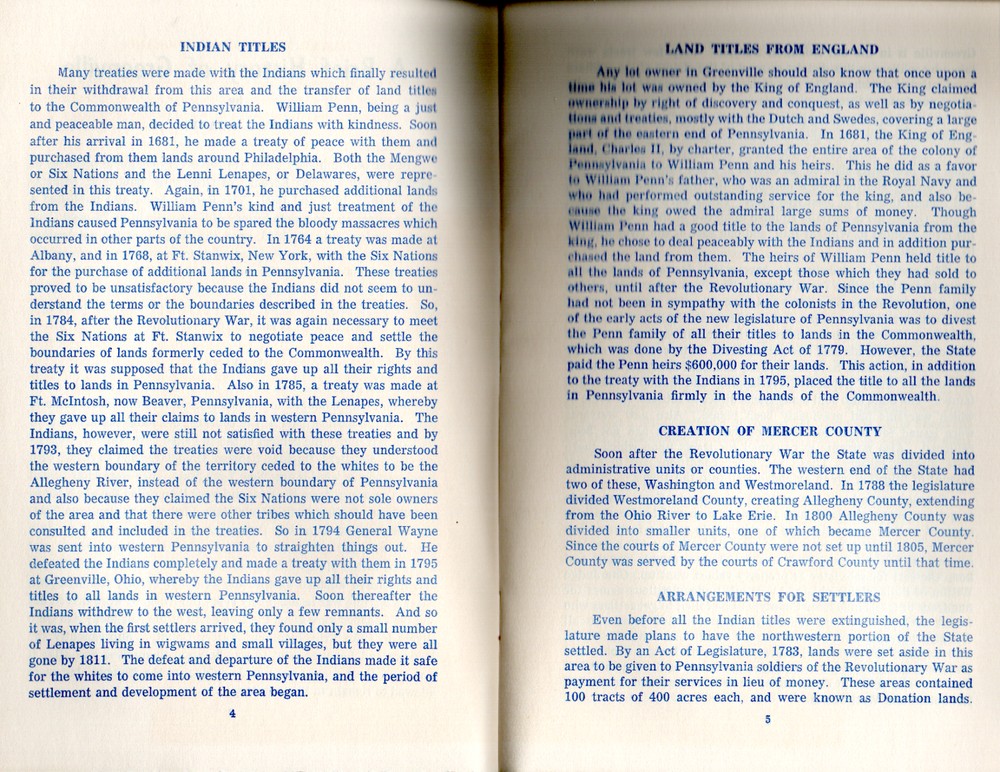
INDIAN TITLES
Many treaties were made with the Indians which finally resulted in their withdrawal from this area and the transfer of land titles to the Commonwealth of Pennsylvania. William Penn, being a just and peaceable man, decided to treat the Indians with kindness. Soon after his arrival in 1681, he made a treaty of peace with them and purchased from them lands around Philadelphia. Both the Mengwe or Six Nations and the Lenni Lenapes, or Delawares, were represented in this treaty. Again, in 1701, he purchased additional lands from the Indians. William Penn’s kind and just treatment of the Indians caused Pennsylvania to be spared the bloody massacres which occurred in other parts of the country. In 1764 a treaty was made at Albany, and in 1768, at Ft. Stanwix, New York, with the Six Nations for the purchase of additional lands in Pennsylvania. These treaties proved to be unsatisfactory because the Indians did not seem to understand the terms or the boundaries described in the treaties. So, in 1784, after the Revolutionary War, it was again necessary to meet the Six Nations at Ft. Stanwix to negotiate peace and settle the boundaries of lands formerly ceded to the Commonwealth. By this treaty it was supposed that the Indians gave up all their rights and titles to lands in Pennsylvania. Also in 1785, a treaty was made at Ft. McIntosh, now Beaver, Pennsylvania, with the Lenapes, whereby they gave up all their claims to lands in western Pennsylvania. The Indians, however, were still not satisfied with these treaties and by 1793, they claimed the treaties were void because they understood the western boundary of the territory ceded to the whites to be the Allegheny River, instead of the western boundary of Pennsylvania and also because they claimed the Six Nations were not sole owners of the area and that there were other tribes which should have been consulted and included in the treaties. So in 1794 General Wayne was sent into western Pennsylvania to straighten things out. He defeated the Indians completely and made a treaty with them in 1795 at Greenville, Ohio, whereby the Indians gave up all their rights and titles to all lands in western Pennsylvania. Soon thereafter the Indians withdrew to the west, leaving only a few remnants. And so it was, when the first settlers arrived, they found only a small number of Lenapes living in wigwams and small villages, but they were all gone by 1811. The defeat and departure of the Indians made it safe for the whites to come into western Pennsylvania, and the period of settlement and development of the area began.
LAND TITLES FROM ENGLAND
Any lot owner in Greenville should also know that once upon a time his lot was owned by the King of England. The King claimed ownership by right of discovery and conquest, as well as by negotiations and treaties, mostly with the Dutch and Swedes, covering a large part of the eastern end of Pennsylvania. In 1681, the King of England, Charles II, by charter, granted the entire area of the colony of Pennsylvania to William Penn and his heirs. This he did as a favor to William Penn’s father, who was an admiral in the Royal Navy and who had performed outstanding service for the king, and also because the king owed the admiral large sums of money. Though William Penn had a good title to the lands of Pennsylvania from the king, he chose to deal peaceably with the Indians and in addition purchased the land from them. The heirs of William Penn held title to all the lands of Pennsylvania, except those which they had sold to others, until after the Revolutionary War. Since the Penn family had not been in sympathy with the colonists in the Revolution, one of the early acts of the new legislature of Pennsylvania was to divest the Penn family of all their titles to lands in the Commonwealth, which was done by the Divesting Act of 1779. However, the State paid the Penn heirs $600,000 for their lands. This action, in addition to the treaty with the Indians in 1795, placed the title to all the lands in Pennsylvania firmly in the hands of the Commonwealth.
CREATION OF MERCER COUNTY
Soon after the Revolutionary War the State was divided into administrative units or counties. The western end of the State had two of these, Washington and Westmoreland. In 1788 the legislature divided Westmoreland County, creating Allegheny County, extending from the Ohio River to Lake Erie. In 1800 Allegheny County was divided into smaller units, one of which became Mercer County. Since the courts of Mercer County were not set up until 1805, Mercer County was served by the courts of Crawford County until that time.
ARRANGEMENTS FOR SETTLERS
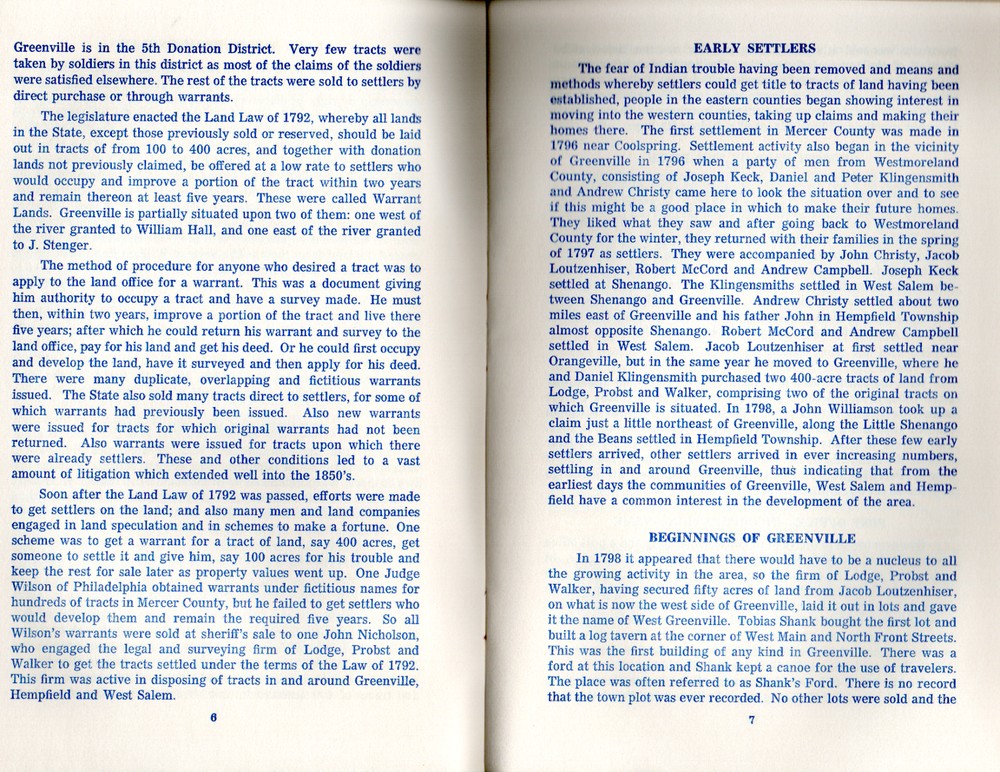
Even before all the Indian titles were extinguished, the legislature made plans to have the northwestern portion of the State settled. By an Act of Legislature, 1783, lands were set aside in this area to be given to Pennsylvania soldiers of the Revolutionary War as payment for their services in lieu of money. These areas contained 100 tracts of 400 acres each, and were known as Donation lands. Greenville is in the 5th Donation District. Very few tracts were taken by soldiers in this district as most of the claims of the soldiers were satisfied elsewhere. The rest of the tracts were sold to settlers by direct purchase or through warrants.
The legislature enacted the Land Law of 1792, whereby all lands in the State, except those previously sold or reserved, should be laid out in tracts of from 100 to 400 acres, and together with donation lands not previously claimed, be offered at a low rate to settlers who would occupy and improve a portion of the tract within two years and remain thereon at least five years. These were called Warrant Lands. Greenville is partially situated upon two of them: one west of the river granted to William Hall, and one east of the river granted to J. Stenger.
The method of procedure for anyone who desired a tract was to apply to the land office for a warrant. This was a document giving him authority to occupy a tract and have a survey made. He must then, within two years, improve a portion of the tract and live there five years; after which he could return his warrant and survey to the land office, pay for his land and get his deed. Or he could first occupy and develop the land, have it surveyed and then apply for his deed. There were many duplicate, overlapping and fictitious warrants issued. The State also sold many tracts direct to settlers, for some of which warrants had previously been issued. Also new warrants were issued for tracts for which original warrants had not been returned. Also warrants were issued for tracts upon which there were already settlers. These and other conditions led to a vast amount of litigation which extended well into the 1850’s.
Soon after the Land Law of 1792 was passed, efforts were made to get settlers on the land; and also many men and land companies engaged in land speculation and in schemes to make a fortune. One scheme was to get a warrant for a tract of land, say 400 acres, get someone to settle it and give him, say 100 acres for his trouble and keep the rest for sale later as property values went up. One Judge Wilson of Philadelphia obtained warrants under fictitious names for hundreds of tracts in Mercer County, but he failed to get settlers who would develop them and remain the required five years. So all Wilson’s warrants were sold at sheriff’s sale to one John Nicholson, who engaged the legal and surveying firm of Lodge, Probst and Walker to get the tracts settled under the terms of the Law of 1792. This firm was active in disposing of tracts in and around Greenville, Hempfield and West Salem.
EARLY SETTLERS
The fear of Indian trouble having been removed and means and methods whereby settlers could get title to tracts of land having been established, people in the eastern counties began showing interest in moving into the western counties, taking up claims and making their homes there. The first settlement in Mercer County was made in 1796 near Coolspring. Settlement activity also began in the vicinity of Greenville in 1796 when a party of men from Westmoreland County, consisting of Joseph Keck, Daniel and Peter Klingensmith and Andrew Christy came here to look the situation over and to see if this might be a good place in which to make their future homes. They liked what they saw and after going back to Westmoreland County for the winter, they returned with their families in the spring of 1797 as settlers. They were accompanied by John Christy, Jacob Loutzenhiser, Robert McCord and Andrew Campbell. Joseph Keck settled at Shenango. The Klingensmiths settled in West Salem between Shenango and Greenville. Andrew Christy settled about two miles east of Greenville and his father John in Hempfield Township almost opposite Shenango. Robert McCord and Andrew Campbell settled in West Salem. Jacob Loutzenhiser at first settled near Orangeville, but in the same year he moved to Greenville, where he and Daniel Klingensmith purchased two 400-acre tracts of land from Lodge, Probst and Walker, comprising two of the original tracts on which Greenville is situated. In 1798, a John Williamson took up a claim just a little northeast of Greenville, along the Little Shenango and the Beans settled in Hempfield Township. After these few early settlers arrived, other settlers arrived in ever increasing numbers, settling in and around Greenville, thus indicating that from the earliest days the communities of Greenville, West Salem and Hempfield have a common interest in the development of the area.
BEGINNINGS OF GREENVILLE
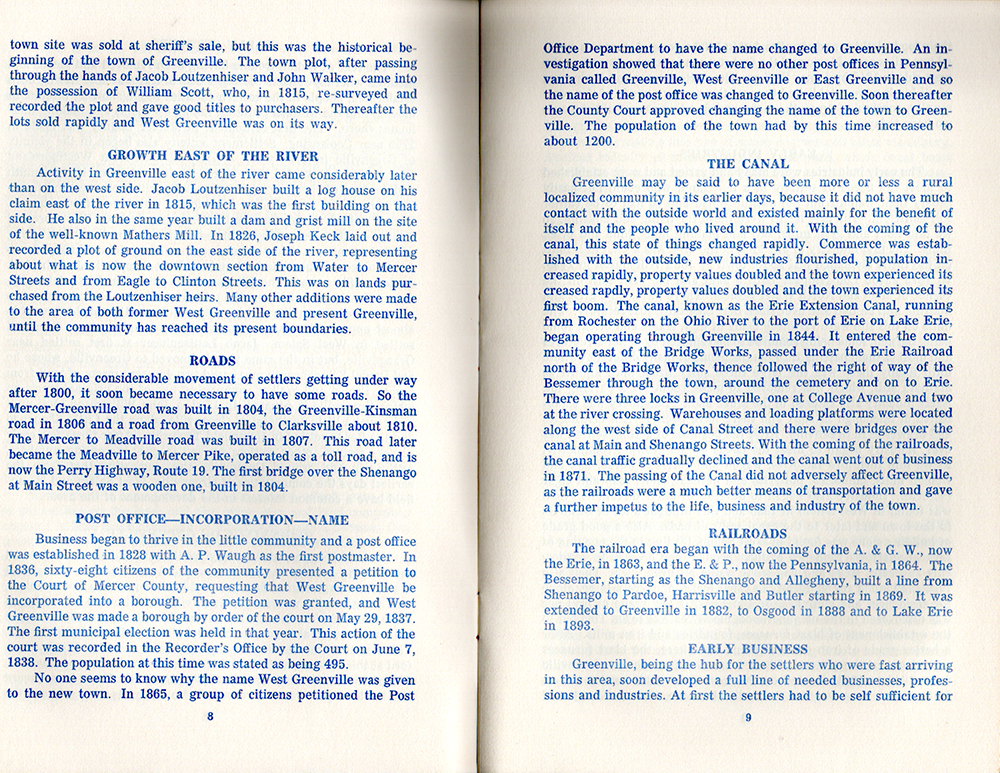
In 1798 it appeared that there would have to be a nucleus to all the growing activity in the area, so the firm of Lodge, Probst and Walker, having secured fifty acres of land from Jacob Loutzenhiser, on what is now the west side of Greenville, laid it out in lots and gave it the name of West Greenville. Tobias Shank bought the first lot and built a log tavern at the corner of West Main and North Front Streets. This was the first building of any kind in Greenville. There was a ford at this location and Shank kept a canoe for the use of travelers. The place was often referred to as Shank’s Ford. There is no record that the town plot was ever recorded. No other lots were sold and the town site was sold at sheriff’s sale, but this was the historical beginning of the town of Greenville. The town plot, after passing through the hands of Jacob Loutzenhiser and John Walker, came into the possession of William Scott, who, in 1815, re-surveyed and recorded the plot and gave good titles to purchasers. Thereafter the lots sold rapidly and West Greenville was on its way.
GROWTH EAST OF THE RIVER
Activity in Greenville east of the river came considerably later than on the west side. Jacob Loutzenhiser built a log house on his claim east of the river in 1815, which was the first building on that side. He also in the same year built a dam and grist mill on the site of the well-known Mathers Mill. In 1826, Joseph Keck laid out and recorded a plot of ground on the east side of the river, representing about what is now the downtown section from Water to Mercer Streets and from Eagle to Clinton Streets. This was on lands purchased from the Loutzenhiser heirs. Many other additions were made to the area of both former West Greenville and present Greenville, until the community has reached its present boundaries.
ROADS
With the considerable movement of settlers getting under way after 1800, it soon became necessary to have some roads. So the Mercer-Greenville road was built in 1804, the Greenville-Kinsman road in 1806 and a road from Greenville to Clarksville about 1810. The Mercer to Meadville road was built in 1807. This road later became the Meadville to Mercer Pike, operated as a toll road, and is now the Perry Highway, Route 19. The first bridge over the Shenango at Main Street was a wooden one, built in 1804.
POST OFFICE—INCORPORATION—NAME
Business began to thrive in the little community and a post office was established in 1828 with A. P. Waugh as the first postmaster. In 1836, sixty-eight citizens of the community presented a petition to the Court of Mercer County, requesting that West Greenville be incorporated into a borough. The petition was granted, and West Greenville was made a borough by order of the court on May 29, 1837. The first municipal election was held in that year. This action of the court was recorded in the Recorder’s Office by the Court on June 7, 1838. The population at this time was stated as being 495.
No one seems to know why the name West Greenville was given to the new town. In 1865, a group of citizens petitioned the Post Office Department to have the name changed to Greenville. An investigation showed that there were no other post offices in Pennsylvania called Greenville, West Greenville or East Greenville and so the name of the post office was changed to Greenville. Soon thereafter the County Court approved changing the name of the town to Greenville. The population of the town had by this time increased to about 1200.
THE CANAL
Greenville may be said to have been more or less a rural localized community in its earlier days, because it did not have much contact with the outside world and existed mainly for the benefit of itself and the people who lived around it. With the coming of the canal, this state of things changed rapidly. Commerce was established with the outside, new industries flourished, population increased rapidly, property values doubled and the town experienced its first boom. The canal, known as the Erie Extension Canal, running from Rochester on the Ohio River to the port of Erie on Lake Erie, began operating through Greenville in 1844. It entered the community east of the Bridge Works, passed under the Erie Railroad north of the Bridge Works, thence followed the right of way of the Bessemer through the town, around the cemetery and on to Erie. There were three locks in Greenville, one at College Avenue and two at the river crossing. Warehouses and loading platforms were located along the west side of Canal Street and there were bridges over the canal at Main and Shenango Streets. With the coming of the railroads, the canal traffic gradually declined and the canal went out of business in 1871. The passing of the Canal did not adversely affect Greenville, as the railroads were a much better means of transportation and gave a further impetus to the life, business and industry of the town.
RAILROADS
The railroad era began with the coming of the A. & G. W., now the Erie, in 1863, and the E. & P., now the Pennsylvania, in 1864. The Bessemer, starting as the Shenango and Allegheny, built a line from Shenango to Pardoe, Harrisville and Butler starting in 1869. It was extended to Greenville in 1882, to Osgood in 1888 and to Lake Erie in 1893.
EARLY BUSINESS
Greenville, being the hub for the settlers who were fast arriving in this area, soon developed a full line of needed businesses, professions and industries. At first the settlers had to be self sufficient for their food, clothing and supplies, but in 1806 a general store was opened two miles east of town and the first store in town was opened on the west side in 1815 by James Walker. Thereafter stores and businesses of all kinds were established to meet the growing needs of the community, continuing up to the many and fine business establishments we have today.
EARLY INDUSTRIES
The early industries were many and varied and were established to meet the needs of settlers in a new land, who could not easily satisfy their wants from the outside world and so had to be rather self-sufficient. The first needs were those for living and housing, so we find flour and grist mills, saw and planing mills, lime and brick kilns. The first industry of any kind in the area was a grist mill built on the Little Shenango just above town by John Williamson in 1799. In 1815 Jacob Loutzenhiser built a dam and log grist mill on the corner of Main and North Water Streets. There has been a grist and flouring mill on that site ever since that time until just recently. The mills on this site were variously made of logs, frame and brick, some being burned, some being removed to be replaced by better structures and most of them passing through the hands of many different owners until finally there was the large three story brick mill, known as Mathers Mill, which was removed to make room for a parking lot. Early industry also catered to the inner man. A distillery was established at Shenango in 1801 and there have been several distilleries and breweries in Greenville. After the business of getting settled was over, industry began to meet the needs of the growing community, so we find furniture factories, wagon and carriage works, flax and woolen mills, tanneries, potteries and harness, shoe, soap and cigar factories. Industry also began to develop in other directions. Coal was found in West Salem in 1833 and this brought a lot of business to the town and later to the canal and railroads. Also a good grade of building stone was found in West Salem, leading to the opening of several quarries. Evidence of their product can be seen in window sills and caps, steps and flag stone walks all over town. They also furnished stone for building the canal locks, and years later, stone for residences and churches. In the 1830’s a low grade of iron ore was discovered in the neighborhood, mostly east of town. This led to the establishment of blast furnaces, foundries and iron mills. After a better grade of iron ore was found elsewhere, the blast furnaces passed out of the picture. There were two furnaces in Greenville from 1842 to 1851, located on the west river bank north of West Main Street. One was the Greenville Furnace, Power, Waugh and Reed, 1842; and one was the Esther Furnace, Vincent, Himrod and Co., 1846. There were several foundries, the best known early one being Hamlin and Sons Co., located on Canal Street. It was established in 1838 and continued to about 1896 under various names and owners. It manufactured products for saw and grist mills, pipe and fittings, brass goods, school seats and castings for canal locks. In later years it made a fine line of steam engines and other machinery. Another industry of interest was the boat yard, where canal boats were built. It was located near where the present Little League baseball field is now.
The coming of the canal had a profound effect on these early industries. Many were adversely affected and put out of business because their products could be brought in and sold cheaper than they could be made here. Other industries, however, took advantage of the canal to increase their business, this being true principally with coal, stone and lumber. The canal also caused for a time a lively trade in cattle and horses.
PASSING INDUSTRIES
Greenville has had a number of other industries since canal days, which are no longer in operation. Among these are the rolling mill, the woolen mill and the tube works. The rolling mill was established in 1869 by P. L. Kimberly. It was built to refine iron by the puddling process and manufacture iron products such as bars and hoops. The works grew in size and capacity, surviving several fires, and passing through several hands, including American Steel Hoop Co., Carnegie Steel Co., and United States Steel. The mill was closed in 1917 because the process and machinery had become obsolete. There was also another rolling mill in 1870, known as the Greenville Iron Co., George Westerman and Co., but it closed after a few years. In 1885 the Pearce Woolen mill was established here. It did an extensive business in fabrics, particularly blankets, and sold them through department stores in nearby cities. It was destroyed by fire soon after 1900 and was not rebuilt. In 1898 the Shelby Tube Co. began operations in the plant which is now the Steel Car Co. It manufactured tubing for industries all over the country including tubes for the boilers of naval vessels. The company was later taken over by the National Tube Co. and the process of piercing billets to make seamless tubing was developed here. The Tube Company discontinued its operation here about 1908. There was also the Anderson Spoke and Handle Factory on Davis Avenue in the 1890’s.
PRESENT INDUSTRIES
This brief account of early industries brings us to a consideration of the present fine industries in our community. The earliest of these is the Hodge Manufacturing Co. It was started in 1876 by Mr. E. W. Hodge simply as Hodge’s Foundry. It was organized into a company, the Hodge Brass and Iron Co. in 1883. It grew rapidly and did an expanding business, making castings and doing machine work for the coal mines, quarries, furnaces, rolling mills and for people in general, with such products as stoves, sash weights, bells, etc. The first foundry was located on South Race Street and after relocating on Ohl Street, the business was moved to a fine new foundry on Leech Road.
The Bessemer and Lake Erie, through its shops and offices, has, over the years, been a mainstay of business and industrial activity in Greenville. The shops were moved from Shenango to Greenville about 1894 and the offices, after having been in Meadville for a while, were removed to Greenville about the same time. Both offices and shops have been greatly expanded to their present size. The Greenville Steel Car Co. was started in 1910 as the Greenville Metal Products Co. in the buildings which had been vacated by the tube mill. At first the company made parts for automobiles, principally axles, and later Empire and Fay automobiles. In 1913 it got into the steel car repair business and changed its name to Greenville Steel Car Co. It now makes a full line of conventional and special freight cars, fabricates car parts, does freight car repairing, and manufactures excavating machinery and other products. The Chicago Bridge and Iron Co. built its eastern plant in Greenville, starting in 1910. This fine company has also expanded in size, equipment and products to become one of the best known and regarded industries of the area. Originally making tanks for water, oil and other purposes, it has expanded its line in keeping with modern times by making products for the space and nuclear age, the chemical, pulp and paper industries, hydro-electric projects and many others.
The R. D. Werner Co. began operations here in 1945, and like the other progressive industries of the town, has greatly expanded its plant equipment, facilities and product to its present size and importance. This fine company deals in aluminum products of all kinds, including ladders, platforms, curtain walls and extrusions of all kinds. It ships its products all over the country, and they are used in the manufacture of all sorts of aluminum furniture, structures and other items. Another new company, the Greenville Machine Co., while small, shows signs of progress and is now located in its fine new building on Leech Road.
REYNOLDS INDUSTRIES
A review of the industries of Greenville would not be complete without mentioning the fine new industries of the Reynolds Development. There are about twenty-five of these, some large, some small. It is true that these industries are not in Greenville, yet they should be considered as Greenville industries because they have been located there through the energy and foresight of the Greenville Business Men’s Association. These industries now employ over 800 persons, which greatly adds to the economic welfare, not only of the Reynolds area, but of Greenville and surrounding townships as well.
OTHER EMPLOYMENT
Industry is often thought of as a manufacturing concern in a building with smoke coming out of a tall chimney. But there are other ways whereby the main purposes of industry—employment and profits—can be accomplished. For example, there is Thiel College with over 125 employes and almost 1000 students living and spending their money here, contributing to the economic welfare of the town. This certainly is a big industry as well as a center of learning. There is also the hospital with its many employes. Also the clinic, the stores, the garages and filling stations, the utilities and even the churches and the Borough itself. All these and many more may indeed be considered as industries in the sense that they help to keep our economic life moving on a high level.
WORK OF BUSINESS MEN
The development of business and industry in Greenville has received great impetus and assistance from its alert businessmen. First through a Chamber of Commerce, then through a Board of Trade, and now through the Greenville Business Men’s Association, business and industry have been fostered and encouraged, especially in more recent years through the Reynolds Development committee of the Association.
PUBLIC UTILITIES
It seems strange to us now that Greenville had to do without all the public utilities as we know them until after 1877. The first was the Greenville Gas Co. which began the manufacture, distribution and sale of artificial gas made from coal that year in a plant located on South Front Street. In 1886 the name was changed to Greenville Natural Gas Co., but the company did not succeed in getting natural gas until about 1900. The company has since been purchased by the United Natural Gas Co. Water began to flow through pipes under our streets in 1883 when the Greenville Water Co. was formed. The company expanded rapidly with reservoir, pumping and purifying equipment and additional pipe lines, and changed hands several times until now it is publicly owned and operated through the Greenville Municipal Authority. The telephone came in 1887. The first company was the Central District and Printing Telephone Co., forerunner of the Bell. For a while there was also the Mercer County Telephone Co. and there was some duplication and confusion. To people today it seems that electricity must always have been with us. But strangely enough it didn’t come to Greenville until 1891. In that year the Peoples Electric Light, Heat and Power Co. began to manufacture electricity in a plant at the corner of Clinton and Canal Streets, part of which is still standing. The generators were driven by steam engines and the exhaust steam, as a by-product, was distributed in pipes under the streets in the business section for heating purposes. The name was changed to Mercer County Light, Heat and Power Co. in 1911, as the distributions of electricity spread to surrounding areas. It was later sold to Boston interests who built a new power house along the Bessemer near the river, and in 1926 the company was taken over by the Pennsylvania Power Co., and with the ever expanding uses of electricity, it could be said that the age of electricity had fully arrived in Greenville. In 1893 public sanitation began with the construction of a few sewers in the downtown area, emptying directly into the river. The network of sewers continued to enlarge until all streets were served by sewers in 1915, and there was a partial sewage disposal plant. A larger disposal and incinerating plant was constructed south of the town in 1929. This soon became inadequate and unsatisfactory, so in recent years a modern sewage disposal plant, acceptable to state authorities, and a sanitary land fill have been put into operation under the Greenville Sanitary Authority.
HOTELS
Greenville’s National Hotel is one of the oldest in the county, having been established in 1838. The Riverview Hotel was built in 1900. Greenville has had other hotels through the years, some discontinued by their owners and some destroyed by fire. The first was Tobias Shank’s log tavern in 1798. Probably the best known of the former hotels was the Exchange, built in 1831, which after many changes and owners, developed into the Arlington, where the Borough building now stands. Other hotel names which may be recalled are Packard, Eagle, Central, Commercial, St. Charles, St. Thomas, Speir, Belvidere, Touraine and Mansion. The last named was on the west side, corner of Main and North High Streets.
NEWSPAPERS
Greenville is well served by a fine newspaper. It came into being in 1848 as the Weekly Express. After a number of reorganizations, changes of name and changes of owners, it became the Shenango Valley Argus in 1871, and in 1877 it consolidated with the Greenville Advance, established in 1871, to form the Advance Argus. In 1897 it began the publication of the daily Evening Record, which was later merged to form the present Record-Argus. There have been other newspapers in Greenville, since discontinued. The first was the West Greenville Gazette, 1830. Then the Visitor, 1836; The Union Democrat, 1861; The Greenville Progress, 1877; The Shenango Valley News, 1882; and the Independent, 1885.
BANKS
Greenville is well served by two strong banking institutions. The First National Bank of West Greenville, now the First National Bank of Mercer County, was incorporated in 1864. It has steadily expanded during the years and in more recent years has established branches in nearby communities and also absorbed the Greenville National Bank, which was incorporated in 1875 and which had previously been Achre, Wick and Co., established in 1856. The Farmers and Merchants Bank began operations in 1900, was reorganized as a Trust Company in 1902 and in 1961 became the Greenville Office of the First Seneca Bank and Trust Co. of Oil City, which has many branch banks in the surrounding area.
SCHOOLS
The First school in this area was a log school about one mile west of town, built by John Speir in 1802. The early schools were all private, and there were several of them in and around Greenville. Schools also were conducted in private homes. The Greenville Academy, a private school, began in 1848 in an 8-room frame building at the corner of Shenango Street and Louisa Avenue. It flourished for many years and finally became a residence, being torn down in 1962 to make room for a parking lot. At the time of the Civil War there were two 2-room schools, one on Clarksville Street and one at the corner of Clinton Street and Penn Avenue. In 1865, construction of the Union School began and it was completed in 1868. It was a three-story, 11-room brick structure which stood where Penn Junior High School now stands. The Greenville School District was established in 1867 and thereafter the schools were conducted in a more orderly fashion. The First Ward School, now St. Michael’s Elementary School, was built in 1878, the Columbia School in 1893, the Washington School in 1904, and Penn High School, now Penn Junior High, in 1919. A new day has dawned for the schools of Greenville, Sugar Grove and Hempfield with the new School Union, the conversion of Penn High to Penn Junior High, the construction of the new High School on Donation Road, the West Side Elementary School, the Hempfield Elementary School, and the East Side Elementary School, completed in 1963, replacing the old Columbia School. The High School was started in the West Side School, then moved to the Central Union School, then to the Washington School, then to what is now Penn Junior High and finally to the new building on Donation Road.
THIEL COLLEGE
Thiel College was opened as Thiel Hall in 1866 at Phillipsburg, now Monaca, Pennsylvania. Upon the offer of land and money by the citizens of Greenville, the institution moved to Greenville in 1870 and incorporated as Thiel College. Until the completion of its first building in 1874, it held classes in the Greenville Academy and the Central Union School. From its humble beginnings Thiel College has grown to be one of the best and favorably known educational institutions in the country, with a fine campus, upwards of twenty buildings, almost 1000 students, and an outstanding faculty and curriculum. It has become one of the great assets of Greenville.
CHURCHES
Greenville has always been known as a community of churches and for its religious atmosphere. There are so many churches in and around Greenville that in this brief history we can not give an account of all of them. One needs only to look at the weekly church notices in the Record-Argus to see how many churches there are and especially the number of new denominations which have come here since 1900. It will be sufficient for this short history to recall early religious activity in and around Greenville and the denominations which were here before the turn of the century. It is difficult to tell when all the denominations began operations because of early unrecorded missionary activities and travels of itinerant preachers. In many cases there was activity many years before the congregations were actually organized. Early services were held in private homes, tents, log cabins, stores, schools, the Academy and in other churches. All the denominations went through the process of getting established, finding a place to worship, building some kind of a church home, improving, enlarging and sometimes relocating it, and in general keeping up with their growth, the growth of the town and the changing times. The first religious group to start operations here was the United Presbyterians, who began in 1798, first worshipping in Shank’s tavern. In 1802 they moved to Main and North High Streets and have been there ever since. Old Salem Presbyterian Church began in a tent near Shenango in 1799 and in 1800 they started services about three miles south of Greenville. The church is gone but the cemetery remains. The Lutherans began operations at Good Hope, near Shenango, in 1805 and they were joined by the Reformeds in 1825. This church became the center for early activities of both denominations in this area. The Presbyterians began in Greenville in 1825 on Shenango Street and in 1898 moved to East Main Street. The Methodist Church began in 1828 and the Catholics in 1838. They started their cemetery in 1848. In 1840 a Congregational Church was established here, but it was discontinued in 1863. Its building on Clinton Street was sold to the Reformed congregation who came here in 1861 and by them sold to the Protestant Episcopal Congregation which started in 1866. The Covenanters came here in 1852 but disbanded in 1888. There was some Baptist activity in the area as early as 1807, and some Baptist preaching in Greenville beginning in 1847, but the congregation was not started and the first building erected in the present location until 1857. The Lutheran congregation was organized and a brick church built in 1865. The United Brethren started a church in 1875 but it did not last; and the Tabernacle Baptists had some activity here between 1878 and 1881. In 1889 the West Side Methodist Episcopal Church, now the Wesleyan Methodist, was started. The Salvation Army arrived on the scene with small beginnings in 1899 and has continued to grow with and serve the needs of the community. There was some activity of the Evangelical denomination as early as 1833, but their congregation here did not get under way until 1905.
FIRE FIGHTING AND FIRES
Fire fighting in the new town in which most of the buildings were of wood construction presented a problem. The only means until the year 1840 was by bucket brigades from any source of water available. In that year a small hand pumping engine was purchased by popular subscription but it was sold in 1854. Thereafter until 1866, the residents went back to the bucket brigade method. But in 1866 a larger hand pump engine and a quantity of hose was purchased, and cisterns were built at various places in town to hold a supply of water. There was no organized fire department; everybody turned out to fight the fires. In 1868 an ordinance was passed prohibiting the erection of wooden buildings on Main Street between the river and Penn Avenue, but by that time most of them were already of wooden construction. There have always been numerous, more or less serious fires, in the town, but the period of the 1870’s was one in which the town experienced its most disastrous fires. Not before or since that decade have there been so many fires. In 1871 the Laird Block on the North Side of Main Street was destroyed. In 1873 it was both sides of Main Street between Canal and Mercer Street, 35 buildings in all. In 1874 it was the Hellein Block. In 1875 it was the Exchange Hotel, a brewery and other buildings and in 1876 it was the Greenville Woolen Mill, Mathers Flour Mill, the Packard Hotel, some dwellings and other property. These fires, no doubt were so serious on account of the inadequate methods of fighting fires at that time. These fires also gave impetus to the organization in 1880 of a real volunteer fire department with a Silsby steam fire engine, three hose companies and a considerable amount of equipment such as hose and ladders. The fighting of fires was greatly aided in 1883 with the coming of the Water Co. and its street hydrants. The fire department was reorganized in 1884 and again in 1902 at which time some of its members began to be paid. Since that time the department has acquired much new and improved equipment and adopted better means of fire fighting, so that today our fire department has the situation well under control. No one wants to have fires, but they do have the advantage of clearing out some old and obsolete buildings to make room for new and better structures, thus improving the appearance of the town.
FLOODS
Another problem which has troubled Greenville through the years is flooding by the Shenango River. Even as early as 1800 one of the pioneer settlers, Jacob Loutzenhiser, had to move because the river backed up behind an ice gorge and flooded him out. Since that time for a good many years the Shenango River has overflowed its banks almost every spring, flooding Water and Race Streets, the Hodge Foundry and Bessemer Shops. One of the worst floods was in 1913 when the water came over Main Street at Water Street. The flooding of the River has been greatly reduced after the flood of 1913 by clearing the river channel south of the town. In recent years the Pymatuning Reservoir also has been of great assistance in reducing floods. We have not had any bad floods for a long time.
FACE OF GREENVILLE—CIVIL WAR DAYS
The face of a community keeps changing. We will look at the face of Greenville as it appeared in Civil War Days when the town was 22 years of age. A map of West Greenville in 1860 shows the town with streets laid out as at present, extending from Diamond Street on the west to about the location of Columbia Avenue on the east and there were only nine houses east of Prairie Street (now College Avenue). The town also extended from the Shenango River on the North to Washington Street on the south. The route of the canal is shown with its three locks, canal office and numerous warehouses along Canal Street. North Mercer Street is extended to cross the river where College Avenue now crosses, because Prairie Street was only two blocks long. There is a public square at Diamond St. and two at the east corners of Main Street and Penn Avenue. An Indian Mound is shown at the junction of the rivers. The map shows the Greenville Academy, five churches, ten small industries of various kinds, the St. Thomas, Exchange, St. Charles and Mansion House hotels, two schools, a blast furnace, then called the Reed and Gregg furnace and about 290 buildings of all kinds.
FACE OF GREENVILLE—TURN OF CENTURY
Forty years later, at the turn of the century, when the town was 62 years old, the face of Greenville began to show signs of maturity. All the borough limits had been extended, especially eastward, and the population had reached 6000. The bicycles, horses, buggies and livery stables were still with us, but there were now a number of paved streets, principally Main, Mercer and Canal. Paving streets was begun in 1892. A trip down Main Street would show the profusion of telephone poles and wires, Central Park with its two Civil War cannons, the numerous groceries and meat markets, the watering troughs and hitching posts for horses, the Laird Opera House and the well known Mathers Mill and dam. The canal was gone, the railroads were here. Going out College Avenue one would see the Shenango Valley Cemetery and Thiel College with its three buildings. The industries were the Bessemer Shops, the Carnegie Rolling Mill, the Shelby Tube Works, Hodge’s Foundry, the Pearce Woolen Mill, Anderson’s Spoke and Handle Factory and the Shenango Valley Creamery. There were eight churches, four newspapers, the Advance Argus, the Evening Record, the Progress and the News. There were also four hotels, the Arlington, National, Commercial and Touraine and three schools, the Union or Central, the West Side and the Columbia.
FACE OF GREENVILLE—AT AGE 100
Again, in 1938, an opportunity was afforded to study the face of Greenville when the town celebrated the 100th Anniversary of its incorporation as a Borough, although there had been settlers here for more than 140 years. The Centennial Celebration was held mostly in Riverside Park, one of the town’s new recreational facilities, which had been developing since 1911. The new amphitheater in the park had just been completed and was used for the centennial pageant. Probably the outstanding change in the appearance of Greenville was due to the ever increasing number of automobiles appearing on the streets, with increasing number of dealers, service stations and garages and parking was beginning to be a problem. The hospital, started in an old residence in 1910, was now coming along nicely. The schools were the new Penn High and the West Side, Columbia and Washington grade schools. The hotels were the National and Riverview. The Borough, since 1904, had its headquarters in the old Presbyterian church on Shenango Street, but in 1938 was making plans for the construction of the fine new building we have now. And the old Mathers mill and dam were still with, the dam having been rebuilt in 1930.
FACE OF GREENVILLE—TODAY
Now, in the Year of Our Lord, 1963, the 125th Anniversary of the Incorporation of Greenville as a Borough and the 167th Anniversary of the arrival of the first settlers in Greenville, we take a good look at the face of Greenville and we find that it has changed more in the last twenty-five years than in any other like period of its history. Many things are going on now to cause Greenville to have a new look. Probably the most important of these is that since the limits of the Borough are so confined and restricted, and since there is very little space in the Borough for expansion, residence, business and industries have moved into the surrounding townships, until the number of people in the Greenville Community of interest is about twice the number in the town itself. The increase in the use of automobiles also has brought major problems such as heavy traffic, traffic congestion, traffic lights and ever increasing number of automobile dealers, filling stations and garages. Happily the parking problem, through the efforts of the Greenville Parking Authority, is well on its way to solution. The Greenville Motor Club, started in 1919, became the Mercer County Motor Club in 1953 and now has over 3300 members.
OUR DOWNTOWN—A SHOPPING PLAZA
Another important thing which is changing the face of Greenville in recent years is the alteration of the appearance and facilities of the downtown business section. Many communities have outlying shopping plazas and there has been some discussion of such projects here. But anyone who looks at the changes going on in our business section will see that our downtown is fast becoming a first class shopping plaza in itself. There are good reasons for this. The area is compact and easily accessible; there is plenty of parking space available within easy walking distance of the stores; there are all kinds of stores, including super-markets, with full lines of merchandise, with access from the street in front and the parking lots in the rear, and many have improved their store fronts, awnings and interiors. Also the post office, banks and many other facilities are right in the area.
REYNOLDS DEVELOPMENT
The Reynolds Development, while not in Greenville, has greatly affected the life of Greenville and must be included in any account of the things that are making Greenville greater. This is because the Reynolds Development has been the result of foresight, energy and work of the businessmen of the town. Reynolds, started in 1947, now has over 1000 residents and about 25 industries with over 800 employees.
RECREATION AND SCHOOLS
Recreational facilities have kept pace with the growing needs of Greenville’s citizens of all ages, with greatly expanded and improved Riverside Park, the Civic and Recreational Center, the swimming pool, the skating rink, the athletic field and the Little League Baseball Field. Our school system has become more efficient through its union with Hempfield and Sugar Grove Townships and the union schools now have five fine buildings, Senior High, Penn Junior High, West Side Elementary, Hempfield Elementary and Washington, with a new East Side Elementary, replacing the Columbia School, now under construction.
RECENT IMPROVEMENTS
Our community is notable for its new Borough building, constructed in 1939, its fine fire department with modern equipment, its efficient police force, its efficient handling of the water supply, sanitation and parking by means of authorities, by the beginnings of a Municipal Airport, and by the modern street lighting which reflects the progressive spirit of the citizens. The community is also notable for the recent improvements made by the churches, especially the Presbyterian, Reformed, Lutheran, Baptist, Methodist, Catholic, United Presbyterian and Evangelical-United Brethren. A great expansion has taken place in Thiel College, which now has twenty buildings and almost 1000 students. St. Paul Children’s and Old People’s Homes have been greatly enlarged, our library has moved into larger and better quarters, our hospital has had several additions in recent years and is favorably known over a large area not only for its building and equipment but for its services and professional care. The method of raising funds for charitable purposes through the Community Chest is, in recent years, a new feature which has added greatly to the welfare of the community.
BUSINESS MEN
In all of these things the Greenville Business Men’s Association has been a guiding spirit. It has given direction to the efforts of the community to advance and improve, especially in downtown development, regional planning, industrial expansion, parking problems, highway planning and of course, the Reynolds Development.
RECORD ARGUS
Our old reliable newspaper, the Record-Argus, has kept pace with the development of the town and surrounding area, has issued many special editions promoting the welfare, business and industry of the community.
PASSING OF LANDMARKS
And now we have sadly to record that the old favorite landmarks of the town for almost 150 years, the Mathers Mill and dam, have finally disappeared from our midst; but this may be considered as one of the signs of progress.
ROSTER OF INDUSTRIES
Now for the sake of the record of Greenville in 1963, we record the industries of the town, including some of the smaller ones, which are mentioned because they advertise our town to the outside world. They are Bessemer and Lake Erie shops and offices, Greenville Steel Car Co., Chicago Bridge and Iron Co., R. D. Werner Co., Hodge Foundry, Greenville Machine Co., Greenville Lumber and Supply Co., Oakes and McClelland, Beaver Printing Co., Curtis Trucking Co., O. D. Anderson and his buses, Beverly Farms Dairy, Green Valley Dairy, Wm. Baird and Sons, Bish Corporation and Pringle Milling Co.
OUR NEW FACE
Thus we have described the face of Greenville in 1963. We believe it is an honest, sincere forward looking face; but also it is a kindly, smiling face, with a warm welcome for newcomers and strangers.
THE VOICE OF GREENVILLE
And now we must not overlook the fact that Greenville not only has a face but a voice. Through the energy, courage and persistence of the Anderson Brothers, Station WGRP, The Voice of Greenville since 1959, is broadcasting music and other entertainment, news, information about Greenville, its products, business and industries, its stores and its people. Station WGRP is creating good will for Greenville in a wide area in Pennsylvania and Ohio.
CONCLUSION
So ends our story of Greenville. Volumes could be written about it, but the little we have written will serve to show how Greenville came through its growing pains and got to be where and what it is, at the age of 125 years. Our history shows that we can be proud of all of it. We have no regrets. All signs point to continued growth in all aspects of community life and our earnest hope is that when the next Anniversary comes to be celebrated, those who celebrate it will be as proud of our town then as we are now.