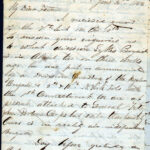
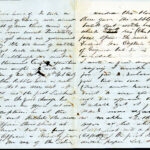
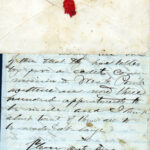
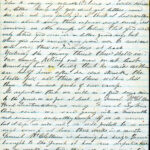
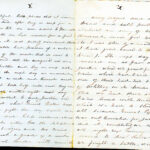
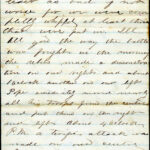
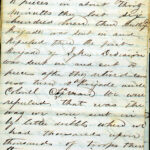
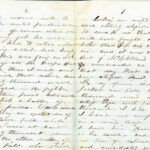
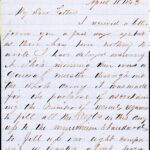
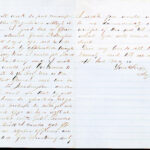
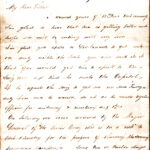
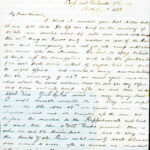
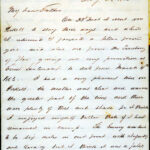
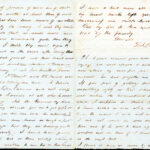
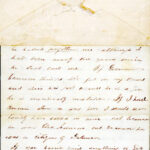
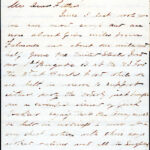
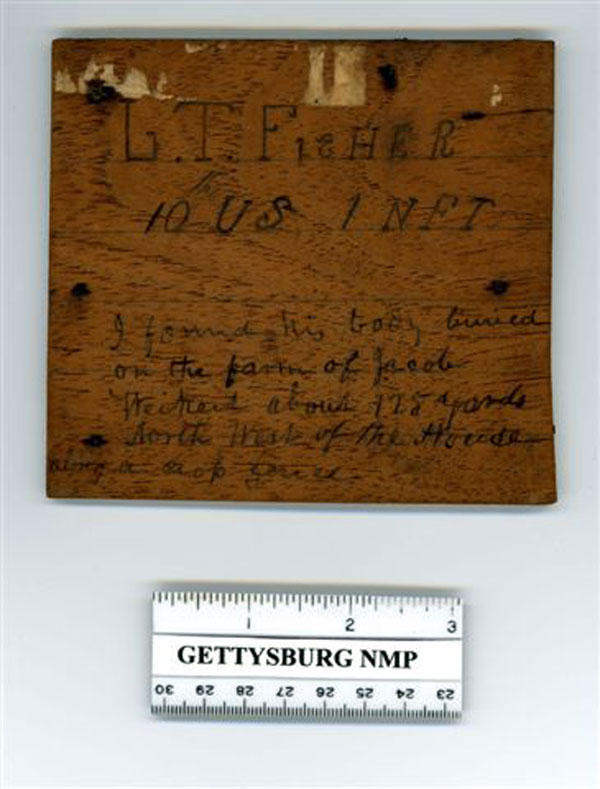
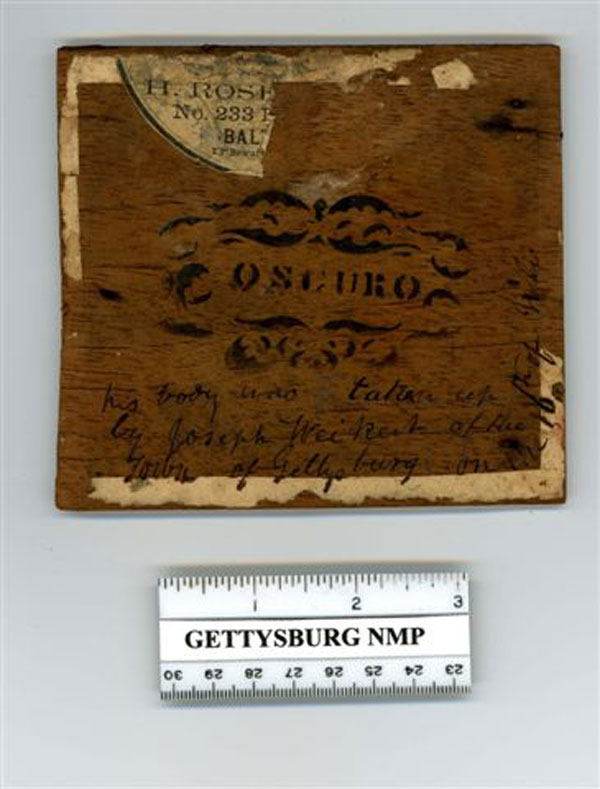
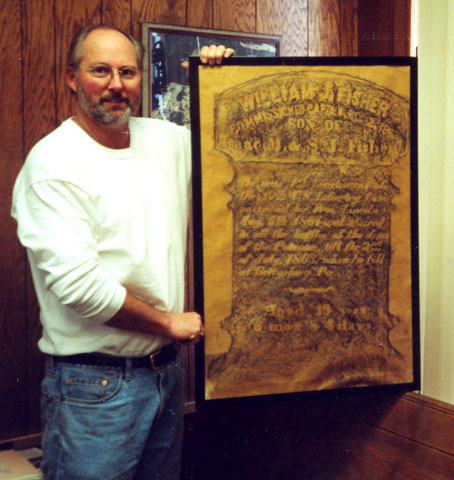
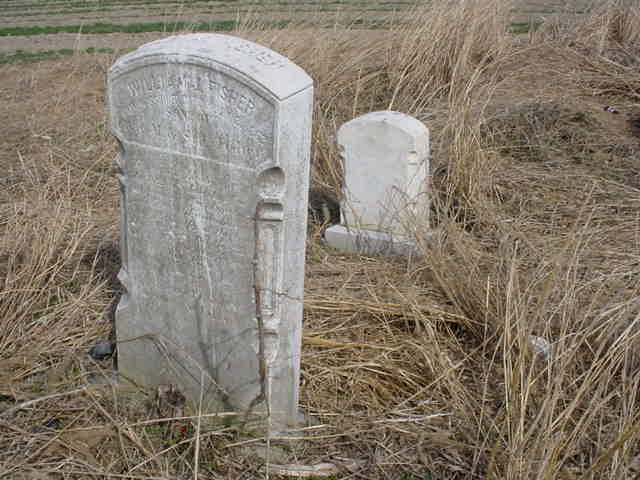
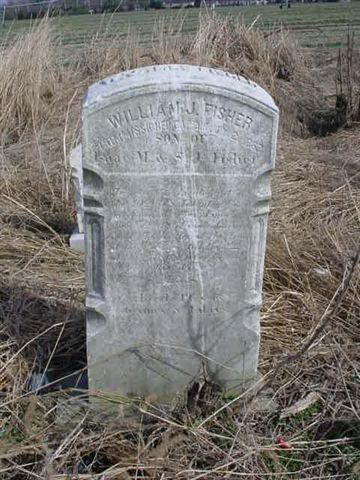
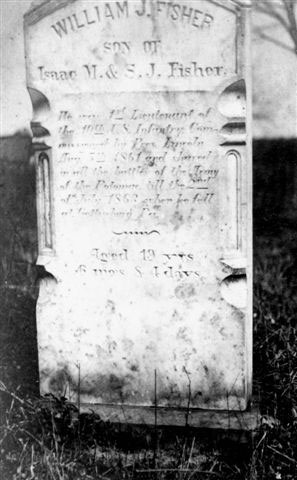
This research was done by my uncle, John Farquhar, who spent many years exploring the life, military service, and death of William James Fisher of Seaford, Delaware.
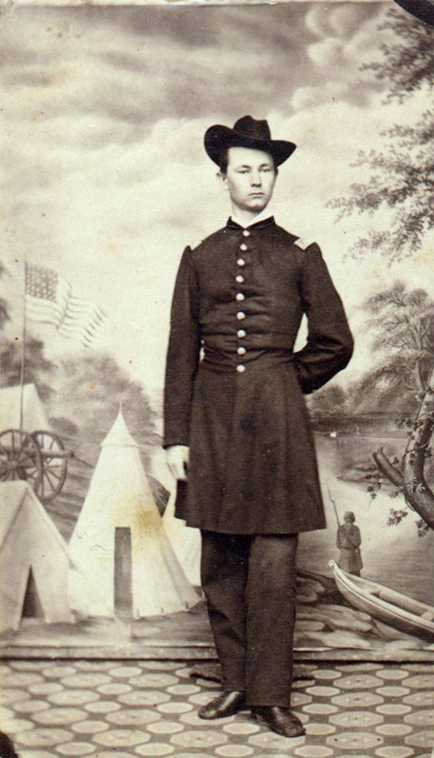
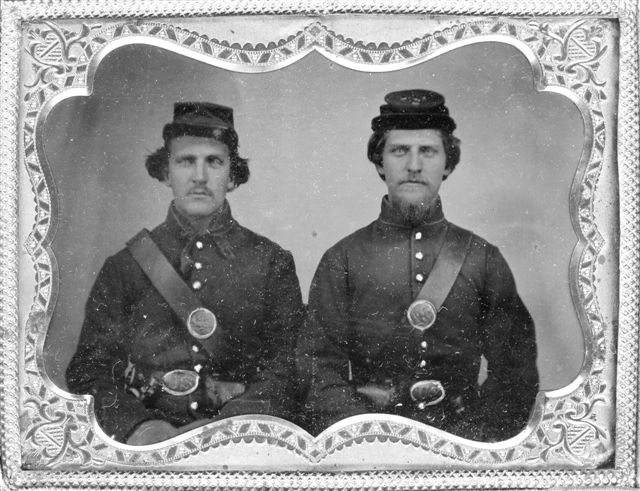
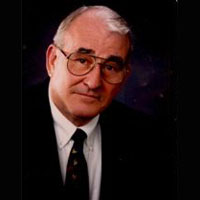
William James Fisher Portrait, Courtesy Gettysburg (GETT42200)
William James Fisher, at the age of 17, received a civilian appointment as 2nd lieutenant to the 10th US Infantry, a regiment of the Regular Army, dated and signed by the Secretary of War and President Lincoln, August 1861. Congressman George P. Fisher (no direct relation) procured Fisher’s commission at the urging of Fisher’s father, Isaac Montgomery Fisher.
The Delaware Volunteer Regiments had no officer billets available for an unknown, uncredentialed teen. Officers left the Regular Standing Army Regiments to staff and train the newly formed Volunteer troops. It was a natural political move to staff these vacancies by appointing promising young men from Civilian Life. As the Fishers were strong Union, Lincoln men, young Fisher was one of twelve to be commissioned into this youngest regiment of the Old Army.
Through the Fisher Collection letters, we learn of Fisher’s service with the Regulars until his death in the wheat field, Battle of Gettysburg, early in the evening of July 2, 1863.
The purpose of this research is to flesh out the life and times of Lt. Fisher and to promote the story of a regular soldier, largely unknown to the Civil War community. His immediate family and descendants cherished the collection of letters and artifacts for many years. These became available for public view in a private museum located in New Market, VA., circa 1954. The collection was put up for auction in 2001. It was subsequently purchased and donated to the Gettysburg National Military Park (GNMP), and now resides in that location. Artifacts and letters of this Fisher Collection are on display, “William is No More,” at the new Museum & Visitor Center of the GNMP.
Who Were the Fishers?
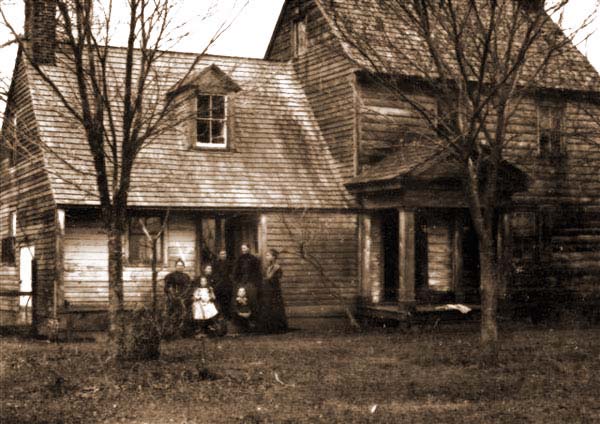
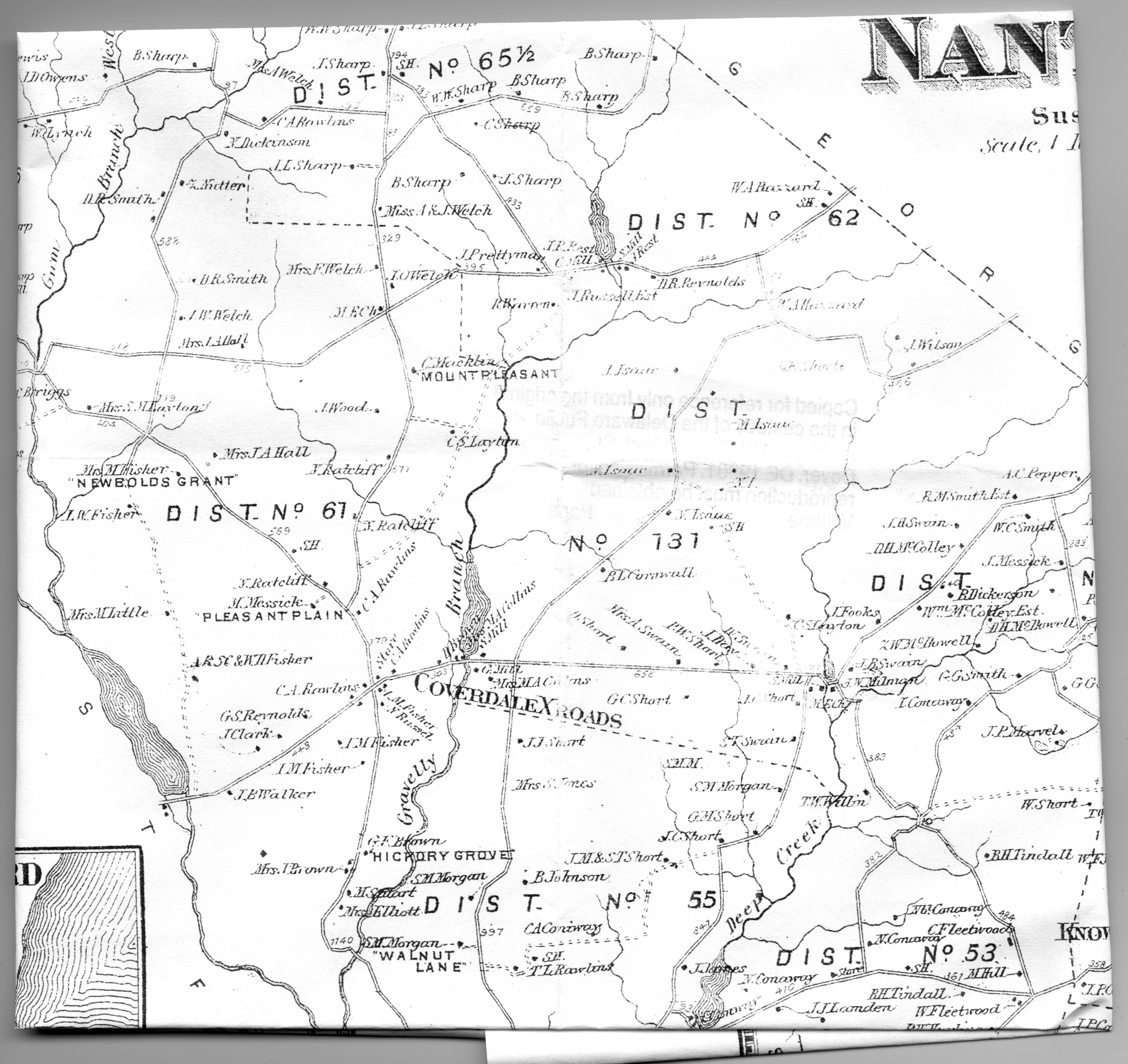
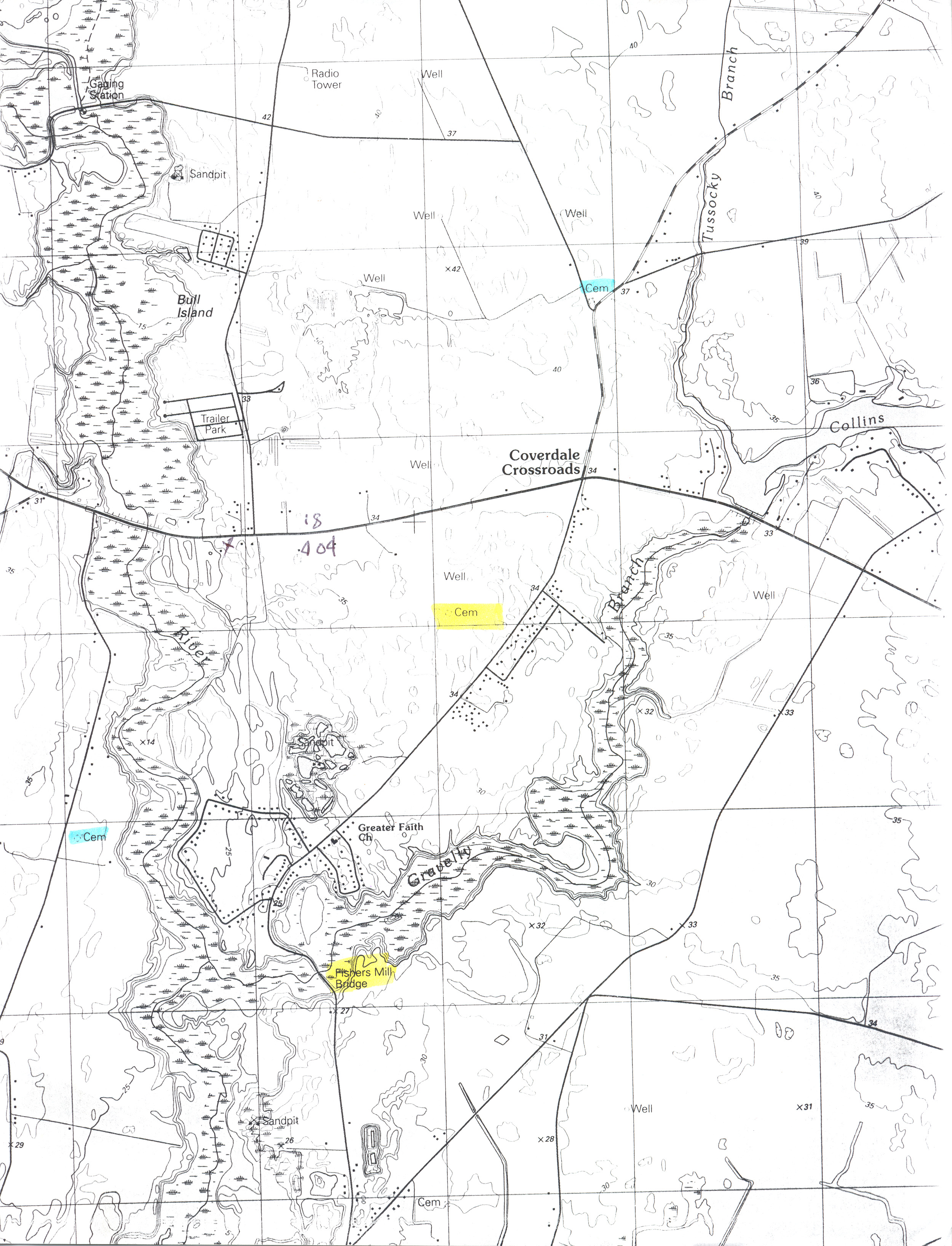
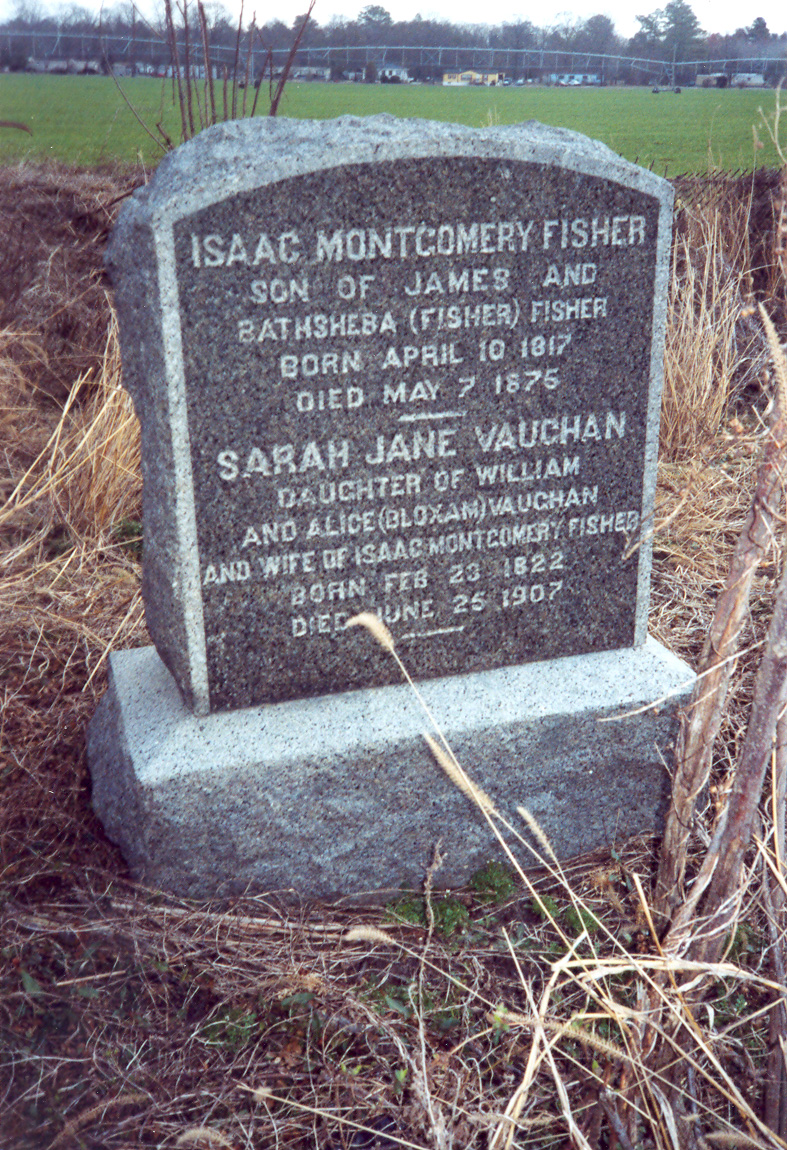
According to the auction house Guernsey’s: William was the first born of Isaac Montgomery Fisher and Sarah Jane Vaughan [sic]. Isaac was born April 10, 1817 and died May 7, 1878 (age 58). He was the son of James Fisher and Bathsheba (maiden name unknown). William, born December 28, 1843 in a house in the vicinity of Seaford, Delaware was one of nine children. The property was granted by the Lord Baron of Baltimore to George Fisher on July 30, 1732 (Fisher’s Fancy, 100 acres) and was know as the Fisher Fancy Farm or Nanticoke Farm. The home was built by George who passed it down to his son James and then James passed it down to his son Isaac. James and Isaac were also born in this home.
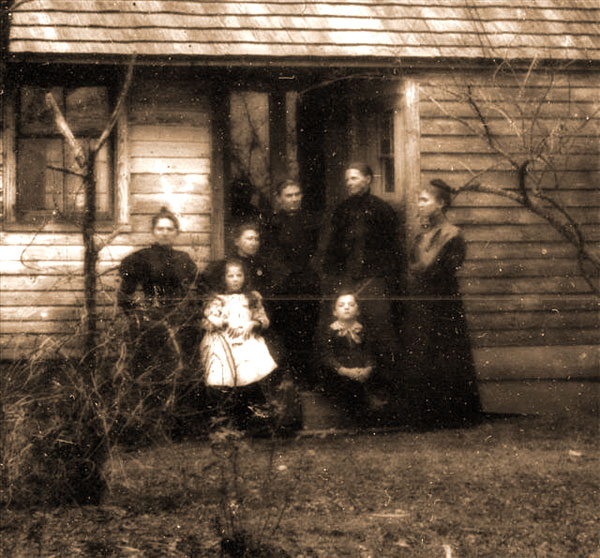
Fisher Home Ca. 1890, Courtesy Gettysburg (GETT42205). Guernsey’s: Glass plate 14 x 11 inch photo of the 1732 Fisher Home. Unusual photo in between 2 panes of glass showing the 1732 Fisher home place. Standing in front of the kitchen are 5 women and 2 children of the Fisher family. Glass is framed with a brass chain 3/8 inches wide with 18 inches of chain to hang on wall. The Horse Soldier, Item Code # 41. Price: $50.00Fisher Home, Courtesy Gettysburg (GETT42205), Detail1868 Beers Map
Letters
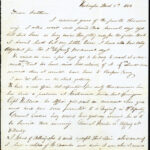
In 1861, Williams’s father, Isaac Montgomery Fisher, requested assistance from William’s teacher, Samuel J. Witherbee, in getting William a commission. Below, Witherbee was responding to a letter from Isaac that he had received two days prior. The Mr. G. P. Fisher referred to was George Purnell Fisher, the lone Congressman from Delaware, who was not a direct relative.
July 13, 1861 [Saturday]
Mr. Fisher:
Dear Sir,
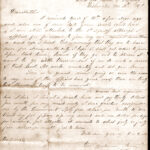
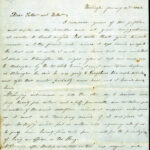
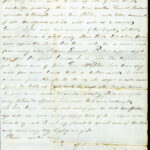
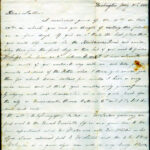
I received yours of the 11th & would say that I can heartily recommend your son in the particulars referred to. But I suppose my recommendation would have no influence where the selection proceeds from merit & not from favor.
I have no doubt William can pass the preliminary examination which is by no means a severe one.
I did not ask Mr. G. P. Fisher for an endorsement of this certificate, as his wife was dying, when I received your letter; he left immediately with her body for Connecticut.
Thanking you for your kind expression of sympathy for me in my bodily weakness.
Allow me to wish you a continuance of the blessing of health, with all other good [things].
Truly yours, S. J. Witherbee
On August 27, 1861, Isaac received a letter from George B. Rodney of New Castle, Delaware. The letter describes the process his son (George Rodney, 4th Artillery) underwent to gain a commission and advises that the cost of uniform, sword, etc. is $75.00.
New Castle, Delaware
August 27, 1861 [Tuesday]
I. M. Fisher, Esq.
Dear Sir.
I received your letter a few days since and I will give you all the information I possess.
After I had seen my son’s name, among those appointed by the President [Abraham Lincoln], I wrote for him [son George B.] to the Adjutant General [Lorenzo Thomas]. But the only answer given was the transmission of his commission. You might, with sincerity, do the same.
My son [George B. Rodney] sent forward his acceptance of the commission with the certificate of having later the oath required. He has since equipped himself with uniform & sword. He is now expecting to receive orders, but to what place he may be ordered is very uncertain.
All the appointments, including that of your son, I understand [are] to be in the Regular Army and will possibly be permanent.
The compensation of a Second Lieutenant is about $1000 per annum.
I had supposed there would be some examination, but as my son has received his commission, it will probably be omitted in his case.
He was a member of the Commonwealth Artillery Company of Philadelphia. [He] served 3 months, as such, at Fort Delaware. That fact may have dispensed with any examination, but, I am not certain that he will yet be examined.
He is between 18 & 19 years of age and, at the time he volunteered, was a clerk in a store in Philadelphia.
I would advise you to write on behalf of your son stating, that having seen his appointment Gazetted, he is awaiting instructions at his place of residence.
Yours very respectfully,
Geo. B. Rodney
P.S. If your son should conclude to get his outfit & will stop here [New Castle] on his way to the city [Wilmington], my son may give him some information as to the articles required, he having consulted Capt. Gibson of Fort Delaware on the subject.
The cost of his uniform, sword, etc., will be about $75.00
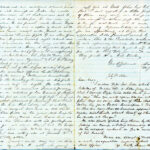
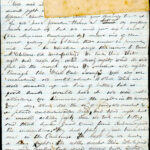
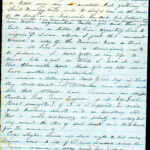
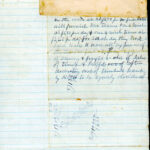
1861 Letters to Home
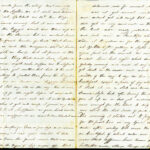
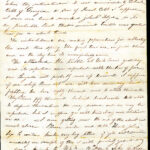
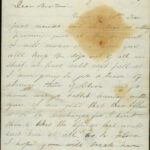
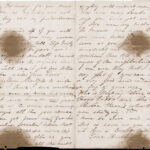
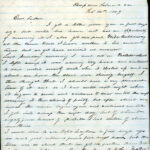
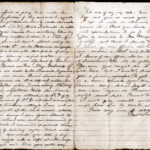
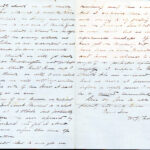
William wrote nine letters home in 1861, mostly covering his movements, gathering supplies, and details of his boarding arrangements where he complains about the high cost of living in Washington DC. There was an exciting incident when he arrested an officer who was suspected of being a woman and, under questioning, admitted to her fair sex, but was not found to be a Southern spy. Click on the image to read the letter and the transcription.
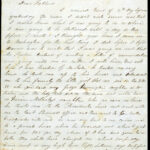
9-24-1861 William Fisher Letter
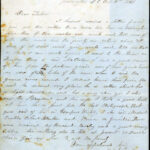
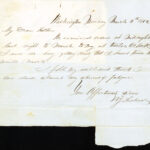
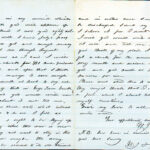
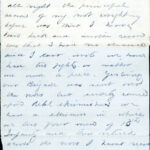
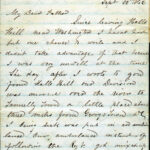
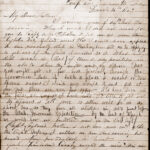
[ Washington, D.C.] Sep 24th 1861 [Tuesday]
Father:
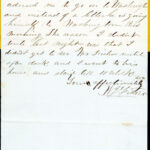
I saw Mr. [George Purnell] Fisher last night. He advised me to go to Washington, D.C. and instead of a letter he is going himself to Washington, D.C. this morning.
The reason I didn’t write last night was that I didn’t get to see Mr. Fisher until after dark. I went to his house and staid till 10 o’clock.
Your(s) affectionate(ly) son
W. J. Fisher
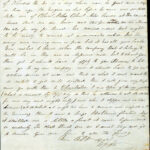
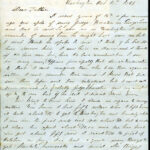
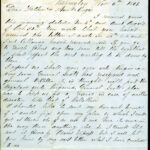
10-7-1861 p1 William Fisher Letter.
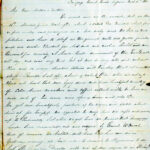
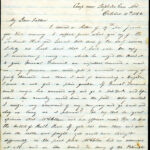
Washington, D.C. Oct 7th 1861 [Monday]
Dear Father:
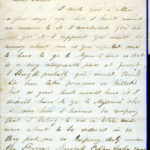
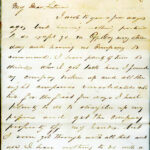
I wrote you a letter a few days ago but I haven’t received an answer to it. I concluded you did not get it.
I supposed you would be uneasy about me as you expected me to have to go to Missouri and as that is a very disagreeable place at present I thought probably you would think I’d been taken prisoner or killed but as good luck would have it, I didn’t have to go to Missouri.
When I came here I learned that the company [G, 10th US Infantry] that I belong to was in Utah and were about to be ordered in. So they put me on temp duty under the Provost Marshall.
Captain Layton came out here the same day I did. He got his commission and orders (I suppose) and departed next day for Boston. He is in
10-7-1861 p2 William Fisher Letter.
the 1st new Regiment
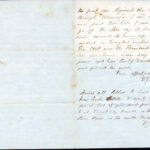
When I came through Wilmington, [Delaware], I saw Nathaniel Heald and paid that bill.
I saw a balloon go up the other day. It took time and or broke a line and carried the owner up in it. It landed in Maryland somewhere.
I’ve seen Gen Scott and the President since I’ve been here.
I am very well at present and hope this (if it reaches you) will find you all the same.
Your affectionate son
WJ Fisher
Direct all letters to: Lt. W. J. Fisher, Head Quarters Battalion, 2nd Infantry, and I will get it but if you don’t put that handle to it, I can’t say I will get it as there is another Fisher in the ranks. Write soon
WJF
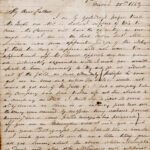
10-10-1861 William Fisher Letter. Washington, D. C. Oct 10th 1861 [Thursday]
Dear Father
I haven’t received a letter from you yet. I’ve written twice since I’ve been in Washington, [D.C.] before this. If this reaches you, write and tell me of all the news. How the family are getting along (too?). And if it don’t reach you, write and tell so that I can write again.
I went to the Review on Tuesday. There I saw McClellan. I had a good view of him from the pictures you’ve seen of him you’d have no idea of the looks of the man. When I saw the guard come round, I didn’t know him from the rest. He dressed very plain; is rather stout; has a light mustache and has a very clear eye.
I also saw the President and his wife. I took a good look at him. He is just like the last photograph you saw of him in Harper’s Weekly.
I also saw McDowell, Sickles, Colonel Blenker and Prince de Joinville.
There were reviewed six thousand cavalry and a great many artillery.
I’ve nothing else to tell at present so I will close. Give my love to all the family.
Your Affectionate son
Wm J. Fisher
There is a regiment of Cavalry passing my window as I write. WJF
10-12-1861 p1 William Fisher Letter.
Head Quarters Battalion 2nd Infantry
Washington, D.C.
Oct 12 ’61 [Saturday]
Dear Father
I received yours of 8th, day before yesterday [Thursday, Oct 10, 1861]
The reason I didn’t write sooner was that I didn’t know what I was going to do or where I was going to be stationed until a day or two before I wrote. I thought you knew I came on to Washington, for the last thing I did, before I left Dover, was to write that I was going on [to Washington] and that Mr. Fisher, instead of writing a letter of recommendation, was going with me…or rather I with him.
You ask how I was treated by Mr. [G. P.] Fisher; He treated me very well and kindly.
He took me up to his house and introduced me to his family. The little girl that we saw on the D.R.R., who you said was Judge Harrington’s daughter, is Mrs. [G. P.] Fisher. And the lady that sat on the same seat with her is Hiram McCauley’s daughter.
When we came on home, he [G.P.F.] took me to the President’s Levee, and went
with me to Adjutant General Lorenzo Thomas’, office. He also went to Gen. Scott’s headquarters with me.
He was very kind to me. Carried me to a private house where he boarded and where I got board for 1.25 per day. Whereas, if I had have gone to a hotel, they would have charged me about $3.00 per day.
House rent is very high here. Capt. Latimer pays sixty-five dollars per month for two rooms for this wife and himself. We got our room for nothing. The Government furnishes them.
My messmates are 2nd Lieut. W. F. Drum of Minnesota
10-12-1861 p2 William Fisher Letter.
who was at West Point for two years, about ten years ago. Lieut. Robt. P. McKibben of Pennsylvania and Dr. Woodholm of Kansas. The Dr. is a very clever man. He just came a day or so ago. The surgeon we had before he came was B. B. Miles, son of Colonel Miles. Colonel Miles boards at the same house that we do. Board costs $1.25 per day. We are allowed $1 and 20 cents per day for board.
We received orders last night to be ready to march at a moments notice. That has every one coming down in force but it has all your back.
You wished to know when the company that I belong to will be in. They are in Missouri now. But I shant join them yet. I should have to apply to Gen. Thomas to let me go to my own company and I should have to go into active service at once and that is what I don’t want to do until I get well drilled. Then I will join my company and go with them to Charleston.
I was Officer of the Day yesterday (what is meant by Officer of the Day is that he attends to all the duties of one day and night only) and when I stepped out on the scene (at 12 o’clock at night, we have to go around and inspect all the guards) there I saw a large balloon floating by. It startled me a little a first. It came before me so suddenly. The clock struck one so I must stop and go to dinner. Give my love to all the family.
Your aff. Son
WJF
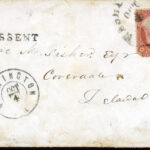
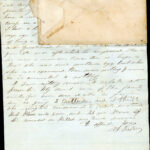
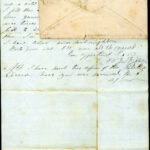
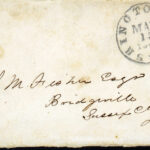
10-12-1861 Envelope William Fisher Letter
10-18-1861 p1 William Fisher Letter.
Washington, D.C. Oct 18th, 1861 [Friday]
Dear Father
I received yours of the 16th a few moments ago.
You spoke of seeing Judge Houston in Georgetown and that he said he saw me in Washington. I don’t remember seeing him. He might have seen me, but I don’t think he spoke to me. I think if he had, I’d have known him. I saw him in Dover and, I think if I’d have seen him here, I’d have remembered him.
I see so many men (officers principally) that I’ve been introduced to, that I can’t recognize them when I see them again or (rather), I can’t remember their names. I know that I’ve seen them before, and have been introduced, but I can’t recall their names.
So probably Judge Houston saw me and spoke to me. But if he did, I didn’t recognize him.
You want to know how I stand in regard to money matters. You know I had fifty dollars when I left home. It took about $15 to get to Washington, plus boarding while I was here. The first week cost me about $10.00. To make it clear, I’ve spent about $10.00 since I’ve been here. I’ve got about fifty now. I receive $10 the first of October as pay. I’ve had a great many things to get (blankets, haversacks and several other things).
We are getting ready to go into the field next week. If I like and nothing happens I shall receive $10 or so at the end of this month.
10-18-1861 p2 William Fisher Letter.
Page 2
I think there are no vacancies in any of the apartments, and if there were, I wouldn’t advise you to try and get it, for, if you be fortunate or rather unfortunate in getting a situation, you’d be sorry for it afterwards.
It would cost you $150 or $200 dollars per month to live here. House rent, for one thing, is so very high. You wouldn’t get a house large enough for less than $75 dollars per month and every thing else is in proportion.
The clerks hardly get time to eat or sleep. It is a continual go with them. They have to be at their place of business by eight o’clock and don’t get to dinner till four and then go back and stay till eight o’clock at night.
There is no news of any importance, I believe. Although there are a great many rumors, they will be contradicted before night
Give my love to all and write soon.
Your son
WJFisher
10-22-1861 p1 William Fisher Letter.
Washington, D.C. Oct 22nd 1861 [Tuesday]
Dear father:
Yours and George’s of 19th was received a few moments ago, and as I have nothing to do, and its raining so hard that I can’t go out, I will answer your inquiries at once.
The Washington news is no news at all. We have reports almost every day of battles and skirmishes just beyond the [Potomac] river, night before last. The train didn’t get in at the usual time and it was surmised that Beauregard had crossed over into Maryland, tore up the Rail Road and had defeated Banks and had possession of Baltimore. But of course it was all false.
Our forces made an advance yesterday. Gen. Stone and Colonel Baker was killed, this is true.
About the fleet that was reported out up at New Orleans is all a humbug. It was taken from Southern papers in the first place.
The tenth came in from Utah and arrived here, night before last 20, I’m expecting an order to join it.
All the officers here are getting ready to go into camp.
George says he have received three letters from you since you have been in Washington. I think this is the fifth one I have written. I wrote one on Sunday last and also one to Fred Callaway.
George says Bill Hinson enlisted and then they refused him
10-22-1861 p2 William Fisher Letter.
on account of his size. That was wrong. I’ve seen boys acting as drummers here, not over 10 years of age. They ought to have made him a drummer [boy].
Who is it that’s raising a company; George Lovell?
I expect I tire you of reading so many letters, but when I’m out of a job, I generally write.
Give my love to all and write soon.
Your son
W. J. Fisher
PS I expect we will go into Virginia this week or early next.
10-31-1861 p1 William Fisher Letter.
Washington, D.C. Oct 31st 1861 [Thursday]
Dear Father
I received you letter of 18th this morning.
The Laurel, Delaware news is news indeed for I never heard of it before. I think I had better correspond with some of the inhabitants of Laurel to tell me the news.
I think Uncle John’s boys might write to me. I wrote to them about ten days ago and haven’t received an answer yet. They might not have received it but if they haven’t they might write. I suppose they know where I’m stationed and if they are as interested in the War as you write, I think they would write to me and ask what they want to know about the looks of the Generals and the general appearance of the Army per se.
You write that you are going to send Sis to Philadelphia to some school but you didn’t write what school it was.
I think I should be able to send one hundred dollars home next month. With this months pay, I have to get an overcoat, which will cost forty dollars, and a heavy suit of common uniform for everyday winter wear besides camp beds and other things.
We are all ready (the soldiers) to go into camp and
10-31-1861 p2 William Fisher Letter.
I believe it is thought that we will get into camp in a few days but I cannot say positively anything about it. We may stay here a month or two or we may go into camp in a few days.
I had a little kind of an adventure a few days ago. I arrested an officer that was suspected of being a woman, carried him into the office and questioned him about where he came from etc. and after while he confessed that he was a woman. I was then in hopes that she was some southern spy, but when she was examined there was nothing proven so it amounted to nothing.
I have nothing more to relate at present. Why don’t some of the families write? You have done it all so far. Sis is going to Crittenden and I think she might condescend to write sometime. But please write soon and let me know, if I’m [not] wounded or killed any time (soon?).
Your affectionate son
WJFisher
11-6-1861 p1 William Fisher Letter.
Washington, D.C. Nov. 6th 1861 [Wednesday]
Dear Father & Aunt Angie
I received yours this morning, dated Nov 4th, and Aunt Angie’s of Oct 31st.
You write that you haven’t received the letter I wrote on the 20th Oct. and Fred Callaway hasn’t received his. If you go to Uncle John’s any time soon, tell the boys that I shall expect the next writing to be done by them.
I expect we shall move over into Virginia very soon. General Scott has resigned and general McClelland, it is thought, will put the Regulars into Virginia. General Scott’s plan was to keep us as a reserve in case of another disaster like that at 1st Bull Run.
I should like to send my overcoat home, if I could fix upon any plan by which I could get it there. It’s of no use to me here. It’s more in the way than anything else. So I think I’ll send it home by Adams Express, but I will let you know by my next letter what I have concluded to do.
I guess you have got your wheat sown and are getting in your corn.
We have it rather cool today. We had a very heavy rain last night.
11-6-1861 p2 William Fisher Letter.
I was passing down the Avenue yesterday and saw a bundle of partridges, a rabbit, summer duck, and a wild turkey hanging up before a restaurant. I felt then as if I should like to take a little spree gunning.
I guess Uncle John’s boys have a nice time now partridge hunting I should like to see them all and go hunting with them.
I’m very well except for a cold which I have taken since last night.
Write soon and tell me all the news.
Your affectionate son
W. J. Fisher
PS I have sent two copies of the Rebellion Record. Have you ever received them? W.J.F.
11-20-1861 William Fisher Letter.
Head Quarters Battalion 2nd Infantry
Washington, D.C. Nov 20th 1861 [Wednesday]
Dear Father
I received yours of 12th a few days ago and also one of same date from Uncle John’s boys.
I am still attached to the 2nd infantry, although I applied for permission to join my own Regiment more than a week ago. I heard this morning that they are to leave soon for Leavenworth City. I hope I shall get orders to join before that time because if they go out to Kansas I want to go with them. But if we do make a move of that kind I’ll write immediately and let you know.
There is a grand review going on over the river today. Most of the officers have gone over. There are thirty-two thousand troops to be reviewed.
To answer Ma’s inquiries on how I live, I live at a private house and pay thirty dollars a month for my meals only. I have quarters assigned to me by the government. I pay five dollars per month to a black boy for fixing up my rooms and one dollar per day for washing. Put all together it amounts to about forty or forty five dollars per month just to live.
Write soon give my love to the family.
Your affectionate son
W.J.Fisher
1862 Letters to Home
In 1862 William shook hands with President Lincoln; complained about the infrequency of letters from home; was grazed in the neck by a mini ball but not injured; witnessed mounds of rebel dead; and decided he’d had enough of soldiering and was making plans to buy a farm.
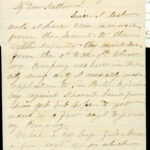
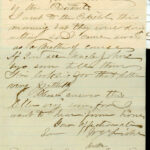
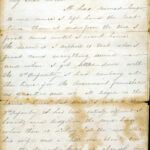
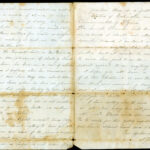
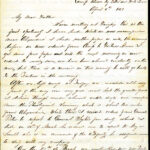
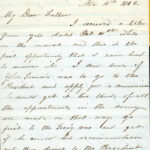
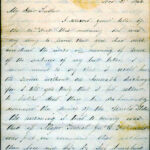
The November 10, 1862, letter image is missing but a translation is found here:
Nov 10th 1862 [Tuesday]. Camp near Warrenton, Va.
My Dear Father:
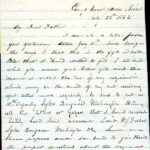
I received a letter from you dated Oct 31st while on the march and this is the first opportunity that I have had to answer it.
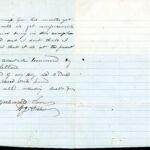
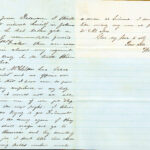
I am sure if John Francis was to go to the President and apply for a commission he could get it. Two thirds of the appointments in the army are made in that way. Go first to the Secretary of War and get, if he could, his recommendation and then direct to the President and I am sure he could get it. If he tries it he had better go to Lt. Col. Garesche of the Adjutant General’s department; He being from Delaware, I think, would interest himself in John’s case. He had better get a letter of recommendation from George P. Fisher. There are vacancies in almost every Regiment in the Army. In the 10th there are two.
General McClellan has been superseded and no officer or soldier, that I have seen, so far has any confidence in anybody else. It would not at all surprise me if we get whipped in the next fight. I believe they are trying to get Fremont to head the army again. If they do, I shall resign and go to South America and try something else; for I don’t like the idea of being killed under such man as Fremont.
I don’t feel like writing any more at present, so I’ll close.
Give my love to all. Your son, Will
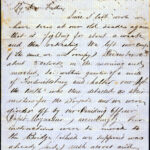
1-3-1862 Father 1.
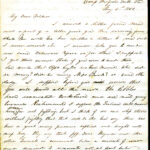
Jan 3rd, 1862 [Friday]. Washington, D. C.
My Dear Father:
Since I last wrote I have been removed from the Second to the Eighth Infantry. They moved me from the 2nd to the 8th. When my Company was here in the city doing duty, I immediately made application to Gen. Porter to join my Regiment. I haven’t heard from him yet but hope to get orders in a few days to join my Company.
We had a very large fire here a few days ago. In which two hundred and sixteen horses were burned.
I was at the President’s house yesterday and shook hands with
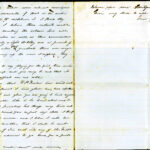
1-3-1862 Father 2.
him. I also saw Mrs. Lincoln who stood by the President.
I went to the Capital this morning but they were doing nothing so I came away as a matter of course.
If you see Uncle John’s boys soon tell them I’m looking for that letter very patiently.
Please answer this letter very soon for I want to hear from home.
Your affectionate Son, Wm J. Fisher
Direct your letters to Headquarters Battalion, 8th Infantry. WJF
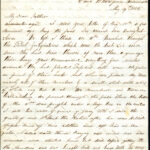
1-3-1862 Mother 1. Jan 3rd ’62 [Friday]. Washington D.C.
My Dear Mother:
It has seemed longer to me since I left home the last time than it did from the time I first came until I went home. The reason, I suppose, is that when I first came, everything seemed new, and when I got settled down with the 2nd Infantry, I had company all the time, for the Government furnished us quarters and we all lodged in the same house, but since I came to the 8th Infantry, it has been entirely different. I board and lodge in the same house where there is nobody else but the man and his wife and a little one, about two months old, who keeps up almost a continual squeak from night until morning. That is the only time I’m in.
I have a very nice little room neatly
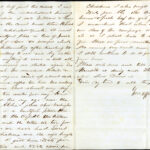
1-3-1862 Mother 2-3.
furnished with bureau, washstands, writing table, and a couple of chairs. It also has a fire place and if I stay here this winter, I shall be fixed very comfortably. I pay fifteen dollars for room and fifteen for board, making it cost me the same as when I was with the 2nd.
I was at the President’s levee on New Year’s Day and had the pleasure of shaking hands with him. He had on a pair of white kid gloves, I suppose when he commenced, but when I saw him, they were about the color of Tom’s kids when he had no gloves. I saw his wife standing by him. I told you I thought she was very near the size of Sarah Meredith but she is not much taller than you and looks as duchy as she well can look.
I’ve been to the Capital several times lately and I’d give about anything to have you all see it. There are more of the finest pictures I suppose that are in America. Several of them are as large as one side of your parlor.
There is a full statue of Washington presented by the Commonwealth of Virginia. The Senate Chamber and House of Representatives I shall not attempt to describe. I couldn’t tell you anything like how they look. But it would be worth while to come here just to see them if you didn’t expect to see anything else.
I hope you all had a merry time of it this Christmas. It was the first one that I ever remember of being absent and I never saw a Christmas that I enjoyed so little.
I have nothing else to write at present so I’ll close, hoping this will find you all well. Please write soon and tell Pa to write for I’m getting impatient to hear from home. I haven’t heard since I came away.
Your affectionate son. W. J. Fisher
1-16-1862 p1.
January 16th, 1862 [Thursday]. Washington, D.C.
Dear Father and Mother:
I received yours of the fifth and sixth on the seventh and, at your suggestion, I wrote to Aunt Angie. You wrote that you hadn’t received a letter from me since I left home except the last one I wrote on before that and wrote that I staid in Wilmington the night after I left and came on to Washington by the 12 o’clock train next day.
I saw Captain Layton in Wilmington. He said he was going to Georgetown this next week and after that would probably come here, but I haven’t seen him.
Mr. Lovejoy introduced a bill the other day to decrease our pay twenty five dollars and a half per month and Mr. Wilson put in another of the same description which I suppose will pass as it don’t cut their pay down. If it does pass I hope Mr. Lovejoy will put in another bill requiring all of us to pay him twenty five cents per month for the privilege of being an officer in the army.
Mr. Cameron, after stealing a million or two, has resigned and Mr. Stanton of Pennsylvania was appointed in his place. I think this will be a move very soon.
We received
1-16-1862 p2.
orders to draw one hundred rounds of ball cartridges for every man and to use up all of our blank cartridges practicing. There has been another Provost Marshal appointed to Washington and General Porter will take command of all the Regulars which will act as a reserve.
General Sykes will have command of the infantry I think, and I believe a great many of them think, when Burnside’s Expedition lands, that there will be a war made from every side.
I saw General Butler a few days ago for the first time. He is just like the pictures you have seen of him.
Gen. McClellan has been very sick for some time but is better now.
There are a great many soldiers and officers, here now that were exchanged.
It has been sunny and rainy for the last twenty three days and we have a very slippery time of it. I slipped down twice today and it’s not very pleasant to sprawl down in the street and have every body laughing at you.
Please write soon.
Your affectionate son, W. J. Fisher
Tell Sis to write what she wanted me to send back by you and maybe I’ll send it if she will knit me a pair of gloves.
1-16-1862 Envelope
1-21-1862 p1.
January 21st, 1862 [Tuesday]. Washington, D.C.
Dear Father:
I received yours of the 10th on the 19th in which you said you thought of visiting this place in a few days. If you do, I think the best place that you will stay would be the Kirkwood House. You could stay there for the first day or two but if you want to find Mr. Luff’s, he lives on 9th between “E” and “F”, 2nd door above “F.” If you could, if you wanted to stay with me, and take your meals at some of the hotels where I think you could get them for about seven dollars per week. I have a very nice room and I think you would enjoy yourself more by staying with me (at Mr. Queen’s) because I’m in a very quiet part of the city on Massachusetts Avenue between 6th & 7th but be sure and come.
We all (of the officers) called on Mr. Stanton yesterday. We first went to the Provost Marshal’s office and from there to the War Department where Mr. Stanton was with Gen. McClelland in his office. I was introduced first to Mr. Stanton and then to Gen. McClellan. Mr. Stanton is a good sized man with a very heavy black beard. That is all I can see of him. I hope he will make as good a secretary as Mr. Cameron.
All those officers that wanted
1-21-1862 p2.
to, then went up to pay their parting respects to Mr. Cameron. As Deputy Secretary he made a short speech and Gen Thomas replied in his reply. Gen. Thomas said our army was all ready to move and that in a short time, a very short time, this Rebellion would be crushed out.
I think we will move as soon as the weather permits.
I am not very well at present and haven’t been right well since I left home the last time.
We have it very muddy here now.
I saw Captain Layton Saturday.
If you can, be sure and come very soon if you want to see the Army before it moves.
Your affectionate son, W. J. Fisher
3-5-1862.
March 5th 1862 [Wednesday]. Washington, D.C.
Dear Father:
I received yours of the fourth this evening. I also received one from Ma several days ago. But I’ve been so busy since then, getting ready for the field, that I haven’t had but very little time. I have also been acting Adjutant for the 8th Infantry for several days.
We received an order a few days ago to be ready to march at a moments notice, but we have since been relieved of it. If we should have moved then, it would have been to Harper’s Ferry.
I saw Mr. Bell in the street yesterday.
We have a new officer that reported for duty this morning. He has been a prisoner in Richmond since last spring. Captain Willard, the officer you saw in command when you were here, has been promoted to a Majority in the 19th Infantry.
General Lander’s body arrived here yesterday evening. He is to be buried this morning. General Hunter is stopping at Willard’s.
I know of nothing else to write except that I’m alive and if I have a relapse of the measles and hives, it was when I was asleep.
Your Affectionate Son, W. J. Fisher
3-10-1862.
March 10th 1862 [Monday]. Washington, D.C.
My Dear Father:
We received orders at midnight last night to march today at twelve o’clock. I am so busy getting ready that I haven’t time to write more.
I feel very well and think I can stand almost any amount of fatigue.
Your affectionate son, W. J. Fisher
3-15-1862 p1.
March 15, 1862 [Wednesday]. Fairfax Court House, Virginia.
My Dear Father and Mother:
We moved out onto the sacred soil on the 10th. Started out from Washington about 2 o’clock P.M.; marched about four or five miles and encamped in a low bushy wood. We have no tents pitched and had to sleep on the ground with one gutta percha and one woolen blanket for a bed, and one woolen blanket and an overcoat for covering.
I had command of the Rear Guard all day and was very tired. But it was so very cold and wet and there was so many drunken soldiers and teamsters that I couldn’t sleep.
Reveille beat off about 4 o’clock A.M. When we got up, those at least that were lying down, and had breakfast consisting of cold ham, crackers, and coffee with no milk. We have a nice set of tin ware, including spoons, knives, and forks, etc. After we got our breakfast, we packed up the wagons, and started about sun up for Fairfax.
We expected to camp here all night and move up to Centerville. But when we got here, we learned that Manassas had been evacuated and was occupied by General McDowell. And of course we halted and have been here since yesterday evening. We received orders to march to Alexandria today. The Quartermaster, with one of our wagons, is in Washington and we are waiting impatiently for his return.
I am acting Battalion Adjutant and have a horse to ride, which,
3-15-1862 p2-3.
if I am on the sacred soil, I’d rather ride than walk.
It is very uncomfortable in camp today. It is raining very hard and has been raining moderately all day. I am sitting on a camp stool in a small tent writing on a small fine table. My adjutant books and desk are on my left, my saddle, bridle etc., are on my right, with the surgeon behind me lying in a small cot, trying to sleep off the blues. The table furniture consists of one bottle of ink, sheets of paper, pipe, dirty collar, necktie, a tooth brush, broken padlock, and sword belt and sash, besides a revolver.
General Smith’s division passed this morning on their way to Alexandria. I think it is estimated that at least fifty thousand men have been sent there.
I had three Rebel Prisoners turned over to me the last time I was Officer of the Day. One was a Louisianan and the other two were Virginians. The Louisianan was dressed in a gray cotton uniform with a blue cap. The others had no uniforms on. We have three more in camp to day; 2 more Virginians and another Louisianan. Neither of them have a uniform on.
General McClelland’s headquarters have been, until today, within two hundred yards of us. But this morning, at 5 o’clock, he moved off toward Alexandria.
We have two companies from the 17th Infantry here. One is commanded by Capt. J. P. Wales of Delaware.
Please write me direct to Washington, D. C., Head Quarters Battalion, 8th Infantry.
Your affectionate son, W.J.F.
4-6-1862 p1.
April 6th, 1862 [Sunday]. Camp between Big Bethel & Yorktown, Va.
My Dear Father:
Since writing at Fairfax this is the first opportunity I have had. While we were encamped near Alexandria I had neither paper nor ink. The evening before we were ordered from Camp to Fortress Monroe, I got some pens, paper and ink. The next morning we were ordered to move. Since, we have been almost constantly on the move. But there is a carrier this evening. He will go back to the Fortress in the morning.
After we left Fairfax, we marched all day, part of the way over a very good road but the greater part, I believe, through mud, almost ankle deep, and encamped near the Physiological Seminary which is about two miles from Alexandria. While there I received orders from General Porter to report to General Sykes for duty which I did on the 22nd of March. He ordered me to report to Major Lovell who is in command of the 10th Infantry. He assigned me to duty with my Company G.
On the 27th of March we embarked for Fortress Monroe as we all supposed and our supposition for once happened to be correct.
We anchored in the
4-6-1862 p2-3.
stream, about one mile from the wharf. Next morning, after hitching on to two lighters, we set sail and arrived at Fortress Monroe at 11 ½ o’clock on the 29th. Our troops were landed the same evening but I was detailed to take charge of the baggage which was taken up as far as Hampton on the steamer but we could not land on account of the great number of boats that had got in ahead of us and the consequence was I had to pass another night on board but it proved in the end to be the best thing that could have happened to me.
I got a good nights rest, supper and breakfast while those that landed got mutton but had to be out all night with nothing to protect them from the heavy dew which fell.
The next day we landed our baggage, but didn’t have transportation for it ‘till very late in the day, then it was my turn to make up for the night before.
It came on to rain about three o’clock and I was out in it until 9 o’clock and got very wet. When I got into camp, I found my bed lying in the mud. But it happened, as good luck would have it, it was wrapped in India rubber blanket and didn’t get wet.
We were encamped near Hampton for three or four days and were then ordered to move. I was again detailed to take charge of the baggage train, then join it, move that was made.
One of my teamsters broke the tongue of his wagon off. That detained me for several hours and the consequence was I got several miles behind the company and didn’t get into camp till near 8 o’clock. When I did get in my room mate or tent mate had the tent all ready pitched after getting supplies and took over a news paper which was about a week old. I turned in for the night.
Reveille beat off at 3 ½ A.M. After getting a light breakfast we were again put in the march. We marched all day and arrived here last night about dusk. It rained very hard yesterday morning and made it very hard marching. Our wagons got stuck in the mud and didn’t get in until about the middle of the day.
To day we had nothing to eat yesterday after breakfast, except a piece of pig which somebody had killed. I stuck it on a stick and tried to roast it in true prairie style but after burning the outside to a crisp I gave up as a bad job and ate it raw or that is raw enough for the blood to drip. But to my mind it was about the best piece of pork I ever ate.
This morning I started out to forage for something to eat for the first time in my life. I went to a farm house and after waiting till near the middle of the day got a breakfast of wheat cakes and coffee and they told me that coffee had been selling for $1.25, for the butter .75 cents and things in proportion.
4-6-1862 p4.
We are now occupying quarters that were built by the Rebbles but were a banded by them when they retreated. It was commanded by Colonel Cobb of Georgia, a son of Howell Cobb I suppose. I saw one trunk marked John S. Floyd, so it very probable that that eminent traitor was quartered here for a short time.
The inhabitants are making preparations for cultivating the soil this spring. The fruit trees are in full bloom and in the day time it’s uncomfortably warm.
We attacked the Rebbles at Yorktown yesterday and it was reported we were repulsed with the loss of five. Our Brigade will probably move up tomorrow. I suppose if we whip them out, we will have some very hard fighting. We have eighty thousand men to attack them with. They have fifty thousand behind breastworks to with which to defend themselves. We may succeed and we may be repulsed but, I suppose, you will know it very soon, whichever we do.
I am getting near the end of this sheet and must close. Please write and tell Uncle John’s boys to write. Write very long letters. If you will write immediately, on receipt of this, I will probably get it very soon.
Direct to W. J. F. 10th infantry, Sykes Brigade, Washington, D. C.
Your affectionate son, W. J. Fisher
4-6-1862 Envelope
4-21-1862 p1.
April 21st 1862 [Monday]. Camp Winfield Scott, near Yorktown
Dear Father:
I received yours of 14th yesterday; the first I’ve received since leaving Washington. I believe one letter was brought into Camp but I never received it. You wrote of the death of Uncle Joe; the only true Uncle that I ever had.
I am very glad to hear that Aunt Eliza is getting well enough to be out again. I hope the next time I go home I’ll find her perfectly well.
I left my trunk and all my other things, except one valise and my bed, in Washington, at Mr. Queens on Massachusetts Avenue, between 6th and 7th Street. I believe you were there while in Washington, so, if I should be so unfortunate as to be killed, you will know where to find them.
Very nearly all the male inhabitants of this section of the country have gone to the war. The females generally are secessionist but you can get anything they have for coin. A piece of gold will open their hearts at once. All that I have seen, so far, say their husbands were drafted into the Rebble service. They have plenty of shinplaster of from two to ten cents,
But will sell a handful
4-21-1862 p2-3.
for a quarter.
I saw an hundred dollar CSA currency note, made payable with eight percent interest, six months after peace is declared between the Northern states and the Southern Confederacy.
I suppose there is no mistake about the death of A. S. Johnston. Jeff Davis announced it in his message about Beauregard losing his arm. I believe it hasn’t been contradicted.
General McClellan is encamped within about one hundred yards of my tent. I see him nearly every day while going out or coming into camp.
There is firing going on almost continually. There was skirmishing a few nights ago, about half mile from our camp, in which several men were killed.
If you could have been at our dinner today you would have seen the use of tin plates. We had oysters, ham, warm bread, onions, and several other little things. We get milk in a condensed form, in a small can, for which we pay about $.75. It’s a very good substitute for pure milk.
My health is, and has been since leaving Washington, tolerably good with the exceptions of a few days. It has been raining pretty steadily for the last four days but cleared pretty well up this morning.
Since I last wrote, we have moved up about three or four miles, so we now are within two & half miles of Yorktown.
There is mail, which runs pretty regularly from Washington to Headquarters, through which we get our letters.
Please write soon and write very long letters and, if you see Uncle John’s boys, tell them, if they want to hear from Yorktown, to write. I would be glad to have letters from anybody.
It’s so very lonely out here. Nothing to see here or read.
Your affectionate son, W. J. Fisher.
5-2-1862 p1.
May 2nd1 862 [Friday]. Camp Winfield Scott, near York Town, Va.
My dear Father:
I wrote home several days ago but as yet I have received no answer. I received a letter on the 28th that was dated March 24th, the same letter, I am almost sure, that came into camp about three weeks ago, but I was not here at the time and it was thrown back and taken to Washington again.
Last night, about half past eight o’clock, our commanding officers came to the tent and told us to have our companies ready to fall in under arms at 4 o’clock this morning.
General McClellan sent a dispatch that the enemy would, in all probability, make an advance during the night.
This morning we were up in time but everything was as quiet as usual. After standing about two hours we were dismissed.
There is one battery, within half a mile of our camp that has five one hundred pounders and one two hundred pounder, the purpose of which is to shell Gloucester Point.
The capture of New Orleans is a grand thing, if true.
It’s rumored around in camp that there is going to be a cessation of hostilities for a short time, but I can’t tell whether there is any truth in it.
5-2-1862 p2-3.
We have plenty of sutlers out here, at least the 10th US Infantry have one, and I know of several of the regiments which have three. They make a great deal of money. In the first place, they sell these things for about three or four times as much as they cost. Eggs, for instance, they sell for 40 cents per dozen; bread, for about twenty cents per pound; and then other things; in proportion. Our sutler told me, Sunday morning about nine o’clock, that he had taken in two hundred & sixteen dollars in cash besides about three hundred dollars in orders. I suppose he makes from two to three hundred dollars clear. Every day he has sold his first cargo and is, tomorrow, going to send after a second load.
I’ve sent for a felt hat, but it’s a little too warm, here, for cap.
As to the news, if there is any, you get it about two days sooner than we do. I believe we have received newspapers two days old, but very often we get them about the 4th day after they are published.
I’ve a notion to write to Mr. Queen and have him send my trunk home by express. I could send the key in a letter and you could have my clothes and other things taken out and aired well so no moths get into clothes that way or do you think that it’s air tight. If Ma thinks there is any danger, I believe, I’ll have it sent home for I have some very valuable clothes in it that I don’t want spoiled.
I have only received two letters from home, since going into the field nearly two months ago. Please write once every week, anyhow, and tell all to write as often as they can and, above all other things, I should like to receive a letter from Ma.
Give my love to all the family. Your affectionate son,
W. J. Fisher
5-4-1862 p1.
May 4th 1862 [Sunday]. Camp Winfield Scott, Va.
My Dear Father:
I received a letter from Ma and a part of a letter from you this evening. From what Ma wrote, Sis has written a letter to me, but I never received it.
I would like you to send me some Delaware newspapers. As for others, I suppose, I get them sooner than if you were to send them.
Sis writes that Capt Layton has been married. Who did he marry? Did he marry Miss Bush: or some other lady?
I suppose before you receive this you will know all the news. The Rebbles have evacuated Yorktown and are now going toward Richmond. I suppose, the Tribune will censure hard McClellan for not fighting, but I think if we can whip them without fighting, that will be to the best way.
There has been a great many prisoners captured and brought into camp today.
They say Jeff Davis, Magruder, and the other Generals in command, held a council of war and decided to evacuate. All, at least but Magruder, and that he appealed to the soldiers to stand by him and defend Yorktown. But they would
5-4-1862 p2-3.
not back him up and were about unanimous in their vote to evacuate. If that is so, then we have no reason to disbelieve it.
I think they are past fighting. I believe these retreats will have the effect of making the soldiers lose all confidence in themselves as well as their commanders.
All of our cavalry and light artillery are in pursuit of the enemy as are also our gunboats. There was very heavy firing this evening up the river. I suppose they had caught them.
Our bands came out today playing for the first time since we have been in this camp and you may be sure that it has a very cheering effect on us all.
I see by the papers that G. P. Fisher has come out and opposes Emancipation.
I am glad you are going to have a good crop of fruit. I should like to be home about next September to get some peaches but things may turn out so that I can be home for a few days then.
I think that as soon as this war is ended, and I believe it will be ended with in a few months, that I shall be sent on recruiting service. If I’m sent to any of the middle states, I will have a chance to get home for a few days.
Please write soon and send me some Delaware newspapers; Advertisers and Messengers.
Give my love to all the family. Your affectionate son. Will
5-24-1862 p1.
May 24th 1862 [Saturday]. Camp, 12 miles from Richmond, Va.
My Dear Father:
I received your letter of May 19th a few moments ago, being the first I’ve received since leaving Yorktown.
We left, I think, on the 10th and marched through the Rebel fortifications which were the best I’ve ever seen. They had been thrown up more than a year ago. Their heavy guns commanded everything for miles around. They had planted torpedoes all over the fields in front of their works but when we passed, they were nearly all of them marked by a small stick with a slip of white rag tied to it.
We marched on towards Williamsburg we passed through the field where the battle of the 5th was fought. Under a large tree, in the center, I saw two Rows of graves of Jersey Vols. I saw the grave of one 2nd Lieutenant. After he was killed, the Rebels stripped him of his clothes and left him on the field. I also saw them burying one man that was wounded. He had started home but died before getting to the landing and was brought back and buried with his comrades. I forgot to mention a grave yard I saw near Yorktown of the 5th Miss. Battalion.
We marched through
5-24-1862 p2-3.
Williamsburg about half past two o’clock. I saw a great many of the inhabitants peering through the windows. I saw William and Mary College and also the court house where Patrick Henry made that celebrated speech. It must have been a beautiful place in time of peace but it’s more full of soldiers.
We encamped about four miles from Williamsburg after marching 21 miles. We had nothing to eat and lay on the ground without anything to cover us with all night. Next morning we started again on an empty stomach. We marched 13 miles and halted, our wagons came up about dark when we got some coffee.
We have been making short marches since then, almost every day, of from five to ten miles per day.
We were encamped two days ago near the White House on Gen. R. E. Lee’s place where Washington was married. It is a beautiful place.
The nearer we got to the Capitol the better the country looks and the better we live. For the last two days we have had sweet potatoes and chickens. An old Negro brought them into camp. I gave him .75 cents for a peck of potatoes and .50 cents for other Chickens. I also bought some butter for .75 cents per lbs. Things such as flour, hams, and fresh beef, we get from the commissary.
I understand that when we get to Richmond our share of the campaign will be over. If it is, I shall hate to lie in camp for three or four months.
It’s raining very hard and looks as though it will continue to do so for the next twenty four hours.
Please write soon and tell me what Wm. Meredith is doing and where he is and also where David is.
Give my love to all the family. Your affectionate son, WJ Fisher
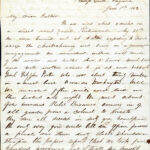
6-1-1862 p1.
June 1st 1862 [Sunday]. Camp Lovell, Va.
My Dear Father:
We are about 8 miles in a direct route from Richmond.
On May 28th we were turned out at 3 A.M., expecting to march across the Chickahominy River and bring on an engagement. We marched within half a mile of the river and halted. Laid 5 hours, went back and took another road to go up and support General Fitz-John Porter who was about twenty miles in a direct line towards Washington. Well, we marched fifteen miles and laid in the bushes all night.
We met about five hundred Rebel Prisoners coming in, of all grades, from a colonel to private. They were all dressed in dirty gray home spun. The only general way you could tell an officer from a private was their dirty black shoulder straps. The papers report that we took five hundred prisoners but I think we brought in more wounded Rebs than that. The next day we marched back to camp.
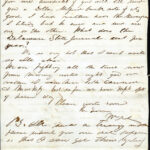
6-1-1862 p2.
I wish you would subscribe for either the Peninsula News or the Messenger for me immediately if you will. I’ll send you a dollar Milford bank note if it good. I had rather have the Messenger, I believe, but be sure and send me one or the other. What does the Delaware State Journal cost per year?
It is so very hot that I can’t write so I’ll close.
We are fighting all the time now from morning until night or rather, I can hear both cannon and musketry, but so far we have kept out of harm’s way.
Please write soon. Your son, Will
PS: I’ll send a treasury note, please subscribe for one Del. paper, so that I can get them regularly.
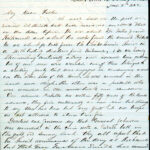
6-7-1862 p1.
June 7th 1862 [Saturday]. Camp Lovell, Va., 8 miles from Richmond.
My Dear Father:
I wrote home on the first or second, I think, but have received no answer to that or the letter before.
We are about 7 ½ miles from Richmond and about two miles from the enemies picketts. We are about ½ mile from the Chickahominy River in a north easterly direction from Richmond.
We are having skirmishing continually along our advance lines. Yesterday two of our men were wounded; one of them belonged to a working party that was engaged in corduroying a road on the other side of the River. He was wounded in the hand and thigh, the other was a Pickett who was wounded in the back and shoulder. Our advance picketts are within fifty yards of the Rebels advance. They fire continually at our men but, strange to say, there has been but very few hits. Our troops are not allowed to return their fire.
Deserters and prisoners say that General Johnston was wounded in the groin with a minie ball in the fight on Sunday last. They all report that he hasn’t commanded the army at Richmond but that Gen. Gustavas Smith has commanded.
I don’t know what else to write except that I bought a revolver of the largest size the other day. It carries a ball weighing half an ounce, the same
6-7-1862 p2.
size that your old rifle carries. I think it can kill a man at fifty yards if I hit him in the proper place but I hope I shan’t have the opportunity. I don’t care to have even Rebel blood on my hands.
I just heard that one of our gun boats (the monitor) is within two miles of Richmond and that the Galena has been sunk; but I hardly believe it.
For the third time I will tell you that the next letter I write will be dated Richmond.
Please write soon, very soon. Give my love to all the family
Your affectionate son, W. J. Fisher
6-15-1862 p1.
June 15th, 1862 [Sunday]. Camp Lovell, Va.
My Dear Father:
I received yours of the 7th but on the 12th answered your inquiries as to which division Sykes’ Brigade is in. About two or three weeks ago he was just in command of a division consisting of the Regular Brigade: The 5th and 10th New York Vols. with the 1st Connecticut. We are at present attached to General Fitz-John Porter’s Corps, but only temporarily. Ours is in reality an independent Brigade.
Day before yesterday a Rebel cavalry officer by the name of Randall, formerly of the 1st Dragoons, did one of the sharpest things I think
6-15-1862 p2-3.
that I ever heard of. He took a detachment of cavalry and rode around the right of our lines. Came up in our rear, burnt Tunstall’s station, and got drunk on government whiskey. Stole 800 head of cattle and got back without being caught, although we put eight thousand cavalry after him, but none caught up with the exception of two Cos. of 5th US Cavalry. Then the Rebbles were in such force that we were [illegible] had the first Lieutenant killed in the first charge. Two Rebbles, one an officer, set on the captain. He, at the first cut killed the [illegible] officer, and then struck at his head. But he being an old officer and knowing perfectly the use of the saber warded the blow off. Then gave the Rebble a back cut with his saber which cut his (the Rebble’s) face open. The name of the Federal was Captain Royal of Virginia but he is much a Rebel.
I wrote a few days ago saying I would like for you to subscribe for two or one newspaper (Del) and have it sent to me. You need not be afraid but that I shall get it for the mail runs regularly no matter whether we move or lie still. I received just now a paper, The Advertiser, the first Delaware paper I’ve seen
6-15-1862 p4.
since leaving home, but I saw no particular news with the exception of the death of William Browne, but that I saw in your letter.
When you write again tell me what Uncle John’s boys are doing. Tell one of them that he had better try for a cadet commission to West Point. There are now three hundred appointments to be made and I think about twenty of them are to be made at large.
Please write soon. Give my love to all, Your son, W. J. Fisher
6-21-1862 p1.
June 21st 1862 [Saturday]. Camp Lovell, Virginia.
My Dear Father:
I haven’t received a letter from you for I don’t remember how long. But having nothing else to occupy my valuable (?) time, I will write a letter home. If you don’t get letters from me it’s not my fault. For I think I have written once about every three or four days since first moving into this camp. I believe that you write only when you received a letter from me, but when you don’t receive any from me, be sure and write every three or four days at least.
Yesterday the enemy threw three shells into our camp. Killing one man or at least wounding him so badly that he died within one half hour after he was struck. The shells fell, all three of them, within less than one hundred yards of our camp.
It’s reported that we will, in a few days, move to the front or as far at least as General McClellan’s head quarters where as one of General Sykes’s aids said we were going into a miserable, wet, swampy, unhealthy camp. If we do move but I hope we will not, we will probably be in our next camp at least three weeks to a month.
General McClellan is having his siege train brought to the front. It has been reported here for a week or two that we are going to be sent there. In my opinion we haven’t the numbers of troops that will justify an attack by our forces unprotected by siege guns on the Rebel hordes that are not encamped between here and Richmond.
Our camp is named after Major Charles S. Lovell, the commander of our Battalion. He enlisted
6-21-1862 p2-3 and 7-3-1862.
in 1823. Served out his enlistment, returned home and went into business in Boston six months after his commission as 2nd Lieutenant was sent to him without being asked for. He has, by regular formation, risen to his present rank, Senior Major in the 10th Infantry. He was a Captain by brevet in the Mexican war and received another brevet in Service of his numerous Indian fights.
Of our other officers, we have three brigadier generals, eight colonels, and one acting commander in the Navy on the Mississippi. His name is Henry A. Maynadier, Captain 10th Infantry. We have two Cols. of Volunteers with Butler in New Orleans. Col. W. A. M. Dudley, who is a captain in our Regiment, and Col C. P. Gooding, who is fist Lt. of my company.
We have, I think, one of the largest according to height, one of the smallest officers in the U.S. Army. One, a 2nd Lieutenant by the name of Welles from Connecticut, a nephew of the Secretary of the Navy, is six feet two inches and a half in height. The other is one of the smallest specimens of humanity that I have every seen.
The tent that I stay in is a Sibeley. Since coming in camp, I have had a cot built of four crotches driven in the ground with two poles put in there length wise and boards laid on them. I have two blankets with me and a gutta percha blanket to go on that. Then I have two woolen blankets to go over me so I’m very comfortably situated.
I have nothing else at present to write so I’ll close. Please write soon…write every two or three days. Give my love to all the family.
If you see Uncle John’s boys tell them that I am expecting a letter from each of them any day. Tell Fred, if he is old enough and can pass the examination, to try for West Point and not make application through any Representative or Senator but to try for an appointment at large. That is to make application to the President direct by a beautifully written letter to the President writing of course by some experienced hand and I think he stands one chance out of three to get it. If he does this, pay will be thirty dollars per month and every thing found to a boot black.
Your affectionate son, W. J. Fisher
July 3rd 1862.
Dear Angy:
I Enclose Will’s last letter which you will take care of. We also received a letter from him, the evening I carried Eliza home, dated the 15th June in which he says “When you write again tell me what Uncle John’s Boys are doing? Tell me of them that they had better try for a cadet’s commission to West Point as there are now three hundred appointments to be made, and I think about twenty of them are to be made at large.”
He also speaks of Shells being thrown by the Rebels and falling in camp and killing and wounding some men and he has escaped unhurt so far and never complains of bad health.
We are all tolerably well. This is a wet, disagreeable morning and I sent George to the post office.
Yours truly, Isaac M. Fisher
7-6-1862 p1.
July 6th, 1962 [Sunday]. Camp near James River.
My Dear Father:
Since I last wrote I have seen some of the most fatiguing and exciting time that I have ever experienced in my life –––––––.
The 26th of June we moved camp, expecting to cross over the River and fight our way to Richmond. We marched to within a few hundred yards of the River and bivouacked for the night in a field. All the evening and a greater part of the night we could hear cannonading in our front and on our extreme right. Well, I got my overcoat and went to sleep and slept until about 3 o’clock. Then we were formed up and marched back on the same road. We were all taken completely by surprise and didn’t know what to make of the movement until we were checked back a couple of miles and formed in line of battle; then we were informed that Jackson, with his whole army amounting to nearly eighty thousand of the very best Confederate troops, was trying to outflank us on the right and that General McClellan had determined to turn his right wing and make the James River the base of operations instead of the Panmunky.
We retreated, I suppose, about five miles where then (the men) retired of our knapsacks. At about ten o’clock we were formed in line of battle and about 11 the ball opened with artillery. The way the Rebel shells flew around, well to say the least of it, it was very unhealthy. The shells they fired fell and exploded right in the 2nd Infantry and killed one man dead and wounded two
7-6-1862 p2.
more. Out of our little battalion of about two hundred men, we lost between sixty and seventy killed and wounded. Out of ten officers, we lost one killed and two of them are missing, supposed to be either killed or badly wounded.
You will see in the Tribune that the Regulars didn’t fight well; but I think when you see the official report, you will change your opinions that are if you have formed them.
I shall not say anything more about it, but we were for six hours (old Mexicano companions say) under one of the most galling fires, I think, that could be ground into us.
We retreated across the river to General McClellan’s old headquarters. We lay there that night and next day until nearly night, when we were put on the march again. We marched all night through the “White Oak Swamp.” Next day we marched on until about 10 o’clock when we were drawn up in line of battle, but as good luck would have it, we were not attacked.
We bivouacked for the night in the swamps. Next day, which was the 20th of June, we marched to a place called Turkey Hill and before night had a small artillery fight where we took one battery, one that had just come from Richmond for the indications and they had plenty of fresh bread and meat in the caissons.
The next day we had a hard fight. The Rebbles directed their whole fire in our center, but were driven back with great slaughter every time. I know we could have held our ground but I think McClellan has some deep move on hand that will take us all by surprise.
The mail is going to leave in a little while so I must close.
Please write soon
Your affectionate son, W. J. Fisher
7-15-1862.
July 15th, 1862 [Tuesday]. Camp near Harrison’s Landing, Va.
My Dear father:
I wrote to you about two days ago but as I have received no answer I suppose you didn’t receive it.
Since I last wrote, Capt. C. R. Layton has joined his Regiment bringing his company of recruits with him. He looks very well but you must remember that he hasn’t passed through the ordeal of two days retreating and fighting at the same time.
We have fallen back to the James River where we are strongly entrenched and I think if the enemy does not put up batteries before us on the River that we can hold this place till the last.
The President made a visit to this Army a few days ago and it’s reported that he was very well pleased with the troops as well as the position they hold.
I’m getting very tired of this kind of life when for the last three weeks we have had nothing to do as well as nothing fit to eat. We get plenty such as beef, pork and hard bread but such things as that I have got very tired of.
I wish I could get ordered to recruiting service but I suppose that’s an impossibility and I guess I’ll try and be satisfied where I am with the troops, that some day I may see civilized life again.
Why don’t you write oftener? I write about every three or four days and I only receive answers to about one letter of four that I write. Why is it? Don’t you receive them? Or don’t I receive yours? I wish you would make a practice of writing at least twice a week and then I shall be sure to receive one now and then. At least I received a letter from Uncle John’s boys which I answered immediately.
Give my love to all. Your son, W. J. Fisher
7-20-1862.
July 20th, 1862 [Sunday]. Camp near Harrison’s Landing, Va.
My Dear Father:
Since our little brush with the Rebs, I have written to you twice and have been expecting a letter every day in answer.
Yesterday Lieut. G. Luff came over to see if I was in the land of the living or in Richmond. He said his father (I made a mistake, it was Col. Jones that was acquainted with you, and Major Woodruff lived next door) was well acquainted with you and that you had written a letter to him requesting him to inquire if I was alive.
I just this moment received a copy of the Peninsular News in which I see you have allowed a letter from me to be published. I never felt in my life so much like a fool as when I read it in that abominable paper. Please for my sake never have another one published.
I received a letter from Uncle John’s boys in which they wrote that Mr. Witherbee had died and also that Wm. Frost had named a ship Caroline Ross near Seaford. Is it ex. Gov. Ross’s daughter? If it is, I suppose he will quit teaching school and do something else that is more or probably do nothing but loaf around the store of some Sesech and blow Sesech for the community.
Captain Layton came up late last night to see me and also to see if I have written home. He had received a letter from his father inquiring at your request about me.
Why don’t you write oftener? I think Sis might write every week at least.
Give my love to all. Your affectionate son, W. J. Fisher
7-20-1862 Reverse, post-war
7-23-1862 p1.
July 23rd 1862 [Wednesday]. Camp near James River.
My Dear Father:
I received a letter from you yesterday dated July 15th.
Since being in this camp, I think, this is the fifth or sixth letter that I have written to you. I see now where you address your letters; you omit the name or either the no. of my Regiment, which may be the cause of my not receiving your letters more regularly. Be sure to put in 10th Infantry, Sykes Brigade, Washington D. C. All the letters or papers that I have received lately have been addressed Lieut. W. J. Fisher, Sykes Brigade, Washington D. C. Send more of those papers and be sure to give them the proper directions about the Regiment to which I belong. I think we will
7-23-1862 p2.
be in this camp for two months yet or at least until we get reinforcements.
My health, since being in this camp, has been very good and I don’t think I ever felt better than I do at the present time.
We are to be reviewed tomorrow by General McClellan.
I don’t know of anything else to write at present. Please write soon. My love to all including Dick and Tom
Your affectionate son, W. J. Fisher
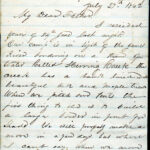
7-27-1862 p1.
July 27th 1862 [Sunday].
My Dear Father:
I received yours of 24th June last night.
Our camp is in sight of the James River boarding on a stream of water called Herring Creek. The creek has a bank lined with beautiful oak and maple trees. When we pitch our tents the first thing to do is to build a large boarder in front for shade.
We will probably make a move in a few days but where I can’t say. When we move we will not be allowed to carry any tents or cot beds. I don’t think any other Division with the exception of ours have received
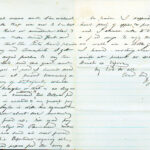
7-27-1862 p2-3.
any such orders and I’m inclined to think that we are to be sent up the River or somewhere else to try and take some fort or battery that the Reb’s have planted to annoy our transports.
I got half dozen peaches today the first I’ve seen this year and an apple or pear I haven’t seen.
I am at present commanding a company of the 2nd Infantry which will be here after or, that is as long as I’m in command I am entitled to ten dollars per month in addition to my present pay.
Capt. Layton is with his Regiment encamped about one hundred yards from us.
Did you buy the postage on Peninsular News? There had been an order from the Post Office Department requiring all postage on papers for the army to be paid.
I suppose you have plenty of apples and peaches now.
I should like to be home a few days to enjoy the fruit as well as a little quiet.
I have nothing else to write at present so I’ll close.
Direct as before. My love to all.
Your son, W. J. Fisher
8-5-1862 Father p1.
Aug. 5th, 1862 [Tuesday]. Camp four miles from Washington.
My Dear Father:
Since I last wrote we have been retreating almost constantly. On the 14th of August we commenced to evacuate Harrison’s Landing. We marched to New Port News, a distance of eighty miles, in four days. We were started every morning at about 3 ½ o’clock. We were at New Port News two days in which time I took three baths in Hampton Roads. After staying two days we embarked on the Steamer Montréal for Aquia Creek. We arrived next day about 10 o’clock and immediately landed and left for Fredericksburg on the cars. We were encamped on a hill about 1 ½ miles from the town but it appeared to be not over half mile. It is one of the most
8-5-1862 Father p2-3.
beautiful little places that I have ever seen. After being in camp for a day or two we were ordered to Warrington, VA but after we had marched for a few miles and turned and marched back half mile and lay on our arms another night next day we marched to some Junction on the road where General Hooker had had a fight the day before we saw dead Rebels scattered about over the field. Here the Rebels burned three bridges and two trains at least a quarter of a mile long and each loaded with ammunition, Army wagons, and enough bread and salt pork to subsist an army of twenty thousand men for 30 days. (So I was told by a man who I had good cause to think knew).
The next day we moved on as far as Manassas Junction where we joined five union trains which had burned. One of them had two batteries of artillery on it. Besides all this, we had three very large trains, loaded with knapsacks, which we had to blow up; all because General Pope was out generaled for Jackson did it completely. We lay here all night.
Next morning we moved to Bull Run where we fought a battle with
8-5-1862 Father p4.
a result as Bull Run of 1861; at least as bad as, if not worse, for we were completely whipped, at least those of us that were put in. I’ll tell you the way the battle was fought in the morning.
The Rebels made a demonstration on our right and about 1 o’clock, another on our left. Pope immediately moved nearly all his troops from the center and put them on the right and left. About 4 o’clock p.m. a terrific attack was made on our center. Sykes’s Division was the first that was attacked, along with the 5th New York and 10th New York under Colonel
8-5-1862 Father p5.
Warren commanding, were entirely cut to pieces in about thirty minutes. They lost six hundred men. The Butterfield Brigade was sent in and repulsed there. The first Brigade of Sykes’s division was sent in and cut to pieces. After they retired it became our turn; 2nd Brigade under Colonel Chapman. We were repulsed. That was the way we were sent in, by little driblets, where we had thousands upon thousand that never fired a shot. Besides this there were batteries that were placed in position
8-5-1862 Father p6-7.
and ordered not to fire until further orders and of course when the enemy got too near, they had to retire without firing a shot. Such bungling as this was going on all day of all the troops that was there. I really don’t believe that more than twenty thousand were engaged in the fight and their first advance they took a battery of six pieces. We were fighting on one side of a large field while there were at least thirty thousand men on the other side of the field who stood looking on until we were entirely whipped out. It seems to me that I could have fought a battle better than Pope did this one. And I am confident that if McClelland had commanded us on that day, that we would have whipped them out.
It’s my opinion that Jackson can take ten thousand men and whip Pope with forty thousand and I tell you, I have no confidence in a man that is to have his “head quarters in the saddle” and having no line of retreat, and immediately get on his horse and commence retreating.
We had to retreat as far back as Centerville the same night of the battle.
I suppose you have heard a great deal of the property that McClellan lost on the Peninsular campaign but I am perfectly sure that Pope lost a million dollars worth of property where McClellan lost a thousand dollars worth. If McClellan don’t get command I’m going to try to get some other department for I don’t like to serve under a man who is not competent to command a Brigade.
You say they are drafting in Delaware. Are you liable to be drafted for I must confess that I don’t know how old you are? W. F. Callaway is, I’m sure, and I think W. F. is.
I came through the last two fights all right. I had a ball graze my neck, but it didn’t hurt me at all.
I think I shall go to Washington in a few days.
Give my love to all and write soon. Your son, W. J. F.
8-5-1862 Mother Envelope
8-5-1862 Mother p1.
August 5th 1862 [Tuesday]. Camp near Harrison’s Landing, VA
My Dear Mother:
I received yours of the 30th ultimo, last night. I should have written home before last week but I was sick and could not write but I am almost well now.
A few nights ago the enemy set a couple of batteries up on the opposite side of the River and tried to shell us a lot but found us well prepared and after firing for about three hours and killing some ten or twelve men, left for a more congenial clime.
When I awoke this morning, I could hear heavy firing on our left which still continues at 8 o’clock. I understand it’s Hooker who attacked the enemy this morning and is driving them back for the cannonading is growing
8-5-1862 Mother p2-3.
fainter every moment; which is a sure indication that the enemy are retreating. We have another skirmish and two or three Iron Clad Gun Boats lying into the River but I don’t think they will be able to escape or do as much damage.
I hope that General McClellan will receive reinforcements enough to be able to push on to Richmond before the fall. If he does not I think it will be evacuated rather than stand bombardment.
I am really getting very tired of this kind of life. Sometimes I think, that as soon as I can, I’ll resign and go to doing something else that will suit me better, but I suppose its all little fancies of my mind while being wishful.
I should like to go home a few days to see you all and also to get some fruit for I haven’t seen any kind of fruit with the exception of half eaten peaches which were brought from Washington. I suppose you have plenty of apples and pears.
I have nothing else to write at present.
Give my love to all the family
Please write soon. Your affectionate son. W .J. Fisher
8-10-1862 p1.
Aug. 10th 1862 [Sunday]. Camp near Harrison’s Landing, Va.
My Dear Father:
I haven’t received a letter from you since sometime in July and therefore have none to answer.
I received a letter from Will Callaway and also one from Alexander Fisher, both of which I have answered.
Every thing goes on quietly with us with the exception of a little brush now and then with the enemy just to show them that we are alive. General Hooker taught them a lesson the other day which, I suppose, they will not forget in a hurry, but you saw the account of it in a paper.
But, what I sat down to write about is this: I have a little
8-10-1862 p2-3.
plan in my mind which I think you will approve of. You know I owe you eighty dollars. Well, I have July’s pay due me yet and enough money to last me through August. As soon as I can, I will get a check for $80 and forward to you and after that I think I can manage to save enough every month at least to buy one share of stock in the Georgetown bank. I wish you would write me all about it and tell me what a share costs. What interest it pays and so on. I feel as though I ought to be laying up something. When this war is over, I may not want to stay in the Army, or maybe the army will be ordered to its old standard. And in either case I might be discharged. I don’t say that I believe it, for I don’t. I wish you could write to me at once and tell me what you think of my plan. I could get a check for the amount every month and enclose it to you and you could do the business for me.
Please don’t show this to anybody, they might think that I was a fool, which I almost believe myself sometimes. Give my love to all and write soon. Your affectionate son, W. J. Fisher
N. B. I’ve been in the service one year since last Tuesday
W. J. Fisher
9-21-1862 p1.
Sept 21st 1862 [Sunday]. Camp near Shepherd’s Town Ford, Md.
My Dear Father:
So far I’m all right. The principal reason of my not writing before was that I have been sick and another reason was that I have no chance since I last wrote.
We have had two fights, or rather one fight and a truce. Yesterday our Brigade was sent over the river but came upon the Rebel skirmishers. We had a skirmish in which we lost four men of 10th Infantry and then retired across the river.
I haven’t received a letter since leaving Washington.
I captured a nice little hunting rifle yesterday. If I live, and
9-21-1862 p2.
can have a chance, I would have it fixed up and will send it home to you to keep for me.
I am very well now. Write often. I don’t have a chance to write. I have got a poor chance to write.
Give my love to all. Your son W.J.F.
9-22-1862 p1.
Sept 22nd, 1862 [Monday]. Camp near Shepherdstown Ford, Md.
My Dear Father:
Since leaving Halls Hill near Washington, I haven’t had but one chance to write and I didn’t take advantage of that because I was very unwell at the time.
The day after I wrote to you from Halls Hill, our Division was moved over the River to Tannelly Town, a little place about three miles from Georgetown, D. C. I, being sick, was put in an ambulance. Our ambulance, instead of following the Regt. Got mixed up in another train and I was carried to a Hospital near Alexandria. Of course I didn’t want to go in a Hospital so I got in anther ambulance
9-22-1862 p2-3.
and went into Alexandria. There I got on the boat and went across to Washington and went to Willard’s Hotel and was taken with a serious chill. I got a room and went to bed.
I staid in Washington until the next day. At 10 o’clock, I got a carriage and joined my Regt., which was then at Rockville, about twenty miles from the Capital. The day after I rejoined the Regt., which had moved for Frederick, which was at that time occupied by Rebels.
Frederick is one of the most beautiful places that I have ever seen. It is about twice the size of Milford and the best of it is that nearly all the inhabitants are strong Union people. Well we staid here one night and next day moved to a South Mountain Pass where McClellan gave the Rebels one of the soundest whippings that they ever received.
When we passed, the road was completely filled with dead Rebels. Men and Officers were piled on one another lying in every way; some on their back, some on their faces. Some were lying on the fence (it was a stone fence) where they were shot while getting over. Old men of sixty and boys of twelve were piled on one another. I never saw such a sight in my life and I hope I may never see such a one again. Two days after, we met them again at Sharpsburg where they were completely [illegible] out and driven across the river.
9-22-1862 p4.
This is badly blotted but I am in a hurry and haven’t time to write another so please excuse it. What do you think of McClellan and what does that contemptible [illegible] think of him?
The man is all ready to start, so I must close.
I am well and please write soon. My love to all.
Your son, WJ Fisher
9-28-1862 p1.
Sept 28th, 1862 [Sunday]. Camp near Sharpsburg, Md.
My Dear Father:
I received a letter from you yesterday in which you wrote that you had heard, through G. P. Fisher, that I had been taken prisoner. I suppose the one he took for me was Oscar Fisher of the 8th Infantry, who was taken prisoner at the Battle of Cedar Mountain and I believe was afterwards put in Irons for trying to escape or write to his friends or some such offense.
I see that there has been a man appointed to the 10th from Delaware by the name of Hopkins. But he hasn’t reported yet and I haven’t had a chance to
9-28-1862 p2.
find out who he is.
Why don’t John Francis try and get an appointment in the Regular Army? I think he could get one and I’m sure he could enjoy himself a great deal better, even if he resigns as soon as the war is over, which will not be soon, if the bothering Governors don’t let the President and McClellan alone.
The President’s Proclamation may be a very good thing but I can’t see it.
I hope we shall get back somewhere near Washington this winter before going into quarters.
You must excuse my bad writing as I have nothing better to write upon than a camp stool.
We go on Pickett the other day on the banks of the Potomac.
Please write soon. Give my love to all, W. J. Fisher
10-5-1862 p1.
October 5th 1862 [Sunday]. Camp near Sharpsburg, Md.
My Dear Father:
Since being in this camp, I have written, I’m sure, on an average, twice per week, but haven’t received an answer from one letter yet. I don’t know how it is. Whether you don’t get the letters I write, or whether I don’t get the letters you write.
We go on Pickett every 4th day. The last time we were on, the enemy sent over three flags of truce. One was to bring some prisoners. Four officers of Stuart’s cavalry came over with them. We had a long talk. They would acknowledge when they whipped.
While we were conversing, a man came up with the New York Herald and sang out, “New York Herald; Jeff Davis suing for peace.” This of course, caused a great laugh at his expense.
How does William Cannon get on with his cavalry company? Is John F. Allen recruiting anywhere and what is his rank to be, 1st or 2nd Lieut.?
I suppose you are done and saving fodder by this time. I should like to be home for a few days to go squirreling. Tell George that I will give him my right to my gun.
What do you think of the chance of making peace now? There are great many rumors going the rounds now about propositions which have been and are going to be made by commissioners from the South. I hope they will fix it up before there is any more fighting done, but before they should dissolve the Union I would rather fight two years yet.
Please write soon.
Give my love to all the family and tell Ma to write. I wrote to Sis the other day. Your Son, William
10-5-1862 p2-3.
a man came up with the New York Herald and sang out, “New York Herald; Jeff Davis suing for peace.” This of course, caused a great laugh at his expense.
How does William Cannon get on with his cavalry company? Is John F. Allen recruiting anywhere and what is his rank to be, 1st or 2nd Lieut.?
I suppose you are done and saving fodder by this time. I should like to be home for a few days to go squirreling. Tell George that I will give him my right to my gun.
What do you think of the chance of making peace now? There are great many rumors going the rounds now about propositions which have been and are going to be made by commissioners from the South. I hope they will fix it up before there is any more fighting done, but before they should dissolve the Union I would rather fight two years yet.
Please write soon.
Give my love to all the family and tell Ma to write. I wrote to Sis the other day. Your Son, William
10-5-1862 Envelope
10-17-1862 p1.
October 17th 1862 [Friday]. Camp near Shepherds Town, Md.
My Dear Father:
I have written no less than four letters this month and haven’t received an answer to one of them yet. I can’t tell what the reason is whether you can’t write or whether it is in the fault of the mail. I wish you would make it a practice of writing at least twice per week and then I should always know what to expect.
What is Georgetown Bank Stock selling at per share now? And if you know please tell me what Smyrna Bank Stock is selling at. I will enclose a check for two hundred dollars. I want you to take eight out, which I owe you, and invest the rest in some kind of stock that you think is safe and will pay.
My ambition is to get to own a farm. How do the corn crops look through Kent and Sussex Counties?
Does Mr. Sullivan still own the farm in Kent? When did you hear from Uncle John’s boys last? What does the dirty Tribune think of McClellan?
10-17-1862 p2.
I tell you, candidly, that I should like to help hang the contemptible man that publishes that paper. Think of all that McClellan has done; to commence abusing him immediately, as soon as the enemy is driven from Maryland. If he had carried a musket from Harrison’s Landing to this place, I don’t think he would feel like going forward. If he can’t like the way things are carried on why don’t he come out himself and fight a while.
Greeley’s nigger brigade, I believe, hasn’t been organized. Well I guess I have said more than I ought to about him. But I can’t help but hate a man that abuses McClellan all the time; whether he is successful or not.
Your affectionate son. W. J. Fisher
10-18-1862 p1.
October 18th 1862 [Saturday]. Camp near Shepherdstown, Md.
My Dear Father:
I received a letter of 14th last from you this morning.
I suppose from what you say of the Tribune that you haven’t seen some of the daily issues lately at least some that I have seen. One copy I remember of seeing in which he urged the President to give General Fremont an important command. A man, in my opinion, was more unfit to command an army of forty thousand men than I am of commanding a Brigade.
I want to ask you a plain question: If General Fremont could resign his command only, and get to New York and before when the country needed him in the field, why couldn’t I resign my command of my company and go home and stay as long as I please?
You say that it is your opinion that McClellan and his officers caused Pope to lose the Battle of Bull Run. If you had been there and seen how the latter fought, you would have thought differently. In the first place McClellan had no command at all. And in the second, the Army of the Potomac and Burnsides Army fought the Battle of Bull Run unaided, almost entirely, by either Pope’s or Siegel’s armies.
10-18-1862 p2-3.
Pope had his army of nearly thirty thousand men and, in my opinion, if he had put them in at the right time, we would have been entirely successful, but he didn’t do it. He wanted us to whip the Rebels and then he was going to put his army in pursuit. And it’s my honest and candid opinion and also of nearly all the officers, that I have seen that were there, that we were whipped with about one man to our three, and all by Pope’s blundering.
The Army of the Potomac lost in proportion in numbers ten men where Pope’s army lost one. Out of our little battalion, of two hundred and about twenty five men, we lost nearly one hundred in killed and wounded, besides two officers killed and one so badly wounded that it is thought he will die.
And at Antietam, in which you seem to think that Porter’s Corps was not engaged, we lost fifty-four men and one officer in the second Infantry in which I have been serving. There has been out of twenty that started, five officers killed and four badly wounded. One was shot in the mouth and his jaw is paralyzed for life. Another lost his leg, another was shot in the groin and it is doubtful very much whether he will live or not. The other one is shot in the breast and when last heard from was not doing very well. Besides them, three have been cashiered for cowardice before the enemy. Two have been retired and one dismissed, reducing the officers down to three that intended the field at first. Out of the whole 2nd Infantry there are not men enough left to make three full companies.
When we crossed over the River it was not by General McClellan’s order, but General Porter’s and, if you remember, none worth mentioning were lost with the exception of the 118th Pennsylvania, Corn Exchange Regiment. That was owed actively to their repugnance to wetting their feet. It they had gone two hundred yards farther down the river and waded across, I believe, they would have all got across safe but instead of that they tried to cross a little dam that would almost of put one man at a time and consequently was that it took them as long to cross that the enemy came up and literally cut them to pieces. For that dam, we took one man killed and four wounded, in all the fight’s that have been taken place, I suppose, you haven’t seen one where the Regulars have been in.
Please write soon. Give my love to all,
Your son W. J. Fisher
10-18-1862 p4
11-18-1862 p1
11-18-1862 p2-3
11-27-1862 p1.
Nov. 27th 1862 [Thursday]. Camp near Falmouth, Va.
My Dear Father:
I received you letter of the 21st last this morning and was very sorry to learn that you had misconstrued the words or meaning of some of the sentences of my last letter.
I never meant to say that I would leave the service without an honorable discharge for I tell you truly that I had rather be killed dead than be dishonorably dismissed from the service of the United States.
The meaning I tried to convey was that if Major General John C. Fremont was put in command, that rather than lose my life by his bungling, I would resign and leave the country all together.
I sincerely hope that General Burnside may be successful and next to General McClellan I had rather
11-27-1862 p2-3.
General Burnside should command than any other general of the United States.
I suppose you saw Halleck’s letter in regards to the furnishing of supplies to the Army and, let me tell you, he wrote a great many things that was not true. Our command is now not even supplied with winter clothing, tents, blankets or shoes and they are suffering extremely in consequence. You have no idea how cold and disagreeable it is to sleep or rather try to sleep these cold nights without a blanket. I know, for I have had reason to try it several times lately. There is one other thing you don’t know and can hardly imagine; what a damper the removal of McClellan has upon the spirits of everybody. We thought that we were almost running a race with Lee for the possession of Richmond and I believe if they had let McClellan alone, that before this, if I had lived, I should have written from Richmond.
I never saw anything work better. Every one seemed to be in the best of spirits. We marched rapidly and underwent hardships without complaining but the thing is done now. It’s no use to complain.
I hope if we go into winter quarters this winter that I shall be able to obtain a leave of absence for a few days to visit home. I should like very much to see you all once more.
I got a letter from Sis a few days ago and also one from W. Frances Callaway.
The tenth infantry will be united in a few days and I hope I shall be able to join my own Regt. Very soon.
I wish you would give my proper address to the Peninsular News and Advertiser for I don’t get one paper out of five and it’s all wrong to the address. Give my love to all. Your son, Will.
12-17-1862 p1.
Dec. 17th, 1862 [Friday]. Camp near Falmouth, Va.
My Dear Father:
Since I last wrote we have been at our old trade again, that is, fighting for about a week and then retreating.
We left our camp (the same we now occupy) December 10th, about 5 o’clock in the morning and marched to within a quarter mile of Fredericksburg and halted our Regiment. The tenth was then detailed as skirmishers for the Brigade. And we were divided off by our Commanding Officer (Capt. Maynadier) accordingly. Our instructions were to march to the bridge (which, I suppose, was already laid), rush across and immediately deploy on the other side and cover the advance of the rest of the Brigade. But some unforeseen difficulties being in the way, the order
12-17-1862 p2-3.
was changed and we were for once properly speaking in the Reserves.
We lay when we first halted all the day and bivouacked at night in the same spot next day (Saturday). We lay still until about two o’clock when we were ordered to and did move over the river to relieve some other Division (I think Couche’s). But, we got over too late so took no action part in the fight. We lost an officer (Capt. Machlenburg, 17th Infantry), and several men of different Regiments. We were thrown out as picketts, our Regiment occupying the advance.
Lieut. Welles and myself, with twenty men, were thrown out as an advance Pickett, about one hundred yards in front of the rest, behind a small frame house. While we occupied one side of the house, they did the other, and every few moments you could catch a glimpse of one of them peeping around the corner. But if one of our men would miss, he would quickly withdraw. This went on until morning when their sharpshooters opened upon our men, who were about one hundred yards in our rear. We were within yards of their rifle pits and couldn’t move an inch for fear of being shot. Well, we lay in this predicament until dark. We withdrew with a loss of only one man killed. One brigade, in rear of us, lost heavily; and all this without firing a shot.
On Sunday night we were relieved and marched to Fredericksburg and bivouacked for the night in the streets. But the most dangerous place I ever was in my life was before Fredericksburg, on Saturday night and Sunday, for twenty-four hours. Where we were, the ground was perfectly black with our killed. I firmly believe that our loss was 1000 to one in killed and wounded.
We crossed over to this side of the river yesterday and marched to our old camp today.
The call for tattoo has just blown so I must close.
By the way my paper comes all right with the exception that they address me as belonging to 11th Infantry instead of the 10th. I wish you would give them my address such as you write on your letters.
Your Son, Will
12-23-1862 p1.
December 23, 1862 [Tuesday]. Camp near Falmouth, Va.
Dear Father:
Since I last wrote, our battalion has been relieved from duty with Sykes’s Division and put on duty with Headquarters Center Grand Division, that is, General Hooker’s. So, for the present, no more fighting on Pickett duty. Which you may be sure is very acceptable to all of us just as the present time when the weather is so cold and General Halleck and the President have assured the people that the Army of the Potomac shall not go into winter Quarters. By the way, I see in the last paper that Secretary Simon has resigned and General Halleck been removed.
12-23-1862 p2-3.
I hope to see General McClellan in command of the Army in a few days as I confidently believe that he is the only man capable of handling it.
If he had had commanded the Battle of Fredericksburg, it never would have been fought.
If even Burnside had been allowed to use his own judgment, he never would have made the attack. And how do you expect a man sixty miles away to fight a battle that never even looked over the ground he wished to fight?
We are encamped in a beautiful and warm place, surrounded entirely with pine and cedar bushes.
We are independent now of anybody below General Hooker. The way we came to get up to him is that Major Hayden, of our Regiment, has been appointed Provost Marshal of Hooker’s Army and of course he would do all he could for his own Regiment.
If nothing happens, and all things work well, I expect to be on recruiting service before this time next year.
Our Camp is about two hundred yards from the Rail Road.
Has John F. Allen made any efforts to get a commission yet?
There are about three hundred vacancies in the New Regiments for 2nd Lieutenants.
I received a letter from Aunt Angie a few days ago saying that W. F. was sick.
I wish you would have the Editor of the News change his 11th Infantry to 10th Infantry on my address. If he would, I think, I could get my papers without any trouble.
Nothing else at present, Give my love to all. Your Son, Will
P.S. Merry Christmas
1863 Letters to Home
1-5-1863 p1. January 5th, 1863 [Monday]. Camp near Falmouth, Va.
My Dear Father:
I haven’t received a letter from you in at least two weeks. What is the matter?
I got a copy of the News yesterday but saw no news in it.
I have a very comfortable place.
I have nothing to do except go and guard once in five days and have nothing to do.
How did you spend Christmas? I spent Christmas day hauling wood for General Hooker or rather over seeing that it was hauled.
What is W. F. Calloway doing? I haven’t received a letter from him in I hardly know how long. I haven’t heard from Sis in about two weeks.
How do you get along drilling your Company? Or don’t you drill it. I wish you would send me a list of all the men and officers in it as I should like very much to see. Do you want any Tactics? If you do I will send you some.
What are Meredith’s boys doing?
I wish you would write a note to the Editor of the News and give him by proper address. He now addresses me as belonging to the 11th Infantry. My proper address is 10th Infantry, Head Quarters Center Grand Division, In care of Maj. Hayden, Provost Marshall.
Nothing else at present. Give my love to all. Your son,
W. J. F.
1-5-1863 p2
1-12-1863. January 12th 1863 [Monday]. Camp near Falmouth, Va.
My Dear Father:
I received yours of 6th Inst. this morning and you may be sure I was very glad to hear from you. And be here after. I wish that you would write at least two letters per week and also to answer my letters immediately after receiving them.
I am very glad you called my attention to that word. I have often noticed that in writing I spelled it wrong and once or twice before my attention has been called to it. But now I think I will try and remember it. I wish you would enclose me a half dozen postage stamps as I am very near out and have no chance of getting more.
I should like to see little Eliza Emily but I suppose I shant have a chance. I am glad to hear she can talk and say Brother Will.
But I hope to be home within a year anyhow.
My address is———10th Infantry Head Quarters, Hooker’s Grand Division, Army of the Potomac, Ica Washington, D.C., In care of Maj. Hayden, Provost Marshall.
My love to all, Your son, W. J. Fisher
1-13-1863 p1. January 13th 1863 [Tuesday]. Camp near Falmouth, Va.
My Dear Father:
There is no particular news just at this moment stirring.
I believe,it is reported, that Sumner is going out West. Franklin is going down South somewhere and that Hooker will fall back on the defenses of Washington. Although I hate to think it will be done.
I’ll tell you now, frankly, what I sat down to write for. I wish you would send me $25 in treasury notes. I will be able to return it on the first of next month, when I shall have a month pay due.
I must tell you the cause of this. I sent my pay accounts, for two months, to Washington, by an officer, to get them cashed, as I was in need of money and no pay masters were about. He made an ass of himself; got drunk, went to one of the gambling houses and lost all of his own money and mine in the bargain. I don’t want you to say a word about it to anybody as I have hopes of getting it all back some time. I believe
1-13-1863 p2. he is honest and that he will pay at the earliest opportunity. I wish you would send it to me immediately on receipt of this as I haven’t a cent now.
Please don’t say a word to anybody about it. I’m sure I shall get it again. Your affectionate son, W. J. Fisher.
1-23-1863 p1. January 23rd 1863 [Friday]. Camp, near Falmouth, Va.
My Dear Father:
I haven’t received a letter from you for at least two weeks and I’m sure I have written at least three.
Four days ago the Army moved. But the day after, it rained so hard that the trains and artillery were stuck in the mud so that they could not move and are in the same predicament yet.
The last I heard of Sykes’s Division was that they were trying to get back to their old camp and were building corduroy roads on which to move the trains, but this, as you know, is slow work.
We did not move our camp but staid, intending to accompany as guard, General Hooker’s train. He is coming back and, I suppose, every thing will become quiet
1-23-1863 p2-3. as ever in a few days.
Our camp is very close to the Rail Road and we get almost everything we want for the Mess direct from Washington through the caterer of General Hooker’s Mess, who goes regularly back and forth twice per week.
You need not send to me either the Postage stamps or the money that I wrote for as in the first place the story that I heard about the Officer losing my pay etc. on cards is happily an untruth or rather an —-. I hardly know what to call it, but it pleases me very well, and as to Postage stamps, there is a kind of book stall or store at the Depot, so I can supply myself when I need any.
The weather here is quite warm, but very wet and muddy.
I wish you would write oftener and tell me everything that takes place.
That check I sent you, you had better get it cashed pretty soon, as they become good for nothing after being issued a certain time.
What are the Meredith boys going to do now?
Did you tell me that Isaac was maimed or not? If you didn’t, I must have dreamed it.
What are Billy & Jimmy Reynolds doing? And where is David Lofland?
Give my love to all, Your son, W. J. Fisher
1-24-1863 p1. January 24th 1863 [Saturday]. Camp, near Falmouth, Va.
My Dear Father:
This morning I received your two letters of the 16th & 20th Instant.
One of them enclosing a $20 bill, which I am happy to say that I can return to you, as the story I heard about the officer that had my money has proved to be untrue. At the time I wrote to you I did not know, personally, what I wrote had occurred; but as the man had staid six days beyond his time, when the story was told me by our officers of his own regiment, I could do nothing else but believe it.
My trunk is still at Mr. Queens in Washington and I should have sent it home months ago if I had known that this campaign was going to hold out as Long as it has.
1-24-1863 p2-3. As to being “ragged,” I can’t say that ever I have been. I get under- clothing from the Sutlers, and such things as pants & shoes, I get from the commissary by paying the Government price.
The rifle that you inquired about, after carrying it to Snicker’s Gap, I got rid of it and gave it away.
I don’t think you could, at present, get here at all as they don’t allow citizens to come within the lines. Some do come, yet, if the order is at anytime countermanded, I will write to you immediately. I should like you to come very much.
You could not send me anything just now with any certainty of it getting here. We have a way of getting things direct from Washington and our Caterer keeps the mess well supplied.
Peace is a word that I don’t often hear used, but I think if something isn’t done pretty soon, that we will have peace with a vengeance by recognizing the Southern’s Confederacy.
I will tell you, secretly, that there is a dissatisfied spirit all through the Army. A few days ago one whole Division mutinied because they hadn’t been paid within two or three months. And when this Army moved a few days ago, I think, five thousand would not cover the desertions, I mean from the Volunteers.
A Regular Soldier looks up to Uncle Sam (as we all call him) almost as their God. Although in our little battalion of about two hundred men, we have men from every State in the Union, and I think if there is a final thrash up, as I am afraid there will be, if this army is not handled better, the Regulars will stand by the Government to the last.
The whole Army now is where it was one month ago and, instead of decreasing as you seem to suppose, I believe, it had been increased by at least two Divisions.
The reason that I think I shall be sent on Recruiting Service is that by the 15th of March we will not have men enough in our regiment to make a Platoon. Our men were, nearly all, enlisted in 1858; as yet we have got no recruits. Men will not enlist in the Regulars if they can help it. The principle
1-24-1863 p4. reason is that, in the Regulars, there are several little things required that a Volunteer can’t see the use of. To give you a sample: a Volunteer would as soon think of poisoning himself as to touch his hat to an officer; and the Regular soldier would almost as soon take poison as not salute when he meets an officer, for if he neglected it he would be severely punished.
My financial affairs are prospering and I think in a month or two, I will be able to send you another check for one hundred or two.
My health is very good and I am heavier by thirty pounds than when you saw me last.
Everything is very comfortable here. We get the daily papers regularly and I expect sooner than you do.
Give my love to all, Your son, W. J. Fisher
1-29-1863 p1. Jan. 29th 1863 [Thursday]. Camp, near Falmouth, Va.
Dear Brother:
Yours of the 20th I’ve received and, as there is nothing pressing, just at the moment, I will answer it.
I hope you will keep the dogs out of all mischief, at least until next fall, as I am going to get a leave of absence. Then, if I live, I’d go home and go rabbit hunting with you.
I am glad that Doc. Lofland is to be discharged for I don’t think that the life we lead would suit him at all.
As to Flora I hope you will break her all right so you will be able to ride her when I get home again. When I do, maybe I will be old enough
1-29-1863 p2-3. to go fox hunting, for you know, I suppose that fox hunting, was not by a long shot, my favorite amusement.
Well to wind up, if you will be a good boy, you may have my gun, and tell Eliza Emily that if she will be good and don’t cry that probably she will be able to see the original sometime.
Tell Pa I got his letter that he mailed from Dover.
Tell William Meredith to write to me. I think I have written to him once or twice but never as yet have been so very fortunate as to receive an answer.
So Georgie, all the good advice you can get from me, (for I’m a regular Socrates, I believe that was the old chap’s name) is to write to me as often as you can and tell me all the news. Anything will interest me. Tell me how many lambs and pigs you have got and also if there are any ducks along the entrance. How many Partridges have you killed here George?
As soon as you get this set down immediately and answer all my questions then tell me all the news of the neighborhood.
I see one thing that I am very glad of, you can write a very good hand, indeed, for a boy your age.
Who is keeping store at the Crossroads and who is Post Master there?
What are you studying, George?
Now be sure and answer this as soon as you receive it.
How is David Lott Rawlins? Your brother, Will
2-9-1863. Feb. 9th 1863 [Monday]. Camp, near Falmouth, Va.
My Dear Father:
Since my last letter we have again been moved to Sykes’s Division and you will change your direction accordingly and also write to the Editors of the News and give them my proper address. I believe they have never addressed a paper correctly to me yet. The last one I got was directed to 2nd Division, Hooker’s Corps.
We got orders today to report to General Sykes for duty and, I suppose, before twenty four hours more, we will be under his command.
I received a letter from Aunt Angie a few days ago in which she told me of the death of several Delaware Volunteers.
I haven’t got a letter from Sis in several days, perhaps two weeks, although I wrote to her. I also wrote to G. F. Callaway at Milford.
Nothing else at present. My love to all. Your Son,
W. J. Fisher
2-20-1863 p1. Feb. 20th, 1863 [Friday]. Camp, near Falmouth, Va.
Dear Father:
I got a letter from you a few days ago but, until this, have not had an opportunity of answering it. I also got one from Will Callaway at the same time. I have written to Sis several times but, as yet, have received no answer.
Last Sunday morning I went out on Pickett duty. When I left camp it was raining very hard and continued to rain until nearly dark when it slacked up and in about an hour the stars were shining bright. I then thought that I should have a very pleasant tour of it and so I had until next night when it began to snow and continued to snow until the next evening it then cleared off partly. But after about one hour the rain began again and continues until I got into camp the next day. Out of about eighty-four hours on Pickett, I had twelve of clear weather.
I went over to see Captain Layton a few days ago. He has just returned from five days leave but, his time was so short, that he got no further than Washington. He told me the son of John Hazzard had been appointed 2nd Lieutenant in his company. The son of E G. Bradford is also in his Brigade.
2-20-1863 p2-3. I hear that an effort is going to be made to increase the Cavalry force, if they succeed, I shall make an effort to get into the Cavalry with the rank of First Lieutenant. I hardly think I should be able to succeed but you know there is nothing like trying. I think if nothing happens I shall become 1st Lt. of Infantry within a year at least.
About writing an account of what I did in the Peninsular Campaign; I hardly remember what to do. All that will be of any interest to you, I can tell in a few words.
When I left Washington, I was Adjutant of General McClellan’s body guard, under Maj. Willard of the 8th US Infantry. When we went to the Peninsula, I joined my own Regt. and was made Provost Marshall there. I served in that capacity until the Battle of Gaine’s Mills when I was acting 1st Lt. of A Company and Malvern Hill the same. At Harrison’s Landing was attached to the 2nd US Infantry and put in command of Co. A, which I commanded at Bull Run and Antietam although I was not in the hottest part of the fight at the last place. After we came to this camp I was again ordered to join my Regiment where I was put in Co. I of the 10th US Infantry which I command at present.
What do you think of enlisting Negroes? What will they be good for? How would you like a big thick lipped greasy nigger with a Captain’s shoulder straps on, come up to you and order you? Well I say, “Git out of my way Suh.” “Move your company or I’ll put you in arrest you white trash.” I hope it will be then unwise but can hardly expect it.
Don’t you think it would be a good speculation to go to Mexico now and offer my services to the Mexican Commander in Chief, not that I think of doing it, but one officer who did do it, and he was made a Col., And killed the same day.
I know of one officer who had accepted a commission of Contraband Volunteers.
As to getting a pass to this army you might do it by going to the Sec. of War. But I hardly think he would give you a pass except to get the dead body of a son which you may have to do some day but I forgot to tell you that we are again on Provost Duty and Minnie bullets don’t kill Provost Marshals. I wish you would write oftener. In your next tell Sis to write also.
Give my love to all, Your Son, W. J. Fisher
3-14-1863 p1. March 14th, 1863 [Saturday]. Camp, near Falmouth, Va.
My Dear Father:
I wrote to you a few days ago, but having nothing particular to do, except go on Officer of the Day every other day, and having no Company to command, I have plenty of time to think.
When I got back home [to camp] I found my company broken up and all the eight companies consolidated into two.
For the first few days I had plenty to do to straighten up my papers and get the Company Property off my hands. But I soon got through with all that and now I have nothing to do with a Company. Now I think I am temporarily attached to one.
Enclosed you will find some photographs but they are not very good and if I live to get back to some civilized place; I will have some better ones taken.
My candle is going out. No more at present. Write soon.
Your son, W. J. Fisher
3-14-1863 p2
3-16-1863. March 16th 1863 [Monday]. Camp, near Falmouth, Va.
My Dear Father:
I received yours of the 14th Inst. this evening.
When I wrote I did not mean for you to apply to G. P. Fisher to get me on some other lighter duty. If I had meant that, I could have applied to him personally, while in Washington; and as to applying to get out of the field, I wouldn’t do it. What I did mean is that if there is any position in the State where they might want an officer, you might get it for me, probably through the Governor. And if such a place is vacant, or it was to become vacant, I wish you would try and get it for me. There are very few officers who have been in the field as long as I have and I’d like to fall out.
My Regiment is all gone, or either will be in a short time, as they were all enlisted in 1858, just before the Utah Mormon Expedition. By the last of April we won’t have a hundred men in the whole Regiment.
Captain Layton’s brother is out here now and also the Captain’s wife. I called on her this evening but heard nothing particularly brilliant.
Genl. Pleasanton’s Cavalry crossed the River this morning and cannonading has been going on all day, but as to results, I have heard nothing.
Your son, W. J. Fisher
3-20-1863. March 20th 1863 [Friday]. Camp, near Falmouth, Va.
My Dear Father;
I see by yesterday’s paper that Mr. Temple our M.C. is dead. I suppose if that’s the case, Mr. Cannon will have the opportunity of appointing our next Member of Congress. I see in the last NEWS that Mr. Fisher has been appointed Judge of the Delaware. If that’s the case, I suppose, he will not want the appointment. If Mr. Cannon appoints any one you are intimately acquainted with I wish you would speak to him personally to try and get me ordered out of the field or some other duty. (Perhaps he can get me on some duty within the state I would not want to get out of the field if I had a company but my company has been broken up and I’m attached to a company as 2nd Lt. I think I’m a first Lt. from the fourth of March as there is a vacancy from that date. The vacancy was caused by an officer being cashiered for not turning over monies in his possession.
If you are in Wilmington soon, I wish you would have your Photograph taken. I should like to have it.
I wish you would write me a letter telling me all you know about the above, whether Mr. Temple is dead, and also who Mr. Cannon will appoint if he has the opportunity.
Your affectionate Son, W. J. Fisher
4-10-1863 p1. April 10, 1863 [Friday]. Camp, near Falmouth, Va.
My Dear Father:
I received a letter from you a few days ago but, as there has been nothing to write, I have delayed answering it.
This morning there was a general muster through out the whole army. It was made for the purpose of ascertaining the number of recruits required to fill all the Regiments in the Army up to the minimum standard. To fill up our eight Companies we wanted about seven hundred men. I believe it is designed to recruit us up with conscripts but I hardly think
4-10-1863 p2-3. it will work, to put conscripts in the Regulars, although it may.
I just saw an officer who returned from Washington a few days ago and he told me that, by application through the Secretary of War, I could get ordered on Mustering duty. I wish you would get Gov. Canon to speak to the Secretary of War or the Adjutant General next time he goes to Washington and if he don’t do that I will get home and speak to Judge Fisher. Perhaps he could get me ordered off as he is well acquainted with Genl. Thomas.
I think I could get off now as regular officers are wanted for mustering duty.
I wish you would write to me immediately, on receipt of this, and tell me what you well can or have done.
Give my love to all the family and tell me in your next how Ma is.
Your son, W.J.F.
4-20-1863. April 20, 1863 [Monday]. Camp, near Falmouth, Va.
My Dear Father:
I received yours of 19th instant this morning.
I’m glad to hear that Ma is getting better and hope she will be entirely well very soon.
I’m glad you spoke to Governor Cannon to get me on duty within the State. You also said in it that you would get him to speak to the Secretary of War next time he visits the Capitol. If he requests the Secretary to get me on some “Fancy” duty I’m sure he would do it as he needs Regular officers for dispersing and mustering duty.
On Saturday we were reviewed by the Major General of the Swiss Army who is on a visit to this Country for the purpose of observing the coming summer campaign.
Some ten or twelve days ago the president reviewed the whole Army. He looked very well. I believe his wife accompanied him but I didn’t see her.
Give my love to all…..and write soon…..Your son, Wm. J. Fisher
5-7-1863 p1. May 7, 1863 [Thursday].
Camp, near Falmouth, Va.
My Dear Father:
I think I answered your last letter but I am not sure.
We left our camp on the morning of the 27th and marched about six miles and went into camp, the 10th being on Provost Duty, marched in the rear of the Division and consequently did not get into camp until about two hours after the Division. We had to stay behind, to keep up the stragglers and also the pack mules (we used pack mules instead of wagons; had one mule to eight officers and mules to carry ammunition).
On the morning of the 28th, we moved again and marched about the same distance that we did the day before and again went into camp. After we had been in it a short time, General Sykes issued an order saying that our next march would be a “long and rapid one.”
On the 29th we again moved; the Division ahead and we bringing up the rear as before. We marched to the Rappahannock and had to wait ‘til the II and XII Corps passed. This is where we laid the Division last. We had to stay on the banks of the River until nearly dark when we were ordered to cross. After we crossed we marched all night (and the rain was pouring down) and also, until next morning when we caught up with the Division, went into camp within ¾ of a mile
5-7-1863 p2-3. of the enemy and went to bed on one blanket for the first time in thirty-six hours. After we had been in camp about two hours, the other Company of the 10th with our flag and band now in our whole Regiment presently consisting of nine Companies and the band.
The next morning the 1st of May we were relieved of Provost Duty and were ordered to report for duty to 2nd Brigade. We hadn’t been in the Brigade on hour before we were ordered to move. We hadn’t marched a mile before we were attacked by the enemy’s picketts but we drove them back about two miles. Killed about fifty and with nearly the same number prisoners. The tenth took twenty seven prisoners and killed eight. But after we drove them back, they brought up reinforcements and drove us back and we had to retreat for the want of reinforcements. We were turned back to where we started from in the morning but the enemy did not follow us near our camp.
I had command of a Company of sixteen men out of which I lost four, just ¼. After dark we fell back about ½ mile and the 10th went on Pickett duty. We were on Pickett until the morning of the 3rd when we again fell back about one mile and entrenched ourselves on a crest of hills. We lay behind our works until yesterday morning when we retreated across the river and afterwards were back to this our old winter camp. I think the whole move was caused by the cowardly Dutchman (XI Corps) belonging to Sykes’ old Corps who allowed themselves to be surprised and a lot of them were taken prisoners. I hope we will hang them.
I am in Camp now. I have no idea how long we will stay or anything about it.
I wish you would write oftener.
Give my love to all. Your son, Wm. J. Fisher.
5-17-1863 p1. May 17, 1863 [Sunday]. 10th US Infantry, Camp near Falmouth, Va.
My Dear Father:
I wrote a letter to you several days ago but I don’t know whether I mailed it or not.
There is no news stirring at present, although I believe it’s the general impression that we will move sometime soon, but how soon, no one knows.
The weather is very warm and has been for several days back.
I have my tent fixed up tolerably comfortably with a Bowers in front by cedar bush.
Have you seen Gov. Cannon since he returned from the Army, and if you have, what did he say about what the Secretary of War told him in regards to my getting ordered out of the field?
Just at this time, there are a great many vacancies for Regular Officers for inspection duty for the Provost Marshals of States and districts. I believe two are almost to each state, but I’m not sure. I know two have been ordered to report to one and I think everyone are allowed two Assistant Inspectors.
The situation I am in now is officially about as disagreeable as it can well be. The whole Regiment is here and altogether make only three Companies and they are not more than
5-17-1863 p2. half full.
Lately I have been commanding one company and it wants thirty seven recruits. Within the last few days another officer, who ranks me, has jaundice, so I shall again have my Company.
Officers are leaving almost every day for duty in the States and I think if George Lauman made the application to the War Department, I shall get out also, at least I hope so, until my Regiment can be filled up to the minimum standard.
We sent out our Picketts this morning but I, very fortunately, was not detailed.
Has John F. Allen raised his company of Cavalry yet? When I passed through Wilmington I tried to find him but failed.
I see by the Delaware papers that Rev. Peter Meredith died some time ago and Mr. James Layton also.
I have to go as Officer of the Day this evening and it seems about time to get ready. I’ll have to close. My love to all the family, Your son, William J. F.
5-21-1863 p1. May 21, 1863 [Thursday]. Camp, near Falmouth, Va.
My Dear Father:
I received a letter from you a few days ago, but I have had nothing to write about.
The reason I didn’t call on Governor Cannon was that I did not know when he visited the Division. At the time he was here, I was on duty at Head Quarters as Adjutant Provost Marshal. I know he was in the Army, but didn’t know when he visited our Division. If I had, I certainly should have called on him.
Everything is quiet in camp. I’m afraid I shall not be able to get out of the field at all. If I stay in the field much longer, at least I will have given up all hopes of getting out before the war closes; if some Sesech bullet don’t send me out double quick, some time, where I don’t desire to go.
I think we will move again before long and have another fight and retreat back to this place or some other farther back, perhaps.
I hear that General Hooker has been relieved and that General Franklin has been put in command. I would not be at all surprised if it is so. Saw Capt. Layton yesterday. He was well.
Give my love to all. Your son, Will
5-28-1863 p1. May 28, 1863 [Thursday]. Camp, near Falmouth, Va.
My Dear Father:
On 23rd Instant, I went on Pickett to stay three days, and when I returned, I found a letter from you, and also one from the Secretary of War, giving me my promotion as First Lieutenant, to date from March 4th 1863.
I had a very pleasant time on Pickett. The weather was clear and warm, the greater part of the time, and there were plenty of trees and shade, so I think I enjoyed myself better than if I had remained in camp.
The enemy was said to be six mile in our front, with Infantry and Cavalry, but I think it was a false alarm.
I believe it’s the general impression that we will not move for some time to come.
In the first place, I believe the enemy out numbers us and having the
5-28-1863 p2-3. choice of position.
Of course, two of their men are worth at least three of ours.
There has been some rumor of an attack on us by the enemy. I wish they would undertake that. We would make them get back considerably faster then they came.
I think they must begin to lose heart in the cause after losing their second best General and their second most important position Jackson & Vicksburg.
Yesterday, I saw Mr. Smithers from Dover; Dr. [Marvel or Maull] and Col. Harris over at Capt. C. R. Layton’s tent. I believe that Gov. Cannon will not stop at this Division at all when he visited this Army. Did the Governor say there was any chance for me to get off? Or haven’t you seen him since he returned?
Saw some ladies in camp a few days ago but they are becoming quite a curiosity.
I haven’t heard from Sis in two or three weeks although I have written to her two or more times.
I have a tent now all to myself. My tent mate left yesterday morning on sick leave.
Give my love to Ma the rest of the family.
Your son, W. J. Fisher
5-28-1863 p4. P.S. I just received your letter of the 25th saying you were afraid to ask Mr. Cannon about my case for fear he would answer, “He had forgotten me entirely.”
If you fear of getting such an insulting reply as that, please don’t even mention the circumstances to him again. I suppose he thinks I ought to have called on him while he was here. The reason I did not was because I did not know he was here at the time, and if he was to come again, I wouldn’t call on him if I knew he was in the next tent.
I know I can do more by applying to the Secretary of War, through Judge G. P. Fisher, but I don’t care about applying personally to any one, besides, I don’t care about applying to him, for anything else, for he has done enough for me already.
I think I could get off by asking Mr. Smithers to aid me in Washington, but I did not feel like it, he hadn’t forgotten me, although it had been nearly two years since he last saw me.
If Governor Cannon thinks I’ll get on my knees and kiss his foot, because he is a Gov., he is considerably mistaken. If I had known when he was here, I think I certainly would have called on him, not because he was Gov. Cannon, but because he was a citizen of Delaware.
If you haven’t said anything to Gov. Cannon, please don’t say anything to him to get an insulting reply.
Your Son, W. J. F.
6-5-1863 p1. June 5, 1863 [Friday]. Camp, near U. S. Ford, Va.
My Dear Father:
Since I last wrote you we have moved camp and are now about five miles from Falmouth and about one mile and half from United States Ford. Our 1st Brigade is at U. S. Ford. The 3rd is at Bank’s Ford while we are held in reserve to support either party.
The orderly just brought me a circular issued by General Hooker, saying that the Army must be held in readiness to move at a very short notice, with three days cooked rations and all the supply baggage sent to the rear. That, I think, indicates a move in a very short time but, which way we will move, remains to be seen.
6-5-1863 p2-3. I hardly think we will make another attempt to cross the River as I believe the enemy has a force superior to our own. I think General Hooker intends to stand on the defense, until the enemy attacks us. Whether we are successful or not, will decide future movements.
Some think we go back towards Washington and perhaps have a 3rd Bull Run. I don’t think we will. I am inclined to think we will hold our position on this side of the River at least as long as we can.
Three men of our Division are sentenced, by a General Court Marshall, to be shot today at 12 o’clock. Fortunately for them, they were reprieved by the President and got the news about two hours before the time of execution.
I should like to have got on Mustering Duty this summer but, I suppose, there is no chance now; owing to my failure to call on the Governor. I didn’t know he was here, but so much for unfortunate mishaps. If I could have got on Mustering Duty, I would have been on some General’s staff, and had a chance to distinguish myself, or perhaps extinguish myself.
I suppose the Governor thinks I’m an untamed cannibal. Perhaps before a week passes, I may be a tamed cannibal.
Give my love to all the family and write soon.
Your son, W. J. Fisher
Address letters to: Lt. W. J. Fisher, 10th Infantry, Head Qtrs. Centre Grand Division, Army of the Potomac, Near Washington, D. C.
Death on the Battlefield
Fisher was killed in action in the wheat field at the Battle of Gettysburg, PA, on July 2, 1863. He was 19 years old. His body was buried in a nearby farm and recovered later by his father, transported to Seaford, DE, and reburied in the Fisher Family Cemetery.
This photo is a quarter plate tintype (4 ¼ x 3 ¼ inches) of two men in Lt. Fisher’s company, Sergeant Terrance McCabe & Private John Buchan of Company H, who aided in taking the mortally wounded Fisher off the battlefield. Buchan, on the left, made the grave marker for Fisher’s temporary grave.
Temporary Wooden Grave Marker for Lt. W. J. Fisher, 10th US infantry (GETT 42189)Grave Marker Verso
This original temporary grave marker was made by Private John Buchan after the death of Fisher and his subsequent burial in a field nearby. It measures 4.5” x 4.75″ x 0.25” and was carved and filled in with period ink on the field at Gettysburg July 2, 1863, and later mounted in a frame by the family. It sold in 2001 for $9,500 along with many other Fisher artifacts. The engraving reads “L.T. Fisher 10th U S I N F T”. After Fisher’s father, Isaac M. Fisher, retrieved the body, he added a further carving: “I found this body buried on the farm of Jacob Wiekert about 175 yards North West of the House along a crop fence.” On the rear of the frame a family member wrote, “This board marked the grave of Lieut. W. J. Fisher on the field of Battle of Gettysburg July 2d 1863.”
The Jacob Weikert house was a farmhouse on the Gettysburg battlefield that served as a temporary field hospital during the Battle of Gettysburg. It is now also known as the Rose Farm. During the battle, the house and surrounding property were used to care for the wounded from both armies, and a 15-year-old girl named Tilly Pierce stayed there, providing assistance. The home of Jacob Weikert was at the north, north west section of Little Round Top north of Wheatfield road. The present day Weikert house was originally a log cabin type that burned after the battle. In 1877 the Althoffs bought the property and built the present structure which reverted back to the Weikert name when the GNMP took it over.
Little Round Top
Fisher Family Cemetery
The Fisher Family Cemetery is located in the Southwest quadrant formed by the junction of Coverdale Road and the Seashore Highway (route 404). Striding approximately 800 feet due west of Jones Dogwood Drive street sign and approximately another 800 feet due south of a green power marker on route 18/404 will take you to a rectangular plot measuring about 575 feet in the North/South axis and 475 feet in the East/West axis in Seaford Hundred, which was split off from the former Northwest Fork Hundred by an Act of the Delaware General Assembly in 1869, in Sussex County, Delaware.
Fisher Cemetery Map
Much of the original cast iron fencing (it is assumed that the entire plot was enclosed) is gone. What is left is in sad condition.
Fisher Family Cemetery, Bridgeville, DE
The headstones face in a westerly direction. The three Fisher homes noted in the Beers Atlas of 1868 no longer exist, and their foundations have disappeared in the seasonal tilling of the acreage, at least since 1954 when James Fisher Morgan sold the property to the current owners. Thus, the orientation of the cemetery to the Fisher home(s) is unknown. All that remains is the run-down fencing, overgrown weeds, numerous groundhog burrows, some trash, and the grave markers.
Fisher Family Cemetery, Bridgeville, DE
Through the efforts of Paul Pool, local Civil War buff and Confederate Re-enactor of a Florida unit, the Veterans Administration is willing to replace Lt. Fisher’s marker with a more modern headstone, so that the current one can be preserved in the Seaford Historical Society Museum (SHSM) for protection from weather and acid rain. These conditions are dissolving the inscriptions on Fisher’s headstone (See photos # 3 & 4 & 5 to compare with the original photo #6 in the Fisher collection). Brad Temple’s charcoal rubbing brings the inscription to life and makes it legible.
Brad Temple’s Charcoal Rubbing of the William James Fisher Tombstone
It reads: “William J. Fisher Commissioned Captain Aug 2, 1862. Son of Isaac M. & S. J. Fisher, He was 1st Lieutenant of The 10th U. S. Infantry, Commissioned by Pres. Lincoln Aug 5th, 1861 and showed In all the Battles of the Army of the Potomac til the 2nd of July 1863 When He Fell At Gettysburg, Pa, Aged 19 years, 6 Mons & 4 Days.” The capstone (top of the marker) reads: Wm. James Fisher. A smaller stone, by two/thirds, marks the foot of his grave.
Permission by the current owner to proceed with the replacement of the marker has not yet been obtained. The Seaford Historical Society (SHS) has been advised to let the matter rest for the time being as the current owner is fearful of “sightseers” tramping over active farmlands, and rightly so. Of course, if the headstone is preserved in the museum, there will be no need to tramp over growing money crops. No current relative has been found to date to adjudicate the situation.
The cemetery also includes the remains of the following family members: Father & Mother, Isaac Montgomery Fisher and Sarah Jane Fisher; two sisters, Alice Annie Fisher and Eliza Emily Fisher; and a brother Jacob Fisher. Three nephews are also interred there: William M. Morgan, Robert Elmer Fisher, and Francis Callaway Fisher.
The following headstones in the Family Cemetery are inscribed thus:
Isaac Montgomery Fisher, son of James and Bathsheba nee Fisher (no relation) Fisher. Born April 10, 1817. Died May 7, 1878 Sarah Jane Vaughan, daughter of William and Alice nee Bloxom Vaughan and wife of Isaac Montgomery Fisher. Born Feb 23, 1822. Died June 25, 1907. (The grave contains both parents marked by a single modern granite engraved stone as noted above.)
Isaac Fisher Gravestone
Alice Annie [Fisher], daughter of Isaac M. and Sarah J. Fisher. Died Nov 7, 1853 in the 5th year of her age. Suffer the little children to come unto me, and forbid them not: for of such is the kingdom of God. (The passage is from Mark, Chapter 10, verse 14.)
Alice Annie Fisher
Jacob [Fisher], son of Isaac M. & Sarah Fisher. Born & Died April 5th, 1858.
Jacob Fisher
Eliza Emily [Fisher], daughter of Isaac M. and Sarah J. Fisher. Born Oct 5th 1860. Died May 9th, 1861. (The inscription that follows is unfortunately illegible.)
William M. Morgan, son of H.H. & Mary F. Morgan. Born Jun 7, 1874. Died July 6, 1903. (Mary Frances Morgan was Lt. Fisher’s sister.)
William M Morgan Headstone
Francis Callaway [Rogers], son of George R. [Rogers] and Sarah A. [Ann] Fisher. Born Sep 23rd 1875. Died March 7th, 1876. (A footstone reads: F. C. F. George Rogers was Lt. Fisher’s second oldest brother.)
Francis Callaway Rogers
Robert Elmer [Fisher], son of R. [Robert] W. [Welles] & M. [Margaret] T. [Terry] Fisher. Born Dec 10, 1893. Died Aug 12, 1955. (This head stone is a modern granite memorial. A footstone reads: R E F. Robert Welles was Lt. Fisher’s youngest brother whose existence he never knew, as his death in battle preceded the birth of the former.)
Robert Elmer Fisher Headstone
The graves occupy the Western half of the cemetery. The Eastern half appears empty of markers, but is piled high with dirt and vegetation. An archaeological dig is necessary to determine what lies beneath, if anything. To date, no graves in the Seaford/Bridgeville/Concord cemeteries have been located for any other family members (Fisher, Morgan, or Morse).
Meet the Author
John Farquhar has been a dedicated Civil War buff since the fall of 1949 when, at age 13, he and his mother first visited the Gettysburg battlefield, stopping and reading every historical sign on the way from their home in Kennett Square, Pennsylvania. They roomed in a private home at 13-11 (today’s Postal address) Steinwehr Avenue, today known as “The Strip,” next to the present-day Avenue Restaurant.
Farquhar received an B.A. degree from Gettysburg College in 1958. While there, he paid little attention to the Gettysburg National Military Park (GNPG). He graduated with a dental degree from the University of Pennsylvania in 1962. He opened his dental practice in Seaford, Delaware, and retired in 1999.
A past board member of the Friends of the National Park of Gettysburg (FNPG), now reorganized as the Friends of the Gettysburg Foundation (FGF), Farquhar guided the FNPG toward more land preservation. He provided Pig ‘n the Poke tours to sites rarely visited on the battlefield as part of FNPG programs to raise funds for land purchase to preserve the integrity of the battlefields and that of the surrounding land.
The definition of “proverb” is “a short, pithy saying stating a general truth or piece of advice.” Proverbs are meant to convey common wisdom or prudent counsel about how the world usually works. A proverb is most often a phrase or saying that gives advice in an obscure way. The phrase usually has an allegorical…
Here I share some of the terms I’ve learned about throughout my years of research. Adz, adze Sharp-edged wood-cutting tool with an arching blade set at right angles to the handle and curving inward. Logs and beams were shaped with the adze. Auger A tool for boring holes in wood, having a long pointed shank…
How many of us have found boxes of old photographs or family documents stored in the attic or basement? Upon inspection, the photos or papers inside are stuck together, stained or discolored, or crumble when touched. Those irreplaceable records of family history will not survive the adverse conditions of attics and basements, the worst places…
I’ve got a few Revolutionary War ancestors, namely Moza Hurt, Philemon Hurt, Frederick Boyer, Cornelius Bogart, and Conrad Mehrkam. Sometimes when I’m reading an account of their service, I wonder to myself, what the heck are they talking about? Some of the terms are opaque to modern people. This list helped me navigate the unfamiliar…