Where to Find Pennsylvania Tax Lists
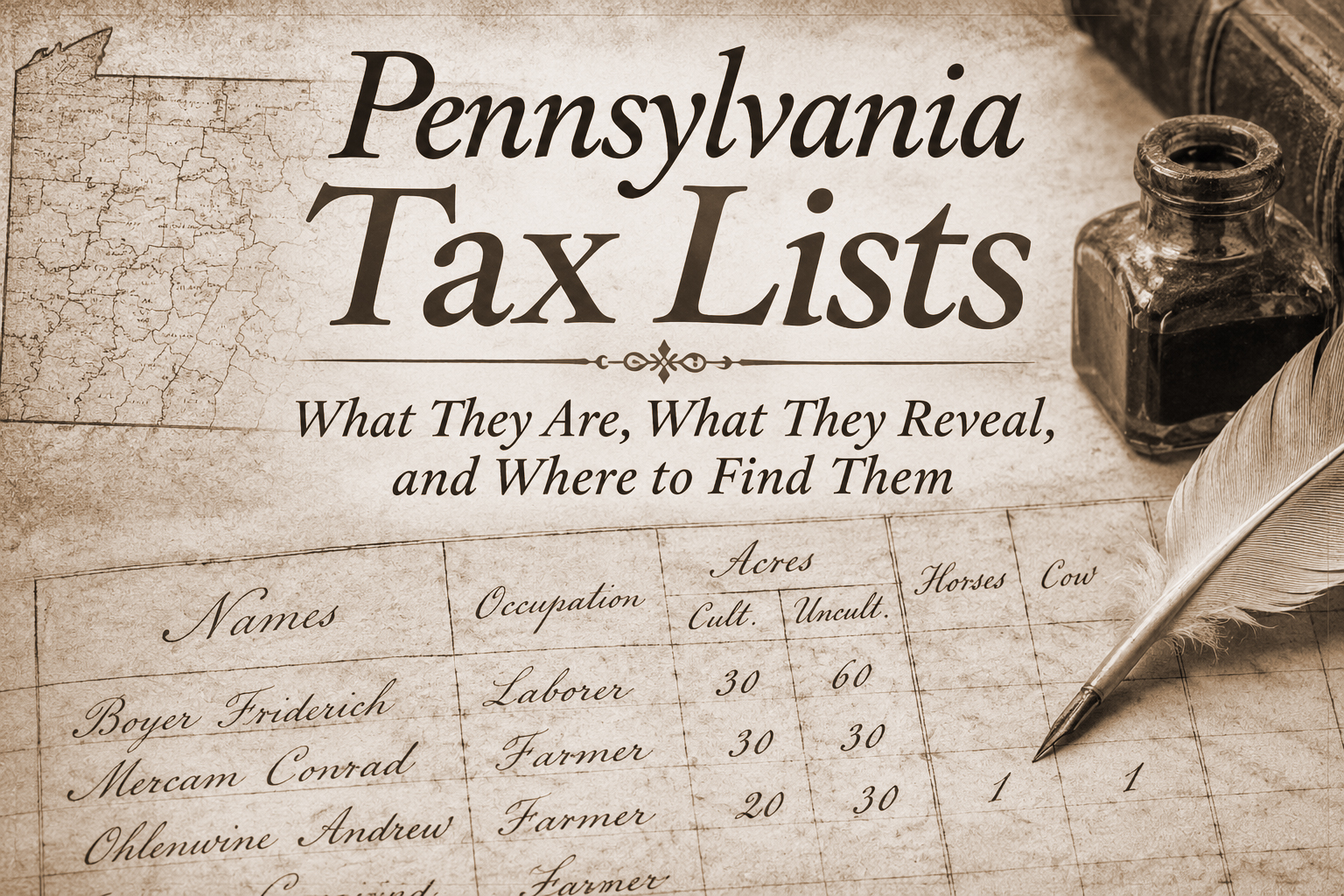
Pennsylvania tax lists are a valuable resource for genealogists, particularly for the eighteenth and early nineteenth centuries, when census records provide little information about individual households. These assessments recorded the names of taxable residents, sometimes identifying their occupations, acreage, livestock, mills, and other taxable property. They can help establish when a person lived in a particular township, provide clues to their economic circumstances, and reveal changes in landholdings and property over time. Some original assessments contain considerably more information than the abbreviated lists published in the Pennsylvania Archives and county histories. Tax laws and the types of property assessed changed over time, so the records must be interpreted carefully. Nevertheless, they offer a fascinating glimpse into the everyday lives of Pennsylvania’s early residents and the communities in which they lived.
Tax records must be interpreted with some caution. The property assessed to an individual was not necessarily property he owned outright; tenants could be taxed on the land they occupied and cultivated. The lists also distinguish between different classes of taxpayers, including landholders, single freemen, and individuals without land who nevertheless possessed taxable property. The poor, elderly, and infirm were sometimes exempted or listed separately. Tax laws and assessment practices changed over time, making comparisons between years particularly interesting but not always straightforward. When examined alongside deeds, wills, estate inventories, and other records, tax assessments can reveal much about the economic and social circumstances of Pennsylvania’s early inhabitants.
Pennsylvania, U.S., Tax and Exoneration, 1768-1801, Ancestry.com
https://www.ancestry.com/search/collections/2497
This database contains various tax lists from late-eighteenth-century Pennsylvania. This database contains exoneration returns and diverse tax lists from Revolutionary-era Pennsylvania. These include documents for supply taxes, 18-penny taxes, liquor taxes, carriage and billiard table taxes, and others. Supply taxes were levied to help pay debts from the Revolutionary War, while the 18-penny tax included both a poll tax on freemen and property taxes assessed to back issuances of paper money.
Records from the following counties are included: Allegheny • Bedford • Berks Bucks • Chester • Cumberland • Dauphin • Fayette • Franklin • Huntingdon • Lancaster • Montgomery • Northampton • Northumberland • Philadelphia • Washington • Westmoreland • York
Details on the lists vary by tax type, but they can include name; residence; occupation; land owned; Negroes owned; tax rate; whether a man was a single freeman.
Source Information: Ancestry.com. Pennsylvania, U.S., Tax and Exoneration, 1768-1801 [database on-line]. Provo, UT, USA: Ancestry.com Operations, Inc., 2011.
Original data: Tax & Exoneration Lists, 1762–1794. Series No. 4.61; Records of the Office of the Comptroller General, RG-4. Pennsylvania Historical & Museum Commission, Harrisburg, Pennsylvania.
Pennsylvania, U.S., Tax and Exoneration, 1768–1801, Ancestry.com
https://www.ancestry.com/search/collections/2497
This database contains a variety of tax lists and exoneration returns from eighteenth-century Pennsylvania. These include supply taxes, 18-penny taxes, liquor taxes, carriage and billiard table taxes, and other assessments. Supply taxes helped finance debts from the Revolutionary War, while the 18-penny tax included a poll tax on freemen and property taxes intended to support the issuance of paper money.
Counties included: Allegheny • Bedford • Berks • Bucks • Chester • Cumberland • Dauphin • Fayette • Franklin • Huntingdon • Lancaster • Montgomery • Northampton • Northumberland • Philadelphia • Washington • Westmoreland • York
Information varies by the type of assessment but may include names, residences, occupations, acreage, taxable property, enslaved people, tax amounts, and whether a man was classified as a single freeman.
Source Information: Ancestry.com. Pennsylvania, U.S., Tax and Exoneration, 1768–1801 [database on-line]. Provo, UT, USA: Ancestry.com Operations, Inc., 2011.
Original Data: Tax & Exoneration Lists, 1762–1794. Series No. 4.61; Records of the Office of the Comptroller General, RG-4. Pennsylvania Historical & Museum Commission, Harrisburg, Pennsylvania.
Pennsylvania, U.S., Septennial Census, 1779–1863, Ancestry.com
https://www.ancestry.com/search/collections/2702
Pennsylvania conducted enumerations of taxable residents every seven years beginning in 1779. Known as the Septennial Census, these enumerations were used for taxation and to help determine representation in the state government. Although not conventional population censuses, the surviving returns can be particularly useful for locating individuals between federal census years.
Early returns generally identify taxpayers by name, county, and township. Later records may provide ages, occupations, sex, and additional information. Women sometimes appear, particularly widows. Some returns also include information about enslaved people and residents with disabilities.
Coverage varies by year and county, and not all original returns survive.
Source Information: Ancestry.com. Pennsylvania, U.S., Septennial Census, 1779–1863 [database on-line]. Provo, UT, USA: Ancestry.com Operations, Inc., 2012.
Original Data: Septennial Census Returns, 1779–1863. Box 1026, microfilm, 14 rolls. Records of the House of Representatives. Records of the General Assembly, Record Group 7. Pennsylvania Historical and Museum Commission, Harrisburg, Pennsylvania.
Pennsylvania, U.S., U.S. Direct Tax Lists, 1798, Ancestry.com
https://www.ancestry.com/search/collections/2060
This database contains Pennsylvania records associated with the first federal direct tax, authorized by Congress in July 1798. Sometimes called the Window Tax, the assessment covered land, dwelling houses, and enslaved people.
The records include property valuations, tax assessments, lists of property owners and occupants, enumerations of enslaved people, receipts, and related documents. Depending on the form, entries may identify the owner and occupant of a property, describe buildings and land, give assessed values, and record taxes due or paid.
These records are particularly valuable because some contain descriptions of houses and other buildings that are not found in ordinary township tax lists.
Source Information: Ancestry.com. Pennsylvania, U.S., U.S. Direct Tax Lists, 1798 [database on-line]. Lehi, UT, USA: Ancestry.com Operations, Inc., 2012. Indexed by contributors to the Ancestry World Archives Project.
Original Data: United States Direct Tax of 1798: Tax Lists for the State of Pennsylvania. National Archives Microfilm Publication M372, 24 rolls. National Archives Identifier 5121373. Records of the Internal Revenue Service, Record Group 58. National Archives, Washington, D.C.
Bucks County, Pennsylvania, U.S., Tax Records, 1782–1860, Ancestry.com
https://www.ancestry.com/search/collections/2188
This collection contains images of original Bucks County tax records covering nearly eighty years. The information and arrangement vary considerably by township and year.
Early assessments typically identify taxpayers and the property for which they were assessed, including land, houses, horses, cattle, and sheep. Some nineteenth-century lists include acreage, building valuations, total taxable property, and county or state tax amounts. Certain years also contain special taxes, such as taxes on dogs.
Beginning in 1846, some assessments used more detailed forms that could record farmland, town lots, buildings, livestock, wharves, fisheries, mortgages, stocks, money at interest, debts owed to the taxpayer, household furniture, occupations, and annual income.
The collection also contains lists of taxable inhabitants and some early Orphans’ Court records. Researchers should examine both facing pages of the later assessment forms, as the information may extend across two pages.
Source Information: Ancestry.com. Bucks County, Pennsylvania, U.S., Tax Records, 1782–1860 [database on-line]. Provo, UT, USA: Ancestry.com Operations, Inc., 2012.
Original Data: Bucks County, Pennsylvania, Tax Records, 1782–1860. Microfilm, 76 rolls. Bucks County Historical Society, Doylestown, Pennsylvania.
Beaver County, Pennsylvania, U.S., Tax Records, 1832–1925, Ancestry.com
https://www.ancestry.com/search/collections/61334
This collection contains nineteenth- and early twentieth-century tax records for Beaver County, Pennsylvania. The records can help establish when an individual lived in a particular township and provide information about property and taxable possessions.
Depending on the year, entries may identify a taxpayer’s name, residence, property location, and taxable livestock, including horses and cows. These records may also provide evidence of changes in property holdings and agricultural activity over time.
Although the database title gives the dates 1832–1925, Ancestry’s description mentions records beginning in 1823. Researchers should consult the available volumes to establish the actual coverage.
Source Information: Ancestry.com. Beaver County, Pennsylvania, U.S., Tax Records, 1832–1925 [database on-line]. Lehi, UT, USA: Ancestry.com Operations, Inc., 2016.
Original Data: Genealogical Records. Beaver County Genealogy and History Center, Beaver, Pennsylvania.
Web: Chester County, Pennsylvania, U.S., Tax Discount Index, 1740–1865, Ancestry.com
https://www.ancestry.com/search/collections/70822
This database provides access to an index of Chester County tax discount records maintained by the Chester County Archives and Records Services.
Tax discount records document taxpayers associated with reductions or discounts in tax payments. They may help establish the presence of an individual in a particular township and year, especially when used alongside the regular county tax assessments.
This is an index derived from another website, rather than Ancestry’s own digitization of the complete original tax records. Researchers should consult the Chester County Archives for additional information and original records.
Ancestry’s database title gives the range 1740–1865, while its original-data citation identifies tax discount records for 1785–1865.
Source Information: Ancestry.com. Web: Chester County, Pennsylvania, U.S., Tax Discount Index, 1740–1865 [database on-line]. Provo, UT, USA: Ancestry.com Operations, Inc., 2016.
Original Data: Tax Discounts, 1785–1865. Chester County, Pennsylvania Archives and Records. https://www.chesco.org/. Source accessed by Ancestry January 6, 2016.
Susquehanna County, Silver Lake Township, Pennsylvania, U.S., 1878–79 Tax Rolls, Ancestry.com
https://www.ancestry.com/search/collections/5766
This database contains tax records compiled from the papers of Thomas Hawley Jr., tax collector for Silver Lake Township, Susquehanna County, during 1878 and 1879.
The records identify household heads and adult male residents, including individuals who appeared on the tax rolls but did not pay taxes. They record several kinds of local taxation, including county and state taxes, township taxes, school taxes, poor taxes, special road taxes, and dog taxes.
The 1878 records include county and state, township, school, special road, poor, and dog taxes. The 1879 records include county and state, poor, and dog taxes.
These records provide a particularly useful example of the different taxes collected at the local level during the late nineteenth century.
Source Information: Hawley, Daniel, compiler. Susquehanna County, Silver Lake Township, Pennsylvania, U.S., 1878–79 Tax Rolls [database on-line]. Provo, UT, USA: Ancestry.com Operations Inc., 2001.
Original Data: Silver Lake Township Tax Rolls. Higginson Book Company, 1878–187
U.S., IRS Tax Assessment Lists, 1862–1918, Ancestry.com
https://www.ancestry.com/search/collections/1264
This collection contains federal internal-revenue tax assessment records created following passage of the Internal Revenue Act of July 1, 1862. The legislation established a system of federal taxation intended to help finance the Civil War and created the Bureau of Internal Revenue, predecessor of the Internal Revenue Service.
The records cover numerous states and territories over different periods. The Pennsylvania records principally cover 1862–1866.
Unlike ordinary township property tax assessments, these federal records document taxes on incomes, businesses, occupations, licenses, manufactured goods, and other taxable activities. They were organized by federal collection districts and subdivisions.
The assessments generally fall into three categories: annual, monthly, and special lists. Entries may include the taxpayer’s name and address, occupation or taxable activity, assessment date, taxable period, quantity or value of taxable goods, amount assessed, payments, and abatements.
Because these records were organized by federal collection districts rather than county or township boundaries, researchers may need to browse several divisions to locate a particular community.
Source Information: Ancestry.com. U.S., IRS Tax Assessment Lists, 1862–1918 [database on-line]. Provo, UT, USA: Ancestry.com Operations Inc., 2008.
Original Data: Records of the Internal Revenue Service, Record Group 58. National Archives, Washington, D.C. Pennsylvania records are principally from National Archives Microfilm Publication M787, covering 1862–1866.