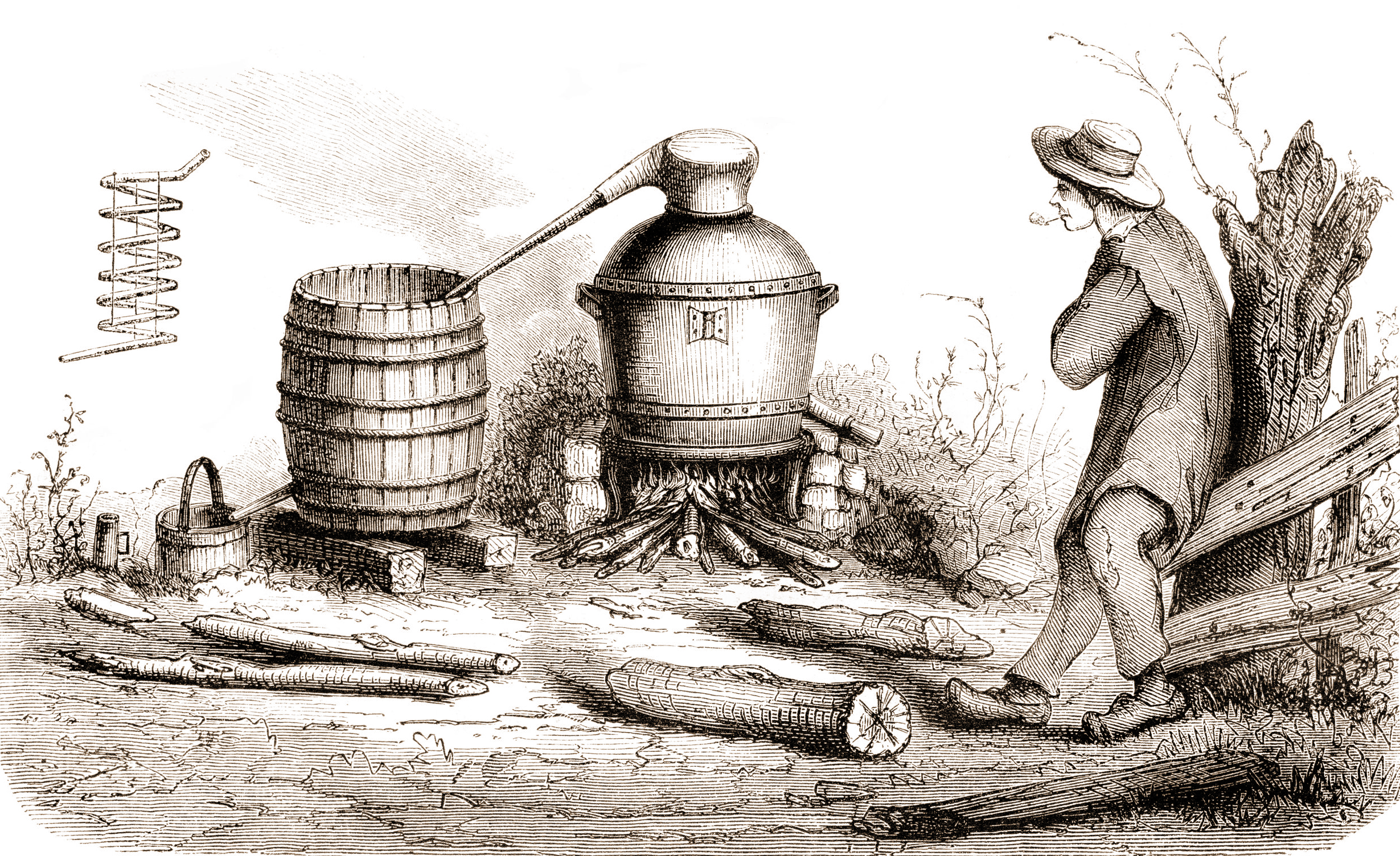
The Farmer’s Still: Distilling in Early Pennsylvania
During the late eighteenth and early nineteenth centuries, distilling was a common activity on Pennsylvania farms. Long before whiskey production became a large commercial industry, many farmers operated small stills as an extension of their agricultural work. A man who raised rye, corn, or wheat might also produce whiskey, sometimes working alone with his own equipment and sometimes with help from members of his household.
For these farmers, distilling was not necessarily a separate occupation. It was another way to make use of the crops they grew, much like milling grain, making cider, or raising livestock. A farmer might produce whiskey for his household, sell it to neighbors, or trade it for goods and services.
Why Farmers Made Whiskey
One of the greatest difficulties facing early Pennsylvania farmers was transporting their produce to market. Roads were often poor, wagons were slow, and hauling a large quantity of grain over considerable distances could be expensive. Distilling offered a practical solution. Grain could be converted into whiskey, a more concentrated and valuable product that was easier to transport and store. Instead of hauling many bushels of rye or corn, a farmer could take a much smaller quantity of whiskey to a merchant or tavern. Whiskey also provided an additional source of income at a time when cash was not always readily available in rural communities. It could be sold, exchanged for merchandise, or used to settle accounts. Local merchants sometimes accepted whiskey in trade, just as they accepted grain, livestock, or other farm products. Distilling also allowed farmers to make use of grain that might otherwise bring a poor price. The resulting whiskey was less perishable than the original crop and could be kept until a buyer was found.
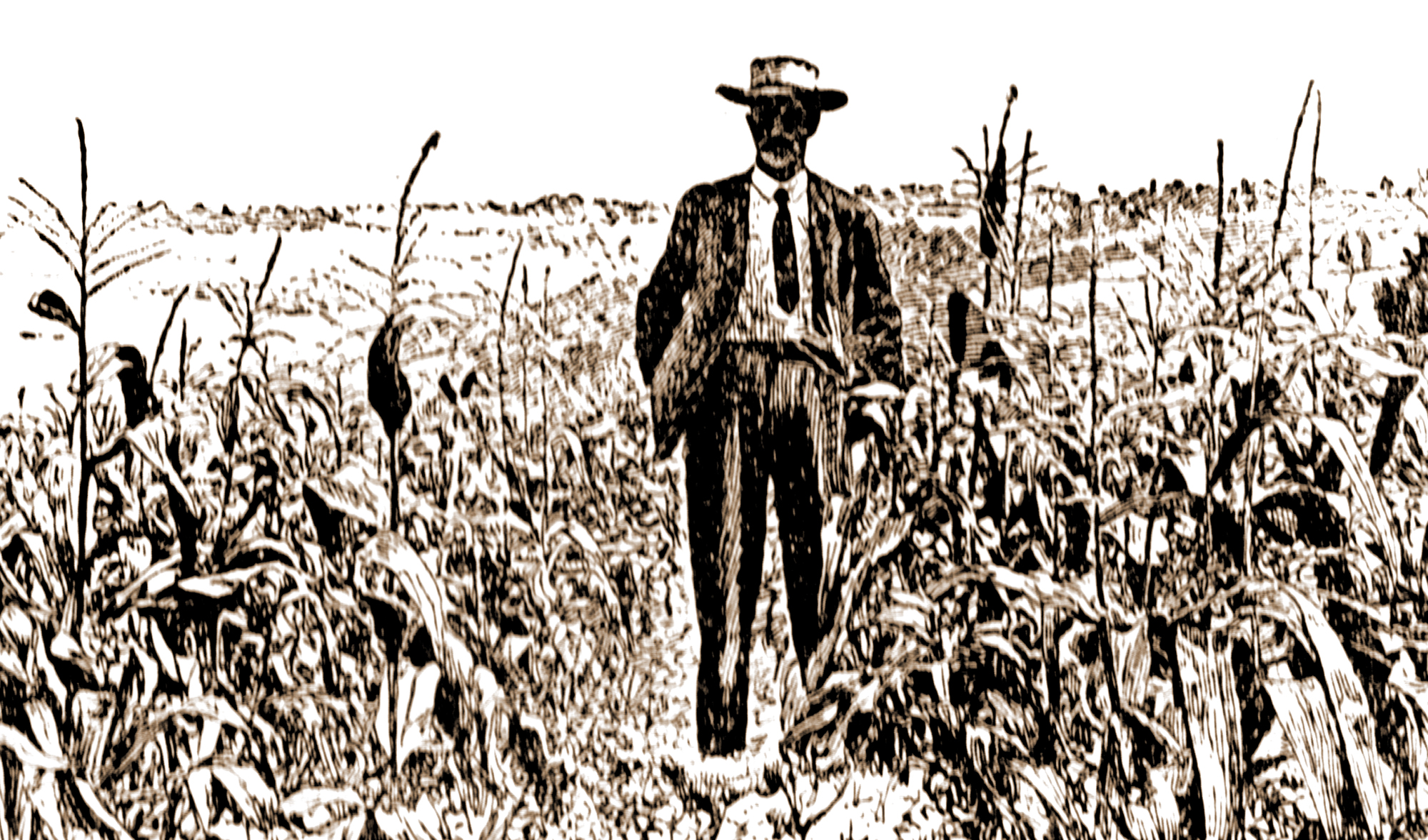
The Small Farm Distillery
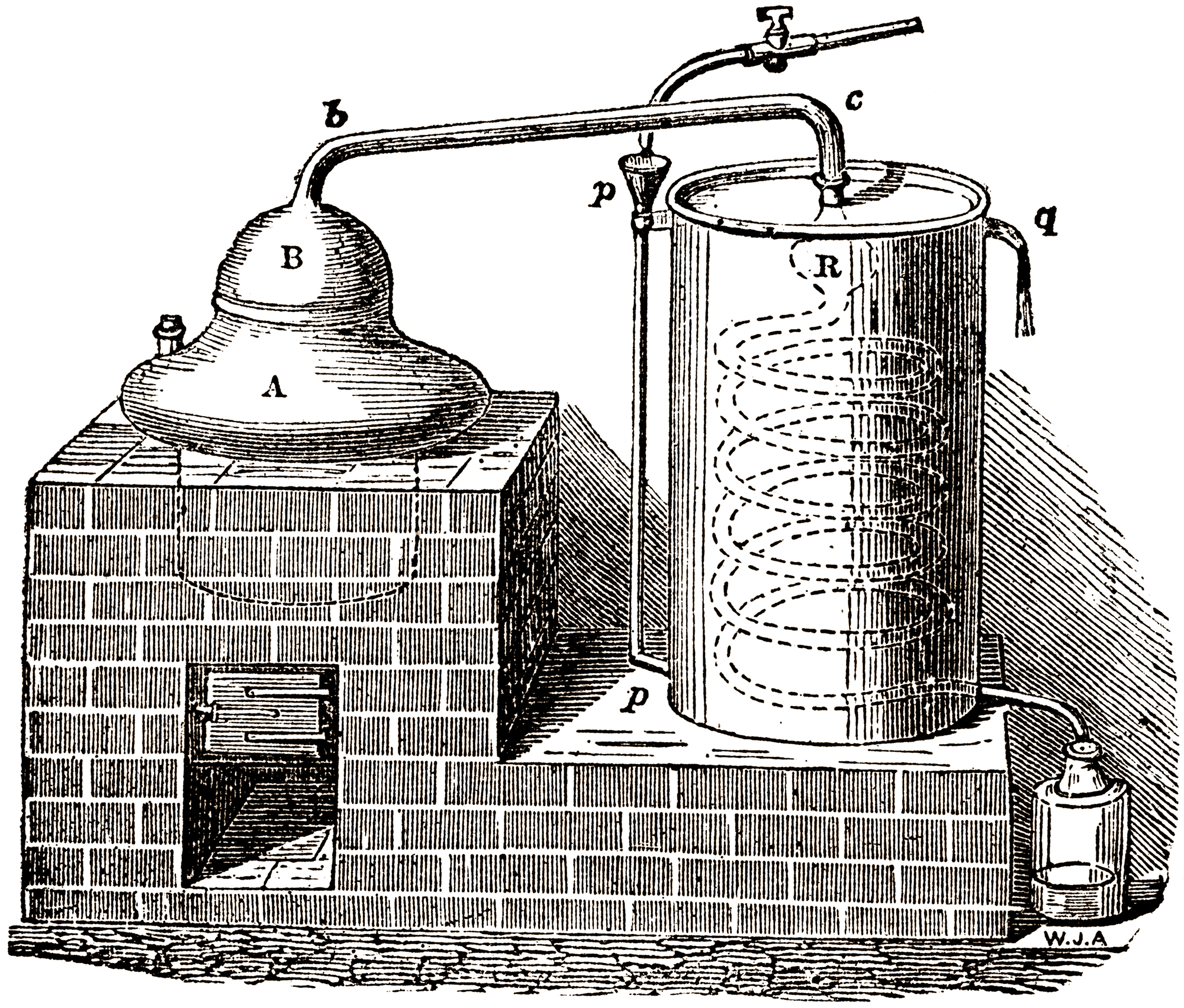
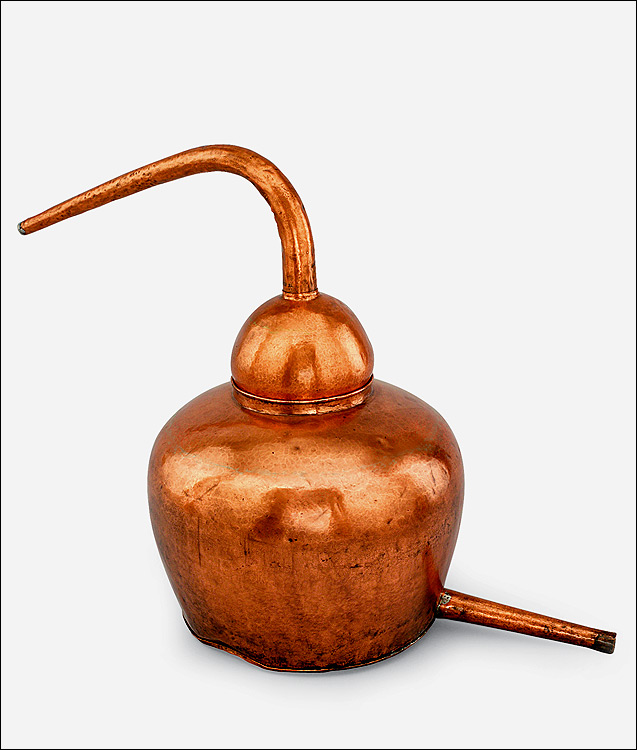
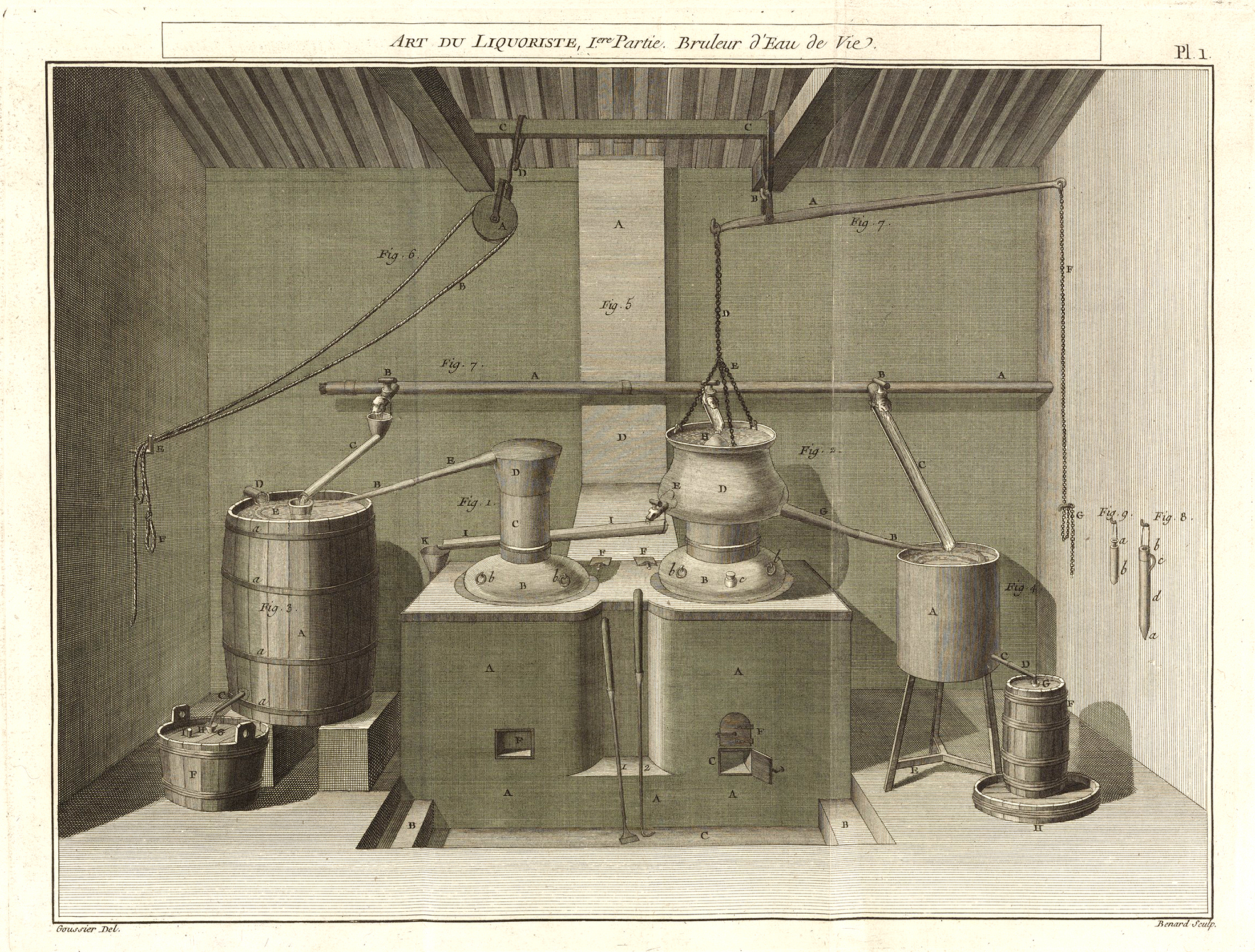
A farmer did not need an elaborate building or expensive machinery to produce whiskey on a modest scale. The essential equipment was a copper still, a furnace or fireplace to heat it, a pipe or coil through which the alcohol vapor could pass and cool, and wooden tubs or barrels for preparing and fermenting the grain. The still was generally a large copper vessel with a fitted top, connected to a copper pipe called a worm. This pipe passed through a container of cold water. As the heated vapor traveled through the worm, it condensed and emerged as liquid spirits.
The still had to be heated over a fire, usually fueled by wood. Maintaining the proper heat required constant attention. Too much heat could scorch the contents or damage the equipment, while too little could interrupt the distilling process. Water was equally important, both for preparing the grain and for cooling the vapor. For this reason, distilleries were often situated near springs or streams.
Some farms had a separate building called a still house. Others used an existing springhouse or another suitable outbuilding. Pennsylvania’s Agricultural History Project documents two early still houses in Cumberland County, dating to approximately 1800–1825. Both were stone buildings measuring roughly 12 by 20–24 feet. Water flowed through channels in the lower level, while fireplaces provided heat above. Such buildings give us a picture of how a small rural distillery might have been arranged, although the equipment and buildings varied considerably from one farm to another.
Making Whiskey on the Farm
The production of whiskey began with the grain. Rye and corn were particularly common, although wheat, barley, and other agricultural products could also be used. The grain first had to be ground or crushed, often at a nearby gristmill. It was then mixed with water and prepared for fermentation. During fermentation, yeast converted sugars into alcohol, producing a liquid commonly called beer or mash. Once fermentation was complete, the liquid was transferred to the still and heated. Alcohol vapor rose through the apparatus and condensed in the cooling pipe.
The first distillation generally produced a relatively weak spirit. A second distillation, known as doubling, increased its strength. The finished whiskey was collected in barrels or other containers. Much of the ordinary whiskey sold during this period was unaged, unlike the barrel-aged spirits familiar today.
The work required experience. The farmer had to judge the condition of the grain, the progress of fermentation, the temperature of the still, and the quality of the finished product. An unsuccessful batch could mean the loss of valuable grain, labor, and fuel.
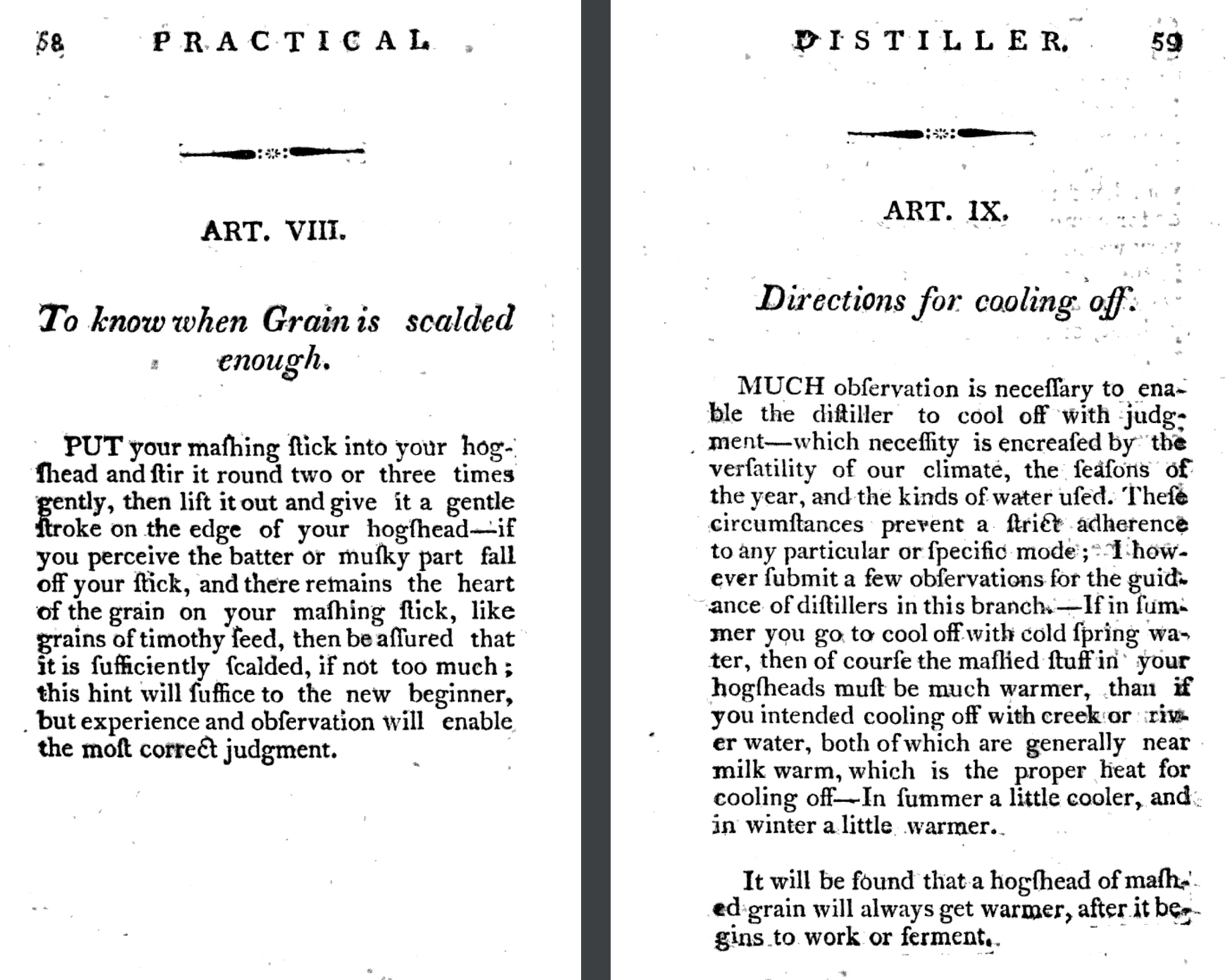
In 1809, Samuel McHarry of Lancaster County, Pennsylvania, published The Practical Distiller, a handbook based on his own experience. His instructions covered nearly every aspect of the business, including selecting grain, maintaining yeast, operating stills, preventing fires, and caring for the wooden vessels used in production. McHarry emphasized that cleanliness, attention, and good judgment were essential to successful distilling.
A Farmer Working His Own Still
For a small farmer, distilling was one more demanding job among many. The farmer had fields to cultivate, livestock to feed, fences to maintain, and crops to harvest. Distilling had to fit around these responsibilities. Much of the work was physical. Grain had to be carried and prepared, water supplied, barrels cleaned and moved, and wood gathered for the furnace. The heavy vessels and hot liquids made the work both laborious and potentially dangerous. Once the still was operating, it could not simply be left unattended. The fire required tending, and the progress of the distillation needed to be watched carefully. A farmer who operated his own still might spend long hours at this work, particularly when producing whiskey for sale. Family members might assist with ordinary tasks, but a small operation did not necessarily require a hired distiller or a permanent workforce.
Production was often fitted to the agricultural year. After the grain harvest, a farmer had a supply of raw material available, and during the quieter winter months there might be more time for distilling. Other farms operated their stills more regularly, depending on the demands of the business and availability of supplies. The size of an operation could vary enormously. Some farmers made only enough for household use and occasional trade. Others produced whiskey in sufficient quantities to make distilling a substantial source of income.
Whiskey and Livestock
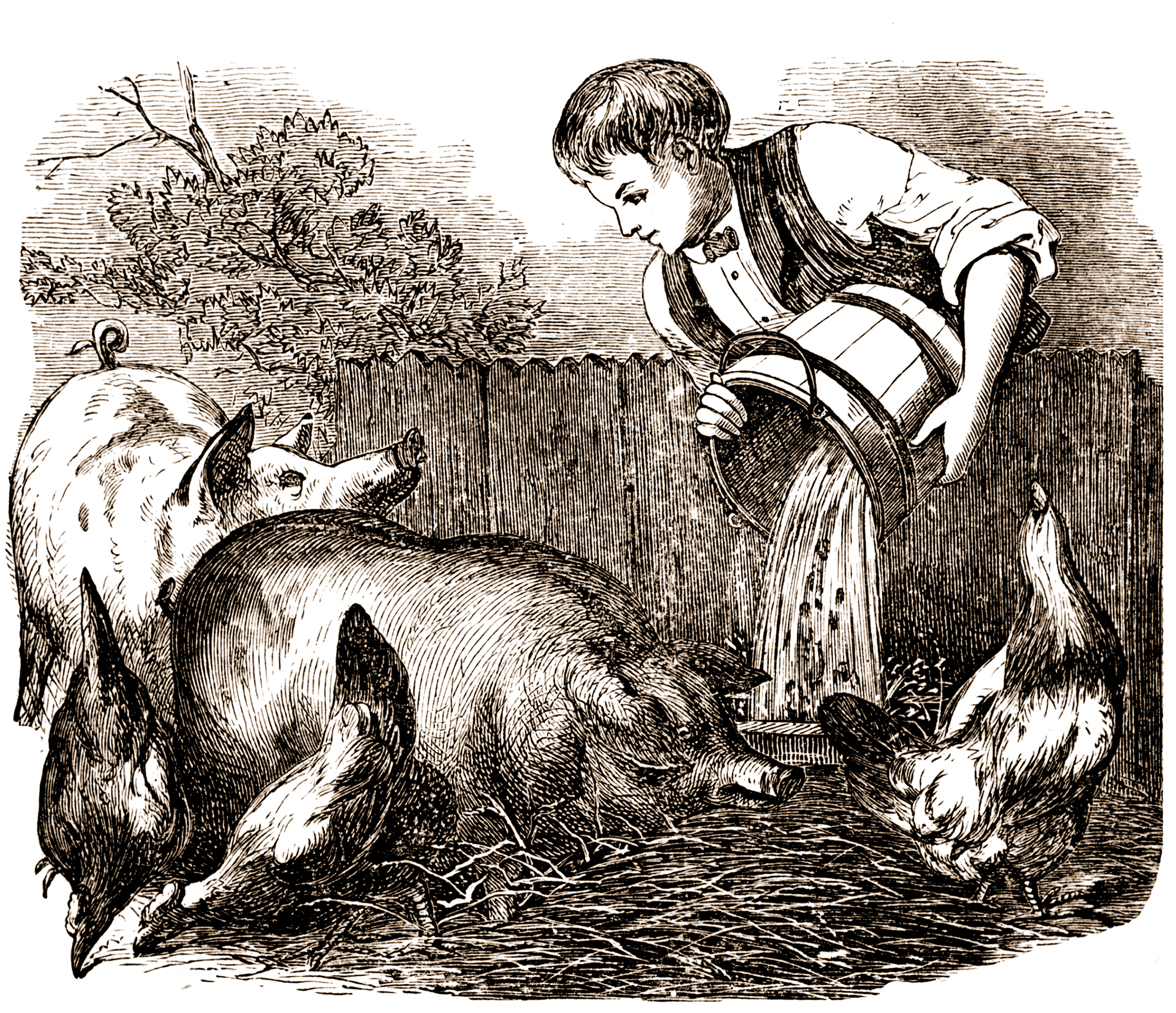
One advantage of farm distilling was that it complemented livestock raising. The grain remaining after the distilling process, commonly called slop or potale, could be fed to hogs and cattle. Rather than discard this material, farmers used it to fatten their animals. This could make distilling doubly profitable. The farmer sold the whiskey and also benefited from livestock raised partly on the residue.
McHarry devoted an entire section of his 1809 book to hogs and cattle. He regarded the use of distillery waste as an important part of the economics of the business. On a small farm, the still, grain fields, and livestock were therefore closely connected. The whiskey brought one source of income, while the animals provided another.
Distilling and Taxes
Distilling was also subject to government taxation, although the laws changed during the early nineteenth century. In 1791, the federal government imposed an excise tax on distilled spirits. The tax was particularly unpopular among western Pennsylvania farmers, many of whom depended on whiskey as a marketable product. Their resistance eventually contributed to the Whiskey Rebellion of 1794. The federal excise tax was repealed in 1802 during Thomas Jefferson’s administration, but taxes and licensing requirements returned during the War of 1812. These wartime taxes were discontinued at the end of 1817. Consequently, farmers who distilled whiskey at different times during the early 1800s faced different requirements. Some left records in federal tax or licensing documents, while others may appear only in local assessments or estate inventories.
A Valuable Part of Rural Life
Distilling was one of many ways Pennsylvania farmers supplemented their incomes and made use of the resources available to them. It required skill and considerable labor, but a small operation could be conducted without the buildings, machinery, or employees associated with large commercial distilleries. By converting grain into whiskey, a farmer could produce something readily marketable, make better use of his crops, and provide additional feed for his livestock.
References to a farmer as a distiller in early nineteenth-century records should therefore not automatically be taken to mean that he owned a large factory or employed numerous workers. Even the description extensive distiller may refer to a farmer whose distilling activities were particularly important or productive within his community. Determining the actual scale of an individual’s business requires additional evidence, such as tax assessments, estate inventories, account books, and property records. These records sometimes identify copper stills, barrels of whiskey, quantities of grain, and other equipment, providing a much clearer picture of an activity that was once a familiar part of rural Pennsylvania life.
Period Books on Distilling
The American Distiller by Michael Krafft, Philadelphia, 1804
The American Distiller; or, The Theory and Practice of Distilling is an 1804 technical manual by Michael Krafft, published in Philadelphia by Thomas Dobson. It is generally regarded as the first American book devoted to distillation, making it an important record of the transition from household craft to scientifically informed American distilling. American Bookbinders Association. This book is for sale at store.Maggs.com.
Krafft combines theory, practical instruction, equipment design, and recipes. The 219-page first edition discusses constructing and operating stills, rectification and the treatment of spirits, preparation of grain and malt, and production of various distilled drinks; it also contains two folding plates illustrating distillation apparatus. American Bookbinders Association
The book is particularly valuable for documenting American grain distilling at the beginning of the 19th century. It gives instructions involving corn meal, rye meal, malt, water, yeast, fermentation, and distillation; Mount Vernon has reproduced one of Krafft’s 1804 whiskey formulas as a historical recipe. The volume also includes dozens of preparations for flavored waters and cordials, plus recipes for usquebaugh, an older term associated with whiskey. George Washington’s Mount Vernon
Krafft was not simply compiling recipes: he was an inventor and working authority on still design. He received a U.S. patent in 1801 for an improvement in stills, and by the publication of the book, 217 distilleries reportedly used his plan; one of the book’s plates contrasts his arrangement with a still Krafft believed was designed to evade his patent. American Bookbinders Association
The book was dedicated to Thomas Jefferson after Krafft wrote to the president in April 1804 seeking permission. Jefferson agreed and praised the application of chemistry to ordinary productive activities, including distillation; he specifically noted that converting surplus grain into spirits could make an agricultural product easier to transport to distant markets. Jefferson’s own library later contained Krafft’s book. The Library of Congress
Its importance extends beyond drink recipes: The American Distiller captures an early moment when American distilling was becoming a technical and industrial discipline involving patents, purpose-designed machinery, chemistry, agricultural economics, and standardized procedures. Later American distilling manuals followed, including Samuel McHarry’s The Practical Distiller (1809), making Krafft’s 1804 volume an unusually early landmark in American spirits literature.
The Practical Distiller by Samuel McHarry, Harrisburg, 1809
The Practical Distiller is an American distilling manual by Samuel McHarry of Lancaster County, Pennsylvania, published by John Wyeth in Harrisburg in 1809. It is one of the earliest American books devoted to distillation, combining practical instruction on whiskey and other spirits with recipes for cider, wine, and beer. Read it online at Project Gutenberg.
McHarry wrote for working distillers rather than scientific specialists. The 184-page book discusses fermentation, yeast, still operation, yields, purification, coloring, and production methods, with instructions for turning American agricultural products—including rye, corn, buckwheat, apples, peaches, potatoes, pumpkins (“pumpions”), and turnips—into spirits. Google Books
The book reflects a period when American distilling was becoming increasingly based on domestically grown grain and fruit. McHarry presents himself as a practitioner who learned through experience and experimentation; in his preface, he recalls beginning with little understanding even of fermentation and then developing his knowledge through observation and practice. Apple
Its historical value lies in documenting early-19th-century American whiskey-making as a working trade. Bibliographical sources describe it as among the earliest American distilling manuals; scholarship notes that an earlier American distilling book by Michael Krafft predates it, making claims that McHarry wrote the very first American work on the subject inaccurate. Christie’s
Some passages look surprisingly familiar to modern whiskey enthusiasts. McHarry discusses charred barrels and the use of charcoal in treating spirits; rare-book scholarship has noted the resemblance of these practices to techniques that later became important in American whiskey production. The book also treats economics and efficiency alongside flavor and quality, making it as much a working tradesman’s handbook as a collection of recipes. Donald A. Heald Rare Books
The original 1809 edition is now a scarce collectible, but the text itself is in the public domain and has been digitized. Project Gutenberg provides a complete transcription, preserving the book’s period terminology and spelling, which makes The Practical Distiller particularly useful as a primary source for understanding early American distilling rather than simply as a modern recipe manual.
The Distiller: Adapted to the Use of Farmers and Distillers by Harrison Hall, 1818
Available on Google Books. Published in Philadelphia in 1818, this expanded second edition of Harrison Hall’s 1813 distilling manual provides a detailed account of American distilling practices during the early nineteenth century. Written for both farmers and professional distillers, the 338-page book explains how to prepare and ferment grain, operate different types of stills, produce whiskey and brandy, and improve the efficiency of distilling equipment. It also includes instructions for making gin, cider, beer, wine, and cordials, along with discussions of yeast preparation, temperature control, and the measurement of alcoholic strength. Of particular interest are its descriptions and illustrations of contemporary American stills, condensers, and other equipment, which help illustrate the technology available to rural Pennsylvania farmers. The book offers valuable firsthand insight into the methods and practical knowledge employed by distillers during the period when small farm distilleries were common throughout Pennsylvania.
Sources and Further Reading
- McHarry, Samuel. The Practical Distiller: or, An Introduction to Making Whiskey, Gin, Brandy, Spirits, &c. Harrisburg, Pennsylvania: John Wyeth, 1809. Read online at Project Gutenberg.
- Krafft, Michael. The American Distiller; or, The Theory and Practice of Distilling. Philadelphia, 1804.
- Pennsylvania Historical and Museum Commission. Agricultural Resources of Pennsylvania, c. 1700–1960: York-Adams Diversified Field Crops, Cannery Crops, and Livestock. See discussion of still houses, p. 25. Read the report.
- George Washington’s Mount Vernon. Ten Facts About the Distillery. Although Mount Vernon’s commercial operation was unusually large, its records demonstrate the relationship between grain production, distilling, livestock, and local commerce.
- Alcohol and Tobacco Tax and Trade Bureau. The Whiskey Rebellion. Background on early federal taxes on distilled spirits.
- Homestead Economics: Distilling Liquor by Andrew Hagenbuch
- When Whiskey Was the King of Drink by Mary Miley Theobald