Reading Old Handwriting: A Genealogist’s Guide to Colonial Script
Anyone who spends enough time researching family history eventually encounters a document that seems almost impossible to read. Wills, deeds, church registers, court records, letters, and family papers may contain unfamiliar letter forms, obsolete abbreviations, inconsistent spelling, and handwriting styles very different from those used today.
The study of old handwriting is called paleography. Fortunately, old handwriting becomes much easier to read once you learn to recognize a few recurring letter forms and conventions. The trick is not to expect every letter to look like its modern equivalent. The National Archives of the United Kingdom maintains a paleography guide specifically for English documents dating from 1500 to 1800, the period covered by many records encountered in early American genealogy.
Handwriting Changed Over Time
There was never a single “colonial handwriting.” The handwriting found in American records reflects styles brought from Britain and Europe and changed considerably from the seventeenth through the nineteenth centuries.
Researchers working with seventeenth-century English records may encounter Secretary Hand, a writing style widely used for government, business, church, probate, and personal documents. Its letters can be surprisingly different from modern handwriting, particularly e, c, r, s, h, and k.
By the eighteenth century, increasingly familiar roundhand and related cursive styles were widely used. These were the ancestors of the flowing penmanship that remained common through much of the nineteenth century.
One of the finest surviving examples is George Bickham’s The Universal Penman, published about 1740–1741, which reproduced the work of accomplished writing masters and demonstrates the elaborate English roundhand of the period.

Alphabet Chart for Handwriting Styles
This is an old alphabet chart from my files. (I do not know where it came from or who compiled it.) It might be particularly useful for those deciphering Pennsylvania German documents. Click on the image to see a larger view or download a pdf.

The Colonial Alphabet: I, J, U and V
Earlier English writing and printing did not always treat I and J, or U and V, as completely separate letters in the way we do today. Instead, the forms often functioned as variants of one another, and their use gradually became standardized during the early modern period. The transition was not instantaneous, so researchers may continue to encounter older practices in seventeenth- and eighteenth-century records.
For example, I and J: A name that we would write today with a J may sometimes appear with an I-like form. U and V: Earlier writers and printers sometimes chose the form according to its position within the word rather than whether it represented the modern U or V sound.
The important lesson for genealogists is not to reject a possible surname merely because one of these letters appears to be “wrong.” What looks like a spelling variation may simply reflect contemporary writing conventions.
The Long S: ?
One of the most common sources of confusion in eighteenth-century records is the long s, written ?. To modern eyes it often resembles an f, but it is actually another form of lowercase s. It was commonly used at the beginning or in the middle of words, while the familiar round s generally appeared at the end. Thus a word such as Congress might appear visually similar to Congrefs, although the writer intended an s, not an f.
“Ye” Usually Doesn’t Mean “Ye”
Another character that confuses researchers is the apparent y in words such as ye. In many early documents this is not really the letter y. It represents an older English letter called thorn (þ), which represented the th sound. As printing developed, printers sometimes substituted a y-shaped character for thorn. Consequently, ye = the and yt = that. So the famous expression “Ye Olde…” would historically have been pronounced “The Old…”, not “yee old.” The Folger Shakespeare Library has a particularly useful explanation of this convention.
Spelling Was Not Standardized
Genealogists should also resist the temptation to treat spelling as fixed. Names and ordinary words may appear differently from one record to another, even when written by the same person. Writers sometimes spelled words according to pronunciation, local usage, or personal habit. A surname such as Farquhar, for example, should not automatically be ruled out because a clerk rendered it differently in a particular record.
When searching databases, it is therefore useful to try • alternate vowels • doubled or omitted consonants • phonetic spellings • I/J substitutions • U/V substitutions • different interpretations of difficult capital letters. FamilySearch specifically recommends comparing questionable letters with other examples written by the same scribe, rather than relying only on a generic alphabet chart.
An alphabet chart is helpful, but no chart can reproduce the quirks of every clerk. If you cannot identify a letter in a surname, find a word elsewhere on the page that you already know. Dates, months, common given names, county names, and frequently repeated legal terms are especially useful. For example, if you cannot decide whether a letter is an S or an L, find another word containing a known S and compare the two. FamilySearch recommends essentially this approach: identify letters in words you can read confidently and use them to build an alphabet for that particular writer.
Quill Pens and Writing
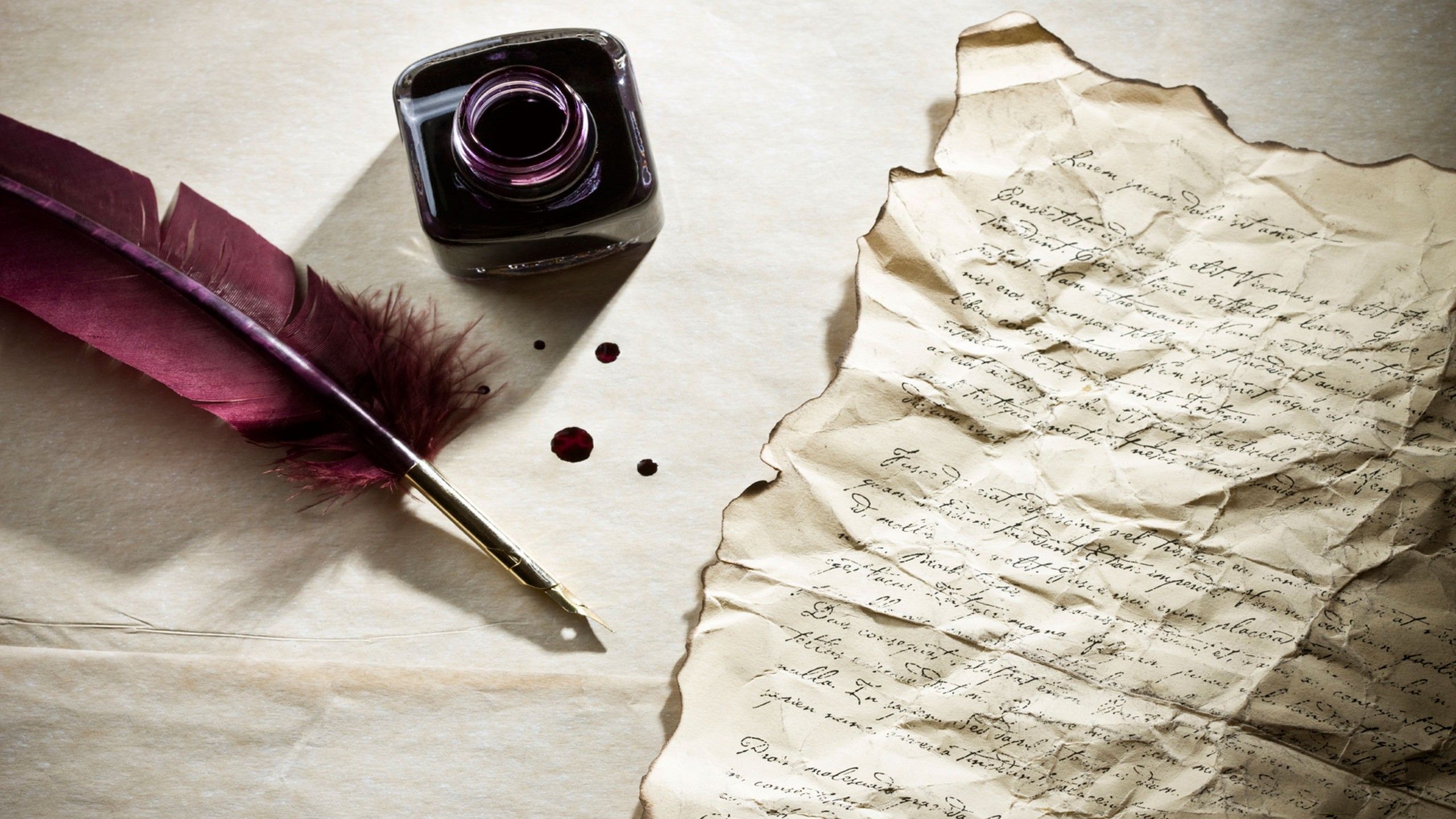
Before mass-produced steel dip pens became common, most writing was done with quill pens. In the 18th century Americans used used quill pens, often home made. Toward the end of the 1700s, people purchased sharpened or unsharpened quills in bundles. The point of the quill pen, called the nib, wore down quickly and needed frequent sharpening.
Quills were generally made from large wing feathers, particularly those of geese or swans. The end of the feather was cut into a writing point, or nib, and the hollow shaft held a small quantity of ink after being dipped into an inkwell. Because the point gradually wore down, writers had to reshape it periodically with a small knife—the origin of the term penknife.
Eighteenth-century black writing inks commonly used oak galls and gum arabic and could either be purchased or made at home. Iron-gall ink was used extensively in Europe and America for centuries. It was commonly made using tannins from oak galls, an iron compound, and a binder such as gum arabic. Fresh iron-gall ink could darken after exposure to air and, as it aged, often turned the familiar brown color seen in old manuscripts.
Writers aimed for a graceful, flowing script. Elegant penmanship was sought after while poor handwriting was frowned upon. It was thought that one’s character–whether lazy, unreliable, competent, or hard-working–was reflected in one’s penmanship. Spelling, however, was executed phonetically.
Recommended Handwriting Resources
- The National Archives — Palaeography Tutorial – Excellent practice with English documents from 1500–1800. Palaeography Tutorial
- FamilySearch — English Handwriting Helps – Includes Secretary Hand alphabets and additional handwriting resources. English Handwriting Helps
- FamilySearch — Tips for Reading Handwriting – Especially good advice on comparing letters within the same document. Get Help Reading Handwriting
- Folger Shakespeare Library — U/V, I/J and Other Early Letter Forms – One of the best explanations I’ve found for these confusing early-modern conventions. Early Modern Letter Forms