
History of Slatington, Lehigh County, Pennsylvania, by Albert Koons
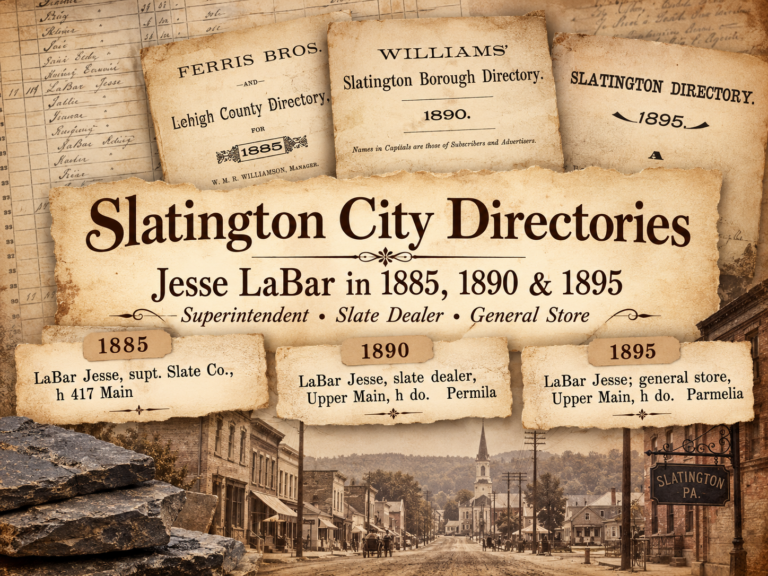
Slatington is of particular interest to me because my great-great-grandfather, Jesse LaBar (1835–1913), lived and worked there. Jesse spent much of his career in the slate industry, and the 1885 city directory lists him as a slate company superintendent residing at 417 Main Street. Interestingly, the history below credits Nelson LaBar, along with William Roberts, with discovering slate in the area in 1844. I have not yet established whether Nelson was related to my LaBar family.
Slatington, a borough in Lehigh County, Pennsylvania, owes much of its early growth and prosperity to the slate industry. First settled in the eighteenth century, the area developed rapidly after the discovery of commercially valuable slate in 1844. The opening of quarries, the arrival of the Lehigh Valley Railroad in 1856, and the establishment of slate manufacturing businesses transformed the small settlement, originally called Liberty, into a thriving industrial community. Slatington was incorporated as a borough in 1864, and by 1885 its population had grown to approximately 2,000.

The following account is reproduced from Albert A. Koons’ Illustrated History of the Lehigh Valley, published in 1885. Written during a period of considerable industrial growth, it provides a contemporary description of Slatington’s early settlement, slate quarries and factories, railroads, businesses, churches, schools, and civic institutions. It is a valuable glimpse of the community as it existed in the late nineteenth century.
History of Slatington (1885)
On the west side of the Lehigh River, thirty-three miles above Easton, at a point where the famous “Warriors’ Path” crossed the Lehigh, one Nicholas Kern, as early as 1737, took up land on which he subsequently made his home. Here he also built a saw and grist mill on Trout Creek. In the year 1761 a wagon road was laid out on the old “Warriors’ Path,” crossing Trout Creek and running through the present site of Slatington. The descendants of Nicholas Kern were the only settlers in what is now Slatington until the discovery of slate, in 1844, by William Roberts and Nelson Labar, while on their way afoot from Easton to Mauch Chunk. They leased the property from John Brenninger, and in the spring of 1845 opened a quarry a little below where Caskie & Emack’s works now are, and in August of the same year John Renninger opened quarry No. 1 of the Heimbach vein. A short time afterwards Owen Jones discovered slate on the property of Jonas Kern, and leased the land for fifteen years. He associated William Roberts with himself, and opened what is now known as the “Tunnel Quarry,” they agreeing to pay Kern twenty-eight cents per ton of “slate shingles” for each and every ton of “slate shingles” made, and stipulating that if he desired to go into quarrying slate himself, he could not associate anyone but Jones and Roberts with himself.
In 1854 the Slatington Bridge Company was chartered, and in November of the same year their bridge was opened to the public. The Lehigh Slate Company was also chartered in 1854, and added many buildings and other improvements to the town. In 1856 the Lehigh Valley Railroad was opened, and marks the era of rapid growth in the slate trade. In the same year the hotel near the depot was opened, several dwellings erected, and the settlement called Liberty. In 1859 the slate-mantel factory of the Lehigh Slate Company was erected. In 1862 the Riverside Slate Quarry was opened. In 1863 David Williams & Co. opened a quarry near the Lehigh River, and two years later put up their first school-slate factory, which was burned down in 1874. The present substantial brick structure was erected in 1875.
The borough of Slatington was incorporated September 7th, 1864. The first borough officers elected were Robert McDowell, Burgess; Henry Kuntz, Charles Peter, Jonas Hoffman, Henry Handwerk, and Abraham Person, Council. A station-house and council chamber were built in the fall of 1867, and in the spring of 1868 the borough was presented with a fire engine and hose carriage by the Slatington Gift Enterprise Company.
In 1826 a stone bridge was built over Trout Creek, which remained in use until 1869, when it was replaced by the present iron structure.
When the slate quarries in this locality were first opened their product was confined to roofing slate; in 1852 slate mantels were made, and in 1865 the manufacture of school slates was commenced by D. & H. Williams, in a small way at first, until now their annual product is ten thousand cases of ten dozen school slates each. In the fall of 1883 the Hyat Slate Company commenced the manufacture of school slate. John D. Emack, of the New York Slate and Novelty Company, commenced the manufacture of school slate in April, 1883.
In addition to the slate factories and quarries, there are several carriage factories, a grist mill, a marble yard, and other manufacturing industries in the town. The post office was located here in 1851, before which time the mail had to be brought from Craig’s Store, at the Lehigh Gap. It was the intention to call the place Waverly, but as there was a Waverly in Pennsylvania that name had to be abandoned.
In 1853 John and George Remaly laid wooden pipes from a spring owned by them down to the town, and supplied several customers with water. In 1859 they leased their pipe system to Moses Kuntz for five years, at eighty-five dollars per year. In 1861 D. D. Jones bought the farm on which these springs were located, and in 1863 secured Kuntz’s lease, which, together with the privilege it conferred, he transferred to the Slatington Water Works Company, who put in iron pipes and extended the system. In 1883 the borough bought the water works and springs, from which eight-inch pipes were laid. The capacity of the works is about 30,000 gallons per day.
September 2d, 1868, the Slatington News made its first appearance, Godshalk & Bright proprietors, editors, etc. After five changes in proprietorship in ten years, it passed into the sole ownership and control of L. E. Schlauch, January 16th, 1878. The paper has been considerably enlarged, and makes a specialty of slate news, without overlooking other matters of interest.
In 1870 the Lehigh Valley Railroad Company built a branch road for several miles along Trout Creek to Franklin, about two miles above the junction. Since then the Berks County Railroad Company have built a railroad from Reading to Franklin, giving a direct western outlet for the slate. This road is now leased to and operated by the Philadelphia and Reading Railroad Company.
The National Bank of Slatington commenced business August 31st, 1875; Peter Gross, president; William H. Gish, cashier.
Evangelical Lutheran Congregation was organized September 19th, 1868. The corner-stone of a union (Lutheran and Reformed) church was laid June 27th, 1869, and the church dedicated December 25th and 26th of the same year. The union arrangement continued until 1880, when it was dissolved—the Reformed congregation purchasing the church property. July 2d, 1881, the corner-stone of the present building was laid; the basement was dedicated November 6th, 1881, and the main auditorium was dedicated December 2d, 1883. The congregation own a parsonage adjoining the church.
M. E. Church.—This congregation was organized in 1869. The corner-stone of the church was laid September 12th, 1869, and the completed building dedicated December 10th, 1869.
The Presbyterian Church.—This congregation was organized in 1850. The corner-stone of the church was laid in July, 1854, and the church dedicated in February, 1855. In 1874 a new church building was begun, and was completed and dedicated September 29th, 1876. The Sunday school in connection with this church was started in 1854 by Robert McDowell with six members.
Evangelical Association.—This society was organized in 1862, and erected their present church building in 1870.
The Welsh have two churches in Slatington—one a Congregational, corner of Fourth and Franklin streets, and one Presbyterian. Both congregations erected houses of worship in 1883.
The Catholic Church is the latest organized religious denomination. They erected their church in the fall of 1883.
The schools of the borough are in a flourishing condition. In 1863 the present handsome and commodious school building was erected, but was soon too small, and in 1878 a two-story wing was added to it. The schools are in charge of Prof. F. J. Stetler.
The town at present has a population of about two thousand, and is rapidly growing.
Present borough officers are:—
Burgess, Alx. Jacobs.
Town Council: Thomas Kern, William Morgan, John Kennel, Chas. Berkemeyer, William Peters, R. H. Dolbey.