The Heekin family is not in my direct line but I was kindly given information on them by Lawrence LeBlond so I’ve included them here in case it helps other researchers. The Heekin family married into my line of LeBlonds.
James Heekin and Mary Malloy
James Heekin was born on December 8, 1843, a son of Patrick Heekin, born June 20, 1818, and Ellen Heekin, born May 21, 1821. Patrick and Ellen were married on February 2, 1841. The family account states that they had nine children, although the document names or mentions only six of James’s siblings: Mary, born in February 1842; Annie, born in August 1845 and died March 2, 1847; Bridget, born in September 1846 and died in December of that year; Patrick, born June 29, 1849; and Thomas and an unnamed twin brother, born June 15, 1852. The twin reportedly died an hour after birth.
According to the family history, the Heekins were originally from Wales and later settled in County Donegal, Ireland. The account places them in Donegal around 1850, when James was about seven years old. From Ireland they emigrated to America, traveling to Cleveland by way of the Erie Canal, where the family purchased a house. James’s mother, Ellen, is said to have spoken Gaelic.
James’s father, Patrick Heekin, made his living peddling linens. He died at Hickman, Kentucky, on August 31, 1858, at the age of forty, and was buried there. Family tradition recalled that after his father’s death James, as the eldest son, promised his mother that he would work to support the family if she did not remarry. Ellen had relatives in Cincinnati, so the family subsequently moved there. James took a succession of jobs, including working in a bakery, hooping barrels, and eventually selling clothing throughout the surrounding countryside.
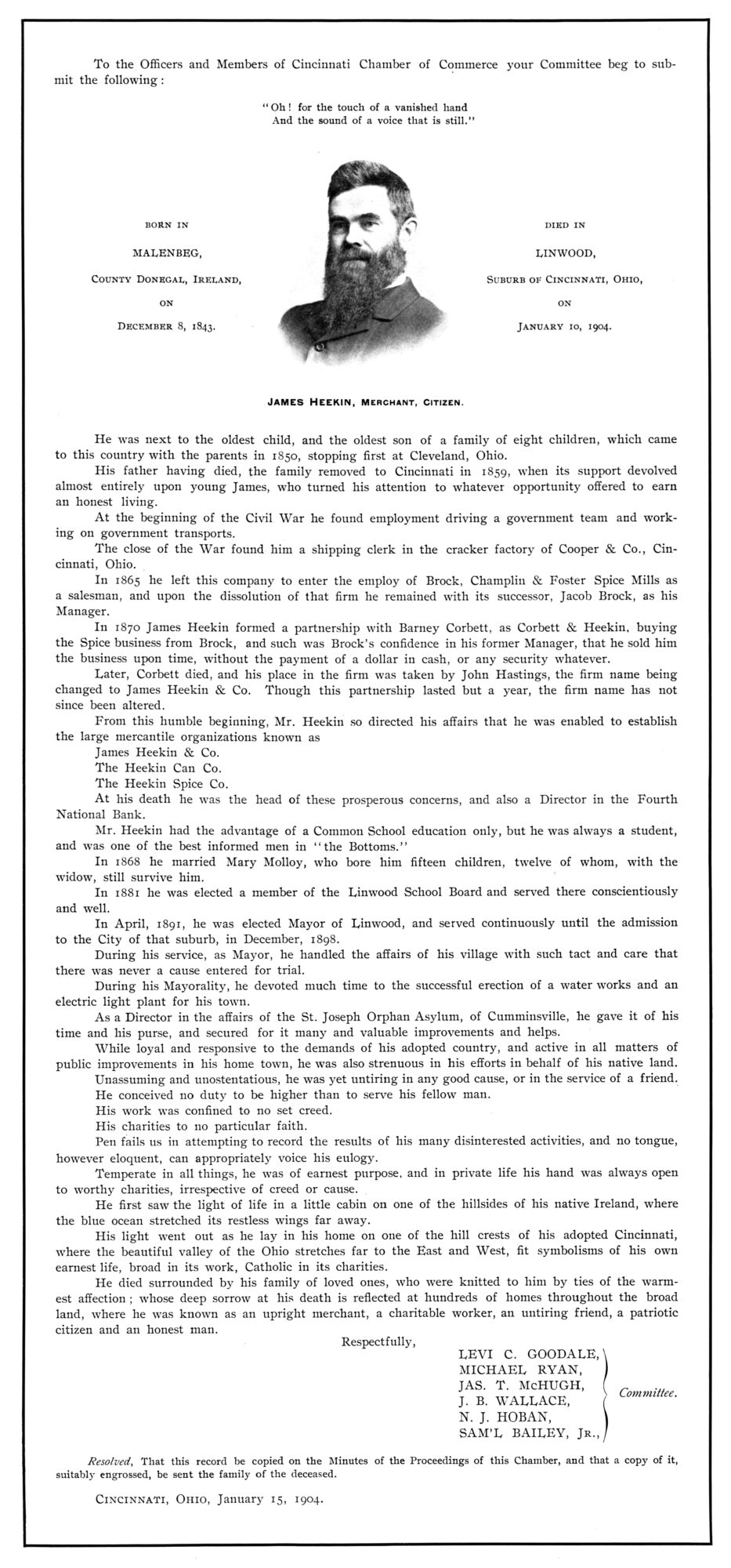
James Heekin Memorial
This is a transcription of the document above:
JAMES HEEKIN, MERCHANT, CITIZEN.
He was next to the oldest child, and the oldest son of a family of eight children, which came to this country with the parents in 1850, stopping first at Cleveland, Ohio. His father having died, the family removed to Cincinnati in 1859, when its support devolved almost entirely upon young James, who turned his attention to whatever opportunity offered to earn an honest living. At the beginning of the Civil War he found employment driving a government team and working on government transports. The close of the War found him a shipping clerk in the cracker factory of Cooper & Co., Cincinnati, Ohio.In 1865 he left this company to enter the employ of Brock, Champlin & Foster Spice Mills as a salesman, and upon the dissolution of that firm he remained with its successor, Jacob Brock, as his Manager. In 1870 James Heekin formed a partnership with Barney Corbett, as Corbett & Heekin, buying the Spice business from Brock, and such was Brock’s confidence in his former Manager, that he sold him the business upon time, without the payment of a dollar in cash, or any security whatever. Later, Corbett died, and his place in the firm was taken by John Hastings, the firm name being changed to James Heekin & Co. Though this partnership lasted but a year, the firm name has not since been altered.
From this humble beginning, Mr. Heekin so directed his affairs that he was enabled to establish the large mercantile organizations known as James Heekin & Co., The Heekin Can Co., The Heekin Spice Co. At his death he was the head of these prosperous concerns, and also a Director in the Fourth National Bank. Mr. Heekin had the advantage of a Common School education only, but he was always a student, and was one of the best informed men in “the Bottoms.” In 1868 he married Mary Molloy, who bore him fifteen children, twelve of whom, with the widow, still survive him.
In 1881 he was elected a member of the Linwood School Board and served there conscientiously and well. In April, 1891, he was elected Mayor of Linwood, and served continuously until the admission to the City of that suburb, in December, 1898. During his service, as Mayor, he handled the affairs of his village with such tact and care that there was never a cause entered for trial. During his Mayorality, he devoted much time to the successful erection of a water works and an electric light plant for his town.
As a Director in the affairs of the St. Joseph Orphan Asylum, of Cumminsville, he gave it of his time and his purse, and secured for it many and valuable improvements and helps. While loyal and responsive to the demands of his adopted country, and active in all matters of public improvements in his home town, he was also strenuous in his efforts in behalf of his native land. Unassuming and unostentatious, he was yet untiring in any good cause, or in the service of a friend. He conceived no duty to be higher than to serve his fellow man. His work was confined to no set creed. His charities to no particular faith. Pen fails us in attempting to record the results of his many disinterested activities, and no tongue, however eloquent, can appropriately voice his eulogy.
Temperate in all things, he was of earnest purpose, and in private life his hand was always open to worthy charities, irrespective of creed or cause. He first saw the light of life in a little cabin on one of the hillsides of his native Ireland, where the blue ocean stretched its restless wings far away. His light went out as he lay in his home on one of the hill crests of his adopted Cincinnati, where the beautiful valley of the Ohio stretches far to the East and West, fit symbolisms of his own earnest life, broad in its work, Catholic in its charities. He died surrounded by his family of loved ones, who were knitted to him by ties of the warmest affection; whose deep sorrow at his death is reflected at hundreds of homes throughout the broad land, where he was known as an upright merchant, a charitable worker, an untiring friend, a patriotic citizen and an honest man.
Respectfully,
LEVI C. GOODALE,
MICHAEL RYAN,
JAS. T. McHUGH,
J. B. WALLACE,
N. J. HOBAN,
SAM’L BAILEY, JR.,
Committee.
Resolved, That this record be copied on the Minutes of the Proceedings of this Chamber, and that a copy of it, suitably engrossed, be sent the family of the deceased.
CINCINNATI, OHIO, January 15, 1904.
Mary Malloy
James’s wife, Mary Malloy, was born in County Cavan, Ireland. Her father, remembered in the family as “Gentleman Dan,” died of tuberculosis while still a young man. Mary’s mother remarried, and Mary emigrated to America with her mother, stepfather, and sister, settling in Cincinnati.
During the Civil War, Mary and her mother reportedly gave food and shelter to soldiers from both the North and the South, at times hiding them on the slanted roof of their home. Mary’s mother later died of appendicitis. The account also mentions an aunt, Mrs. Dundon, who lived in Columbus.
The family history describes Cincinnati’s Irish and German communities as socially competitive during this period, although it notes that Irish mothers sometimes favored German husbands for their daughters because many of the German immigrants had established trades.
James and Mary
James and Mary met through St. Patrick’s, described in the account as an Irish parish and a center of Irish social life. When they began discussing marriage, Mary reportedly told James that she would not set a wedding date until he had saved $500. He succeeded in doing so, but when his mother became distressed over his impending marriage, James gave the $500 to her rather than spending it on furniture for his new household.
The document preserves a charming glimpse of their courtship. One favorite winter outing was attending the theater in Mount Auburn. Heated bricks were placed in the carriage to keep the passengers warm, and after the cold ride home they would have oyster stew.
James was then earning $135 a month, and the couple decided to marry despite having given away their savings. James Heekin and Mary Malloy were married on July 9, 1868. Wanting a small wedding, they traveled to All Saints Church on Eagleton Avenue for a 9:00 ceremony, leaving home at six in the morning to arrive on time. They then returned to the St. Nicholas Hotel at Eighth and Linn Streets for their wedding breakfast. The following day they moved into a house on Reading Road.
Linwood and the Heekin Tea and Spice Company
After James and Mary had four children, they moved to an area that the family account describes as what is now Ault Park. At the time it was a small religious community consisting of four families, including the Williams and Andrews families. The village of Linwood was about a mile away. James later became mayor of Linwood, and the account states that Heekin Avenue received its name before the village was incorporated into Cincinnati.
James eventually became associated with Charles Lewis, a coffee broker whose own business had failed. According to the family history, James went to New York City during a depression to obtain coffee on credit, and Lewis later joined him in the Heekin Tea and Spice Company.
The company was later involved in litigation connected in some way with the Kentucky Bridge. A lawyer named Mr. Shinkle sued the coffee company but, according to the account, lost his case against the Heekin Company.
Muncie, Indiana
James also invested in real estate in Muncie, Indiana, apparently during the natural-gas boom there. He entered the venture with a Mr. Goodale and another man, later bought out his partners, and sold the property for subdivision. The family account states that Heekin Park in Muncie was land James donated to the city.
Later Years
James Heekin died in 1904 after an illness of eight weeks, due to kidney trouble or cancer. He was fifty-nine and his son James Jr., known as “Uncle Jim,” was thirty-two at the time.
In 1913, Mary Malloy Heekin moved to Madison Road. Their son Albert sold the Linwood property to a lithographer named Mr. Ault. According to the family history, after World War I Mr. Ault and his wife donated the land to the city for a park.
Mary Malloy Heekin died in 1934. She and James were the parents of fifteen children.
Learn More
Download the Heekin Family History 16-page pdf. Author unknown.
Gallery